

Advantages of Multicultural Toys for Kids and Classrooms
TL;DR:
- Multicultural toys promote empathy, reduce bias, and develop language and social skills through guided, repeated play.
- Structured adult facilitation and diverse toy variety enhance developmental benefits, supporting inclusive education.
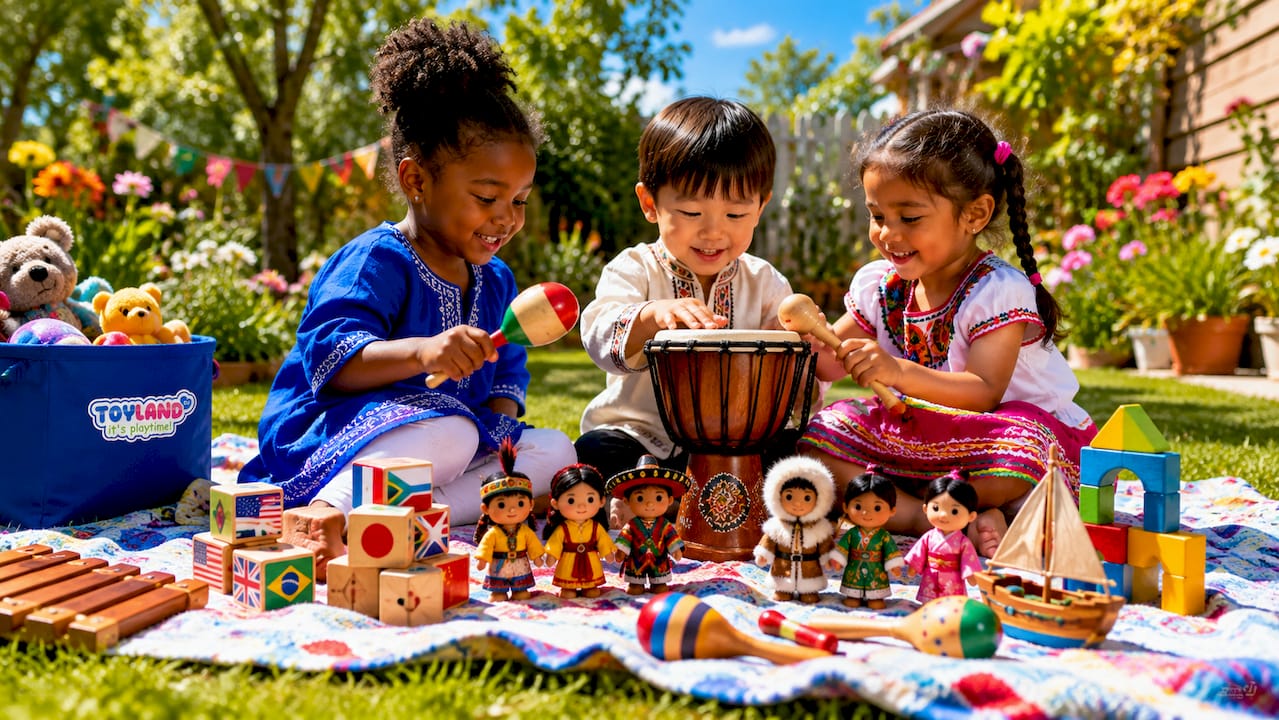
Multicultural toys are defined as play materials that represent diverse cultures, ethnicities, languages, and abilities, giving children direct exposure to the world’s human variety. The advantages of multicultural toys go well beyond decoration or novelty. Research confirms they build empathy, reduce bias, expand vocabulary, and sharpen social skills in children as young as five. Persona Dolls, cultural instruments, and multilingual games are among the tools educators now embed in structured play to produce measurable developmental gains. For parents and teachers who want inclusion to mean something real, these toys are one of the most evidence-backed investments available.
1. Multicultural toys build empathy through perspective-taking
Children who play with culturally representative toys show significantly higher empathy toward peers from different backgrounds. A study of 39 children aged 5 to 6 found that after guided play with migrant Persona Dolls, empathy scores rose at a statistically significant level (p < 0.05), and children expressed greater willingness to play with migrant classmates. That is a concrete behavioral shift, not just a reported attitude change.
The key word is guided. Toys placed passively in a corner produce far weaker results. When an adult facilitates the session and prompts children to consider how the doll feels or what the doll’s home country is like, the empathy gains are strongest. This makes the adult’s role as important as the toy itself.
- Introduce the doll with a short story about its background
- Ask open questions: “What do you think she misses about home?”
- Revisit the same doll across multiple sessions to reinforce gains
Pro Tip: Rotate Persona Dolls into your regular circle time rather than treating them as a one-off activity. Repeated exposure is what locks in the empathy benefit.
2. They reduce unfriendly feelings and social bias
Beyond empathy, the same Persona Dolls research recorded a reduction in unfriendly feelings toward migrant peers after the play intervention. Children who started with neutral or negative attitudes showed measurable improvement. This matters because bias forms early, often before age six, and play is one of the few intervention tools that reaches children at that developmental window.
Toys that represent diverse ethnicities and abilities normalize difference without lecturing. A child who regularly plays with dolls of multiple skin tones simply grows up treating variety as the default. That normalization is harder to achieve through classroom instruction alone.
3. Advantages of multicultural toys for language development
Cultural awareness toys introduce children to new words, phrases, and dialects through play rather than formal instruction. Role-playing with a Japanese tea set, a West African drum, or a bilingual board game adds vocabulary in a low-pressure context. Role-playing and storytelling enhance both creativity and social interaction while simultaneously expanding a child’s linguistic range.
Multilingual toys carry this further. A toy that labels objects in English and Spanish, or that plays greetings in Mandarin, gives children phonetic exposure that builds genuine language readiness. Toylandeu’s guide on multi-language toys documents how this kind of play supports both language skills and cultural appreciation at the same time.
4. Social skill development through collaborative play
Multicultural play benefits extend directly into how children interact with each other. When children play together with toys that represent their different backgrounds, the play itself becomes a conversation about identity. That conversation builds the collaboration and negotiation skills that classrooms and workplaces demand.
Here is how the social skill gains stack up:
- Turn-taking improves when children share culturally themed games with rules drawn from different traditions
- Conflict resolution develops as children navigate different play styles and expectations
- Active listening grows when a child hears a peer explain what a cultural object means to their family
- Inclusion habits form when every child sees their background represented in the toy box
Head Start’s 2025 curriculum guidance requires culturally reflective materials in early childhood environments precisely because these social outcomes are well-documented and curriculum-worthy.
5. Cognitive development and creative thinking
Diverse toys push children to imagine lives and contexts outside their own experience. That cognitive stretch, moving from the familiar to the unfamiliar through play, is the same mental process that underlies creative problem-solving. A child building a model of a Moroccan riad or playing with a Chinese abacus is exercising spatial reasoning and symbolic thinking simultaneously.
Toys with diverse cultural representation also challenge stereotypes by presenting cultures in full, three-dimensional ways rather than as caricatures. A child who knows that a sari is everyday clothing, not a costume, carries a more accurate mental model of the world. Accurate mental models are the foundation of good reasoning.
6. Why multicultural toys belong in schools
The importance of multicultural play in formal education comes down to one practical reality: schools are where children first encounter peers who are different from them. Without tools that make that difference feel normal and interesting rather than threatening, early social friction can harden into lasting bias.
Head Start’s curriculum standards explicitly embed culturally responsive materials into quality benchmarks, treating them as non-negotiable rather than optional enrichment. Teachers who use these toys as part of structured lessons, not just free play, report stronger engagement from children whose backgrounds are reflected in the materials. Representation in the classroom signals belonging, and belonging drives learning.
7. Comparing types of multicultural toys by educational use
Not all cultural awareness toys serve the same purpose. Choosing the right type depends on the child’s age and the specific skill you want to build.
| Toy type | Age range | Primary benefit | Best used for |
|---|---|---|---|
| Persona Dolls | 3 to 8 years | Empathy and bias reduction | Guided circle time discussions |
| Cultural musical instruments | 2 to 10 years | Sensory and creative development | Free play and music sessions |
| Multilingual board games | 5 to 12 years | Language and social skills | Group play and classroom centers |
| Global storybooks and puppets | 3 to 9 years | Narrative thinking and vocabulary | Read-alouds and dramatic play |
| Diverse figurines and playsets | 2 to 8 years | Representation and imaginative play | Independent and parallel play |
Dolls serve as cultural ambassadors that engage children in meaningful conversations about identity. Musical instruments from different traditions add a sensory dimension that books alone cannot provide. The combination of multiple toy types across a school year produces the broadest developmental coverage.
8. Best practices for using multicultural toys effectively
The research is clear that sustained participation drives outcomes. A 10-month inclusion playgroup study found that an intervention dosage of 38% was associated with meaningful child development gains. One-off exposure does not produce lasting change.
Practical steps for parents and educators:
- Rotate toys into regular routines rather than reserving them for special occasions
- Use toys to prompt guided conversations, not just silent play
- Select toys that reflect the actual children in your classroom or home, not just a generic global sample
- Track engagement using both observation notes and child feedback, as Head Start advises for monitoring inclusive curriculum materials
- Combine toys with related crafts or cooking activities to deepen cultural context
Pro Tip: Pair a cultural toy with a short video or picture book from the same tradition. Children who receive context alongside the toy show deeper engagement and ask more questions.
Key takeaways
Multicultural toys build empathy, reduce bias, and develop language and social skills most effectively when used repeatedly in guided, adult-facilitated play.
| Point | Details |
|---|---|
| Empathy gains are research-backed | Persona Dolls studies show significant empathy increases in children aged 5 to 6 after guided play. |
| Repetition is required | One-off exposure is insufficient; sustained play over months produces lasting developmental benefits. |
| Adult facilitation multiplies impact | Structured sessions with open questions drive stronger outcomes than passive toy availability. |
| Schools have a curriculum mandate | Head Start’s 2025 standards require culturally reflective materials as part of quality early education. |
| Toy variety covers more skills | Combining dolls, instruments, games, and books addresses empathy, language, creativity, and social skills together. |
Why I think most parents underestimate these toys
I have spent years watching how children respond to play materials, and the pattern that surprises people most is this: children do not need to be taught to be curious about other cultures. They are already curious. What they need is permission and a prop.
A Persona Doll or a set of diverse figurines gives a child something concrete to ask questions about. The toy does not lecture. It invites. And that invitation, repeated across weeks and months, is what actually shifts how a child sees the world. The mistake I see most often is treating multicultural toys as a one-time gesture, buying one diverse doll and calling it done. The research on empathy-building through play is unambiguous: dosage matters. Ten minutes once is not the same as ten minutes every week for a year.
The other thing I would push back on is the idea that these toys are primarily for children from majority backgrounds. Children who see their own culture represented in the toy box experience something equally powerful: the recognition that their identity belongs in the room. That sense of belonging is not a soft outcome. It is a prerequisite for learning.
— Thane
Explore multicultural toys at Toylandeu
Toylandeu carries a broad selection of toys designed to support cultural awareness, creativity, and inclusive play for children of all ages. Whether you are building a classroom collection or choosing a gift that does more than entertain, the catalog includes options that align with the evidence-based practices covered in this article.
For parents and educators who want to combine cultural exploration with hands-on creativity, the Montessori Drawing Kit gives children a structured creative outlet that pairs naturally with cultural storytelling activities. The Creative Learning Set works across ages 3 to 12 and supports the kind of open-ended, imaginative play that multicultural toys thrive in. Toylandeu ships worldwide, so building an inclusive toy collection is straightforward regardless of where you are.
FAQ
What is a multicultural toy?
A multicultural toy is any play material that represents diverse cultures, ethnicities, languages, or abilities. Examples include Persona Dolls, cultural musical instruments, multilingual games, and globally themed playsets.
How do multicultural toys help with empathy?
Research shows that guided play with culturally diverse toys, particularly Persona Dolls, produces statistically significant empathy gains in children aged 5 to 6. The gains are strongest when an adult facilitates the session with open-ended questions.
Why are multicultural toys important in schools?
Head Start’s curriculum standards require culturally reflective materials in early childhood classrooms because they support language development, social skills, and a sense of belonging for all children.
How often should children play with multicultural toys?
Sustained, repeated exposure over months produces the strongest outcomes. A single session is not enough. Embedding these toys into weekly routines, rather than using them as occasional activities, is what the research supports.
Are multicultural toys only for diverse classrooms?
No. Children from any background benefit from exposure to cultures beyond their own. Representation also matters for children who rarely see their own identity in toys, as recognition of their background supports engagement and learning.