

Why Toys Encourage Curiosity in Kids: A Parent's Guide
TL;DR:
- Toys cultivate curiosity by creating open questions that motivate exploration and discovery in children. Open-ended and ambiguous toys sustain longer engagement and promote complex thinking and STEM skills through active, social, and iterative play. Adults can enhance curiosity by encouraging independent exploration, preserving ambiguity, and guiding play without immediate instruction.
Toys encourage curiosity by creating what developmental psychologists call “curiosity gaps.” These are open questions that pull children into exploration and discovery before they even realize they’re learning. Research from New Scientist confirms that play shapes future thinkers by engaging children as active participants who test ideas, revise assumptions, and build mental models through hands-on interaction. LEGO Education, STEM robotics kits, and even simple cardboard boxes all trigger this process. This guide explains the mechanisms behind toy-driven curiosity and gives parents and educators practical tools to use them well.
Why toys encourage curiosity: the core mechanism
Curiosity-driven play is not passive entertainment. Play supports learning best when children are active participants, engaged meaningfully, socially interactive, and iteratively testing ideas. That means a child pressing a button on a toy robot and watching it spin is not just playing. They are forming a hypothesis, observing an outcome, and deciding what to try next.
This iterative process is the engine behind the importance of play in child development. When a toy prompts a child to ask “What happens if I do this instead?”, it activates the same cognitive loop that scientists use. The difference is that children do it instinctively, and toys are the trigger.
Social interaction amplifies this effect significantly. When a child plays with a toy near a parent or peer, curiosity becomes contagious. Educator Stewart at Children’s Hospital Richmond notes that children’s curiosity with toys leads directly to questions, which opens shared learning conversations between adults and children. That back-and-forth deepens understanding far beyond what solo play achieves.
- Toys with lights, sounds, or movement create immediate sensory feedback loops that invite repeated experimentation.
- Open-ended toys like building blocks or loose parts give children control over outcomes, which sustains interest longer.
- Toys that respond differently each time they are used keep children guessing, which is exactly what curiosity requires.
- Social play around toys multiplies the number of questions children ask and the range of ideas they explore.
Pro Tip: When a child picks up a new toy, resist the urge to demonstrate how it works. Let them explore it independently for at least five minutes first. That initial period of unguided discovery is where curiosity fires most intensely.
How ambiguity in toys drives deeper exploration
The single strongest predictor of whether a toy will sustain a child’s curiosity is not how colorful it is or how many features it has. It is how ambiguous its cause-and-effect relationship is. Research published via phys.org shows that children prefer toys with ambiguous causal outcomes over toys with predictable, instructional results. This finding reframes how parents and educators should think about toy selection entirely.
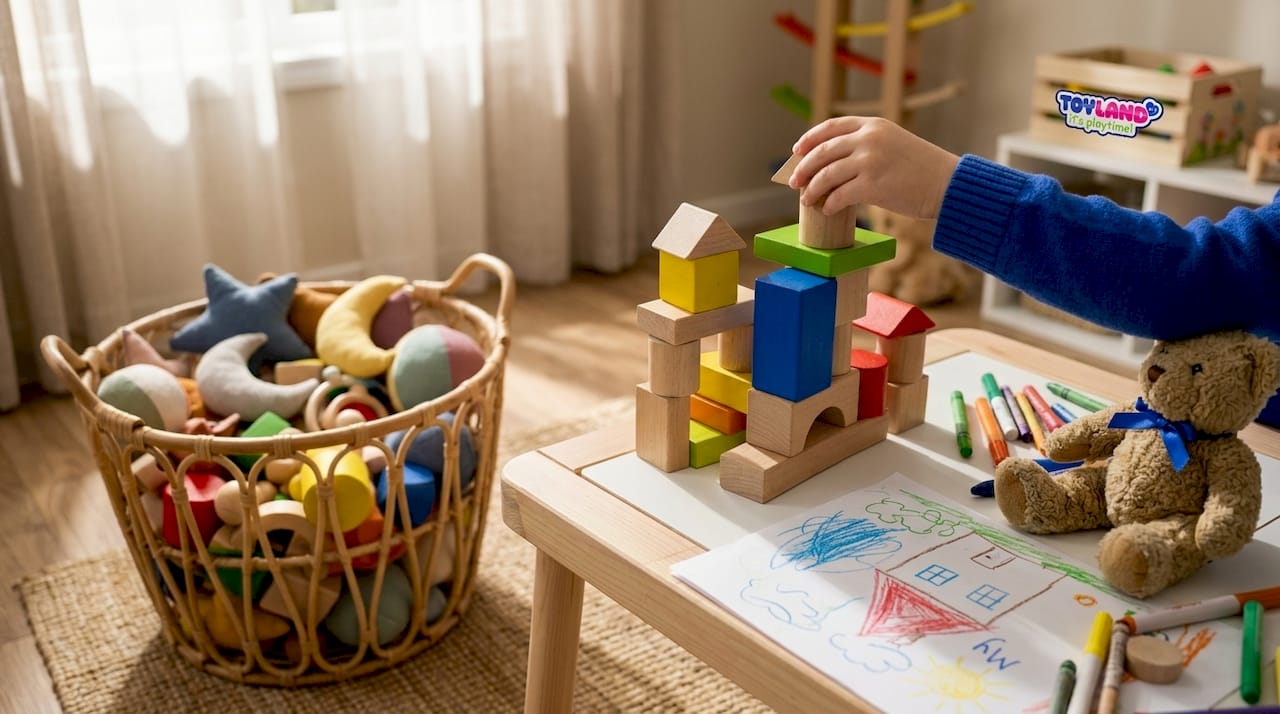
A toy that shows a child exactly what it does the moment they pick it up closes the curiosity gap immediately. A toy that leaves the outcome uncertain keeps the gap open, which motivates targeted exploration and creative problem-solving. Loose parts, cardboard tubes, and open-ended construction sets consistently outperform single-purpose toys in sustaining play length and generating STEM-related behaviors.
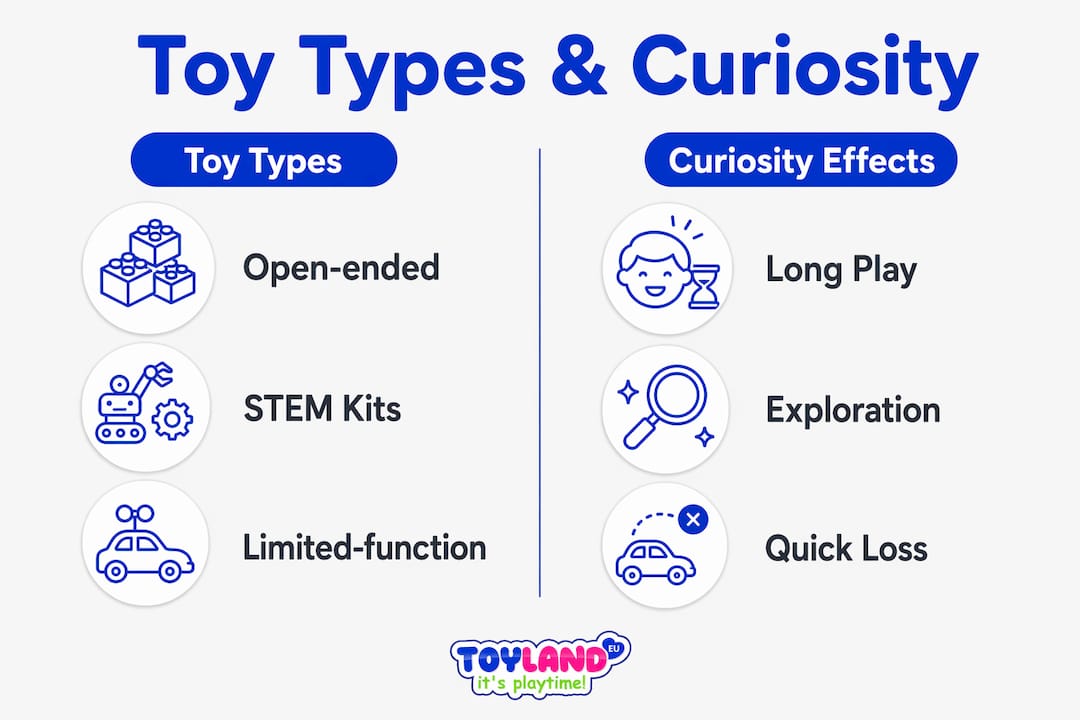
The contrast between toy types is stark when you look at outcomes side by side:
| Toy type | Effect on curiosity |
|---|---|
| Open-ended (blocks, loose parts, cardboard) | Longer play sessions, more complex ideas, child-directed outcomes |
| Instructional (single-function, pre-scripted) | Shorter engagement, limited problem-solving, adult-directed outcomes |
| Interactive with ambiguity (STEM robots, gesture-controlled cars) | Sustained inquiry, iterative testing, high motivation to figure out rules |
| Overly demonstrative (toys that show their purpose immediately) | Curiosity capped early, reduced experimentation, passive reception |
The data is clear: open-ended materials stimulate longer play and more STEM-related behaviors than limited-purpose toys. This is not a minor difference. It is the difference between a child who learns to think and one who learns to follow instructions.
Pro Tip: When buying toys, look for products described as “versatile” or “multi-use” rather than those marketed around a single activity. The less the packaging tells the child what to do, the better.
Do STEM and interactive toys actually build curiosity?
Technology-enhanced toys earn their reputation when used correctly. A 2026 MDPI observational study of children aged 3 to 4 found that interactive robotics play promoted STEM skills through iterative exploration, including early computational thinking. That is a significant finding for parents and educators evaluating educational toys for curiosity.
The key features that make interactive toys effective are responsiveness and programmability. A toy that reacts differently based on a child’s input teaches cause-and-effect reasoning in real time. A programmable robot like those in STEM kits teaches children that systems follow rules, and that those rules can be discovered and changed. This is the foundation of scientific thinking.
Adult scaffolding is the variable that determines whether a STEM toy builds curiosity or frustration. The adult role during interactive STEM toy play is to allow iterative debugging and discovery rather than providing immediate instruction. Stepping in too quickly with the answer shuts down the inquiry process. Staying present but silent while a child works through a problem is one of the most powerful things a caregiver can do.
- Choose toys with programmable or adjustable settings so children can change variables and observe new outcomes.
- Pair STEM toys with open-ended questions: “Why do you think it stopped there?” works better than “Let me show you.”
- Use toy repair as a learning tool. A 2026 Early Childhood Education Journal study showed that repair routines increase children’s reasoning about toy function significantly.
- Balance screen-free construction toys with technology-enhanced options to develop both physical and digital problem-solving skills.
For a deeper look at how interactive toys support development, Toylandeu has published a detailed breakdown of the research behind this category.
Practical strategies for choosing toys that spark curiosity
Selecting the right toy is a skill, and it starts with one principle: prioritize toys that invite questions over toys that provide answers. The benefits of toys for learning are highest when the toy creates space for a child to be wrong, try again, and figure something out independently.
Here is a practical framework for parents and educators:
- Choose versatile over single-purpose. A set of magnetic tiles serves more curiosity-building functions than a toy with one button and one outcome. Versatility keeps children returning to the same toy with new ideas.
- Preserve ambiguity deliberately. Intentionally preserving ambiguity in toy play sustains curiosity by motivating children to predict, test, and revise their understanding rather than receiving immediate answers. Do not demonstrate the toy first.
- Use guided play techniques. Guided play supports freedom within learning goals. Ask open-ended questions, observe without interrupting, and introduce new materials when interest starts to fade rather than when it disappears.
- Incorporate toy repair routines. Guided toy repair transforms breakdowns into problem-solving inquiries, effectively engineering curiosity and boosting tool-function knowledge. A broken toy is not a loss. It is a lesson.
- Mix toy categories intentionally. Combine construction sets, STEM kits, and imaginative play materials. Each category builds different aspects of curiosity and how play encourages discovery across multiple domains.
Trusted categories for curiosity-driven play include LEGO Education sets, STEM robotics kits, open-ended building materials, and gesture-controlled interactive toys. For a curated overview of STEM toys for kids, Toylandeu’s resource covers age-appropriate options across multiple learning goals.
Pro Tip: Rotate toys every two to three weeks instead of keeping everything accessible at once. Reintroducing a toy after a break reactivates curiosity because the child approaches it with fresh eyes and new cognitive tools.
Key takeaways
Toys encourage curiosity most effectively when they are open-ended, ambiguous in their outcomes, and used within a play environment where adults ask questions rather than provide answers.
| Point | Details |
|---|---|
| Ambiguity drives exploration | Toys with unpredictable outcomes sustain curiosity longer than single-function instructional toys. |
| Active play beats passive reception | Children learn through iterative hypothesis testing, not by watching demonstrations. |
| Adult scaffolding matters | Staying present but silent during STEM toy play produces better learning outcomes than immediate instruction. |
| Toy repair builds reasoning | Structured repair routines increase children’s understanding of tool function and problem-solving. |
| Open-ended toys outperform | Versatile materials generate longer play sessions and more complex thinking than limited-purpose toys. |
Why I think we underestimate what toys actually do
Most conversations about toys focus on safety ratings and age labels. That misses the deeper point entirely. Curiosity is the skill that underlies creativity, resilience, and problem-solving. It is not a personality trait some children are born with. It is a behavior that gets triggered or suppressed by the environment around them, and toys are one of the most direct levers we have.
What I find most compelling in the 2026 research is the finding that curiosity drives children to invent problems themselves during play. That is not a small thing. A child who invents their own problems is a child who will grow into an adult who does not wait to be told what to think about. That capacity starts with a block set or a robot kit on a Tuesday afternoon.
The tension I see most often is between parents who want to help and children who need to struggle. The instinct to demonstrate, explain, and fix is natural. But every time an adult closes a curiosity gap before a child has a chance to sit with it, they take away a small piece of that child’s developing confidence in their own thinking. The research backs this up consistently. The best thing a toy can do is confuse a child just enough to make them want to figure it out.
Traditional toys and digital media are not opposites. They are tools with different strengths. A cardboard box and a programmable robot both work, as long as the child is the one driving the inquiry.
— Thane
Explore Toylandeu’s curiosity-building toy collection
Toylandeu carries over 30,000 toys designed for exactly the kind of play this article describes. Two products stand out for parents and educators looking to put these principles into practice immediately. The RC gesture-controlled stunt car responds to hand movements rather than buttons, which means children must figure out the control system through experimentation. There is no instruction that replaces that discovery. The STEM robotics car kit uses Microbit programming with Python and MakeCode, giving children aged 8 and up a real computational thinking challenge. Both ship worldwide with free delivery. Browse the full collection at Toylandeu to find the right fit for your child’s age and learning goals.
FAQ
Why do toys encourage curiosity in young children?
Toys create “curiosity gaps” by presenting outcomes children cannot immediately predict, which motivates them to explore, test, and revise their understanding. This iterative process is the same cognitive loop that underlies scientific thinking.
What types of toys are best for building curiosity?
Open-ended toys like building blocks, loose parts, and STEM robotics kits consistently outperform single-function instructional toys because they leave outcomes ambiguous and child-directed. Versatile materials generate longer play sessions and more complex thinking.
How can parents use toys to support curiosity at home?
Preserve ambiguity by not demonstrating how a toy works before a child explores it independently. Ask open-ended questions during play, rotate toys every few weeks, and use broken toys as repair and problem-solving opportunities rather than replacing them immediately.
Do STEM toys actually improve learning outcomes?
Yes. A 2026 MDPI study found that interactive robotics play with children aged 3 to 4 promoted computational thinking and STEM skills through iterative exploration. Adult scaffolding, meaning staying present without immediately providing answers, is the key factor in making STEM toys effective.
How does play support curiosity differently from classroom instruction?
Play supports learning through active participation, social interaction, and iterative idea-testing, which aligns with how children’s brains develop most effectively. Classroom instruction tends to close curiosity gaps quickly, while play keeps them open long enough for children to build genuine understanding.