

3 Second Test: Toy Storage Ideas Parents Can Use
The best toy storage system combines three things: open bins kids can reach without help, containers sized to match what’s inside them, and a rotation schedule that keeps only a portion of the collection in play at once. Skip the lidded chests and matching baskets that look great in photos but require adult hands to operate. Go for low shelves, shallow trays, mat-bags, and a swap routine that runs on a three to six week cycle.
TL;DR:
- Open, shallow bins and low shelves are the most effective for quick, daily access and avoid lids that add unnecessary steps.
- Use a rotation schedule of three to six weeks with labeled bins to keep toys fresh and prevent collection bloat.
- Depth of containers should be around four inches to keep small pieces visible and prevent toys from getting lost at the bottom.
- Safety measures include anchoring furniture to prevent tip-overs and setting reach zones at child’s natural height for easy access.
- Consistent daily habits, including labeling and a quick 10-minute reset, are key to maintaining an effective and manageable toy storage system.
Table of Contents
- Practical Toy Storage Ideas By Type
- How Do You Set Up A Toy Rotation System?
- Choosing The Right Containers And Materials
- Safety Rules For Reach-Line And Anchoring
- Daily Habits That Keep Storage Working
- What Actually Works In Busy Families
- Compact Toys That Fit The System You Just Built
- Sources
- FAQ
- Recommended Reads
Practical Toy Storage Ideas By Type
Different toys need different containers, and matching the two correctly is most of the battle. Building sets need to breathe and stay visible; loose crayons need a lid; stuffed animals need almost nothing but a net.
Start with the 3-second test: if a child can’t grab a toy and put it back in three seconds or less, the system will fail no matter how nice it looks. Open, shallow bins and low shelving beat lidded containers for exactly this reason. Lids add a step, and that one extra step is often the difference between a tidy room and a floor covered in blocks.
- Open, shallow bins: best for daily-use toys like cars, animals, and small figures. Skip lids entirely for anything used more than once a week.
- Cube organizers and low shelves: modular cube shelving systems are a reliable backbone because bins swap in and out as toys change; they scale as your kid grows. Pair with a low, forward-facing book rack, since young readers respond to covers, not spines, and displaying a handful of titles this way beats a packed shelf of spines every time.
- Drawstring mat-bags: unroll flat as a play surface, then cinch shut for storage. These work especially well for building bricks and other small-parts sets that would otherwise scatter across a rug.
- Stuffed-animal hammocks: a net strung corner to corner in a bedroom clears floor space instantly and needs zero sorting skill from a toddler.
- Rolling art carts: keep markers, paper, and glue mobile so craft time doesn’t require claiming the kitchen table.
- Under-bed totes: ideal for rotation stock and seasonal gear, out of daily reach but easy to pull out for a swap.
- Over-the-door and wall pockets: perfect for bath toys, dress-up accessories, and other small items that don’t need a full bin.
Want a display option that also doubles as storage? Creative toy display setups can turn a favorite collection into part of the room’s décor instead of clutter waiting to happen.
How Do You Set Up A Toy Rotation System?
Fewer toys in the daily zone means less to clean, less to trip over, and, oddly, more focused play. A rotation schedule of roughly three to six weeks keeps the collection feeling fresh without buying anything new.
- Declutter first. Sort everything into keep, donate, or trash. Kids age four and up can help with this; younger kids usually do better if you sort while they’re not watching, then let them “discover” the keepers.
- Split what’s left into rotation bins. Label them A, B, and C. Bin A lives in the daily zone; B and C go into a closet, under a bed, or a garage shelf.
- Set a swap date. Every three to six weeks, box up Bin A and bring out Bin B. Put it on the same calendar you use for library due dates or trash night, so it actually happens.
- Cap categories going forward. One bin per category, full stop. When a new stuffed animal arrives, an old one leaves. This is the rule that keeps the whole system from ballooning again by spring.
Pro Tip: Rotation only works long term when the bin itself sets the limit, not you. Once a category’s bin is full, that’s the signal to donate before adding anything new.
Small homes without closet space can still run this system using labeled totes stacked in a hallway or bedroom corner. If storage is genuinely tight, a rotation guide with more detailed logistics walks through space-saving swap routines for one-bedroom setups.
Choosing The Right Containers And Materials
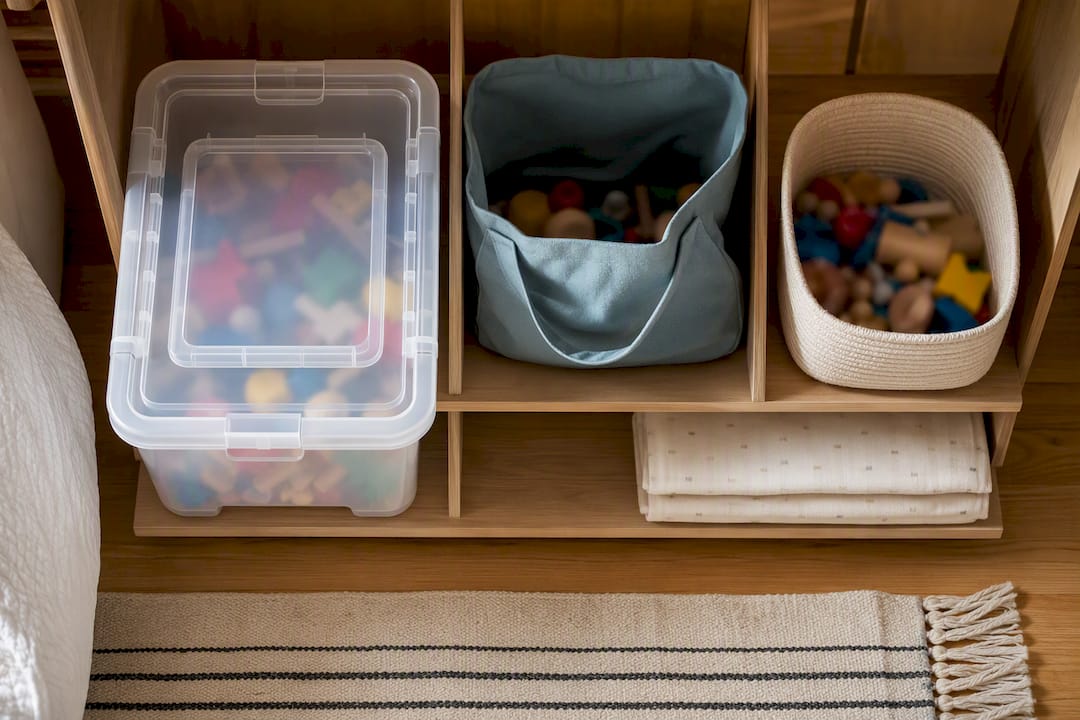
Depth matters more than most parents expect. Shallow containers around four inches deep keep small pieces visible, while anything deeper swallows Lego bricks and puzzle pieces at the bottom where nobody finds them until vacuum time. As a rule, items under about three inches thick belong in trays no deeper than four inches; save the deep bins for bulky, soft items like plush toys or dress-up clothes.
Material matters too:
- Plastic bins wipe clean fast and stack well, though they crack if a toddler treats them as a step stool.
- Canvas bins collapse flat for storage but soak up spilled juice and need occasional washing.
- Woven baskets look great on a shelf but snag fabric and are harder to clean than plastic.
- Soft quilted bins or rope baskets suit baby and toddler zones best, since they lower injury risk if a bin ever gets tipped over.
Check handle strength before buying anything a child will carry. A bin with flimsy cutout handles will crack within a month in a house with more than one kid. Color-code by category or by child in shared rooms, and skip furniture upgrades until the container system itself is dialed in. A cheap set of bins that fits the shelf beats an expensive piece that doesn’t match what’s actually being stored.
Safety Rules For Reach-Line And Anchoring
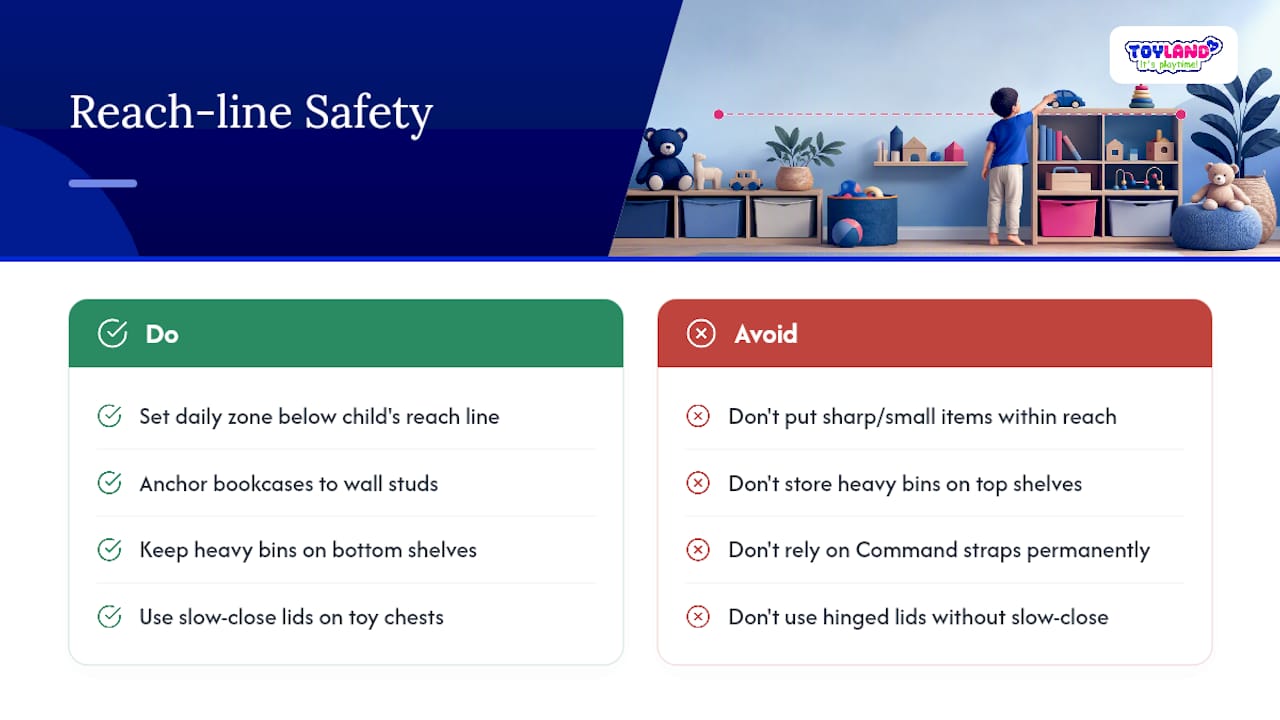
Set the daily zone below a child’s natural reach line: roughly waist to shoulder height for toddlers, a bit higher for school-age kids. Anything above that line is parent territory for sharp, small, or overflow items.
Furniture tip-overs are a real and preventable safety risk, and anchoring every bookcase and shelving unit to a wall stud takes fifteen minutes with a basic kit. Keep heavy bins on the bottom shelves, never the top. If you’re renting and can’t drill into studs, heavy-duty Command-style strap kits are a reasonable stopgap, though they’re not a substitute for a stud anchor in a permanent home. Skip hinged lids on toy chests unless they have a slow-close mechanism. Shared rooms work best with two daily zones at different heights, one per child, so toddlers aren’t reaching for an older sibling’s small-parts bin.
Daily Habits That Keep Storage Working
Labels do the heavy lifting once the bins are in place. Picture labels help kids who can’t read yet find the right bin on their own, while word labels work for older readers. Color-coding by child solves most disputes in shared rooms before they start.
- Run a scripted 10-minute reset before bed: five minutes for the daily zone, five for whatever spilled into the living room.
- Give each age its own job. Two-year-olds can drop stuffed animals in a hammock; six-year-olds can sort bins by category.
- Re-run the 3-second test every few months. If a bin keeps getting skipped, the category is probably too broad or the bin is in the wrong spot.
Pro Tip: When a system stops working, the fix is almost always to simplify, not add more bins. Merge two half-empty categories into one before buying anything new.
What Actually Works In Busy Families
Pretty and practical rarely line up, and chasing both usually means neither survives past October. A shelf of mismatched bins that a five-year-old empties and refills without being asked beats a color-coordinated display that only the adult in the house can operate.
One version of this that holds up: a basic cube shelf, six bins, one weekly swap between an under-bed tote and the shelf. That’s the entire system, and it survives sick days, sports seasons, and grandparents visiting with gifts. Kids don’t learn a new habit overnight, but most pick up a rotation routine within a few weeks of consistent repetition, not months.
— Thane Holland
Compact Toys That Fit The System You Just Built
Storage systems only stay tidy if what’s going into them is sized to match. Various online toy retailers stock compact, giftable options suited for this purpose: mat-friendly building sets, small art kits, and low-footprint educational toys that slide into a shallow bin without hiding half their pieces at the bottom.
A Montessori wooden tool set with its own portable storage box is a good example. It comes with a container built in, so there’s no guessing what bin it belongs in. The same goes for a compact drawing and math learning set that stores flat in a cube bin instead of sprawling across a shelf. If a full closet conversion is on your radar for a bigger organization overhaul, a home organization specialist can build out vertical storage that this kind of system slots right into.
Browse online toy catalogs for a compact pick that fits your rotation bins, then check out at your own pace.
Sources
- Kids Room Organization: Simple Systems Kids Can Maintain
- 8 kids storage and organization ideas (HGTV)
- How to Organize a Kids Room: Storage Ideas That Actually…
FAQ
What Is The Best Way To Organize A Toy Room?
Use open, shallow bins on low shelves for daily toys, keep a rotation stock in totes elsewhere, and swap between them every three to six weeks.
How Many Toys Should Be Out At Once?
Enough to fill one set of rotation bins in the daily zone, roughly half a full collection, with the rest stored out of sight until the next swap.
What Height Should Toy Shelves Be For Toddlers?
Set shelves at or below a toddler’s natural reach, generally waist to shoulder height, and reserve anything above that line for parent-only or small-parts storage.
How Do I Stop My Kid From Dumping Every Bin At Once?
Run the 3-second test on each bin. If it’s failing, the category is too broad. Split it, or reduce how many bins are visible at one time through rotation.
Are Toy Chests With Lids A Good Idea?
Lidded chests work for overflow storage but slow down daily tidying for young children; open bins without lids test better for everyday, kid-accessible zones.
Recommended Reads
- Creative Ways to Display Your Toy Collection Beautifully
- Toy Rotation System: The Parent’s Practical Guide