

The Role of Remote Control Toys in Kids' Development
TL;DR:
- Remote control toys promote problem-solving, fine motor skills, and early STEM thinking through active, social play. They are most effective when age-appropriate, safe, and incorporated into structured activities rather than used in isolation. Recent research shows RC toys aid cognitive development and can support therapeutic strategies for children with developmental challenges.
Remote control toys are defined as motorized, interactive playthings operated via a handheld transmitter, and their role in children’s development extends far beyond entertainment. RC toys build problem-solving skills, spatial awareness, fine motor coordination, and early STEM thinking through direct, physical play. A 2026 qualitative study of 37 children aged 3 to 4 found that free play with technology-enhanced toys (TETs) including remote-controlled devices fosters computational thinking and collaboration. Products like Cozmo, programmable RC cars, and powered mobility devices show just how wide this category has grown, from pure fun to genuine therapeutic tools.
What is the role of remote control toys in children’s development?
RC toys function as what researchers call “possibility tools.” Children press a button, observe what happens, adjust their approach, and try again. That loop builds cause-and-effect reasoning faster than passive play formats.
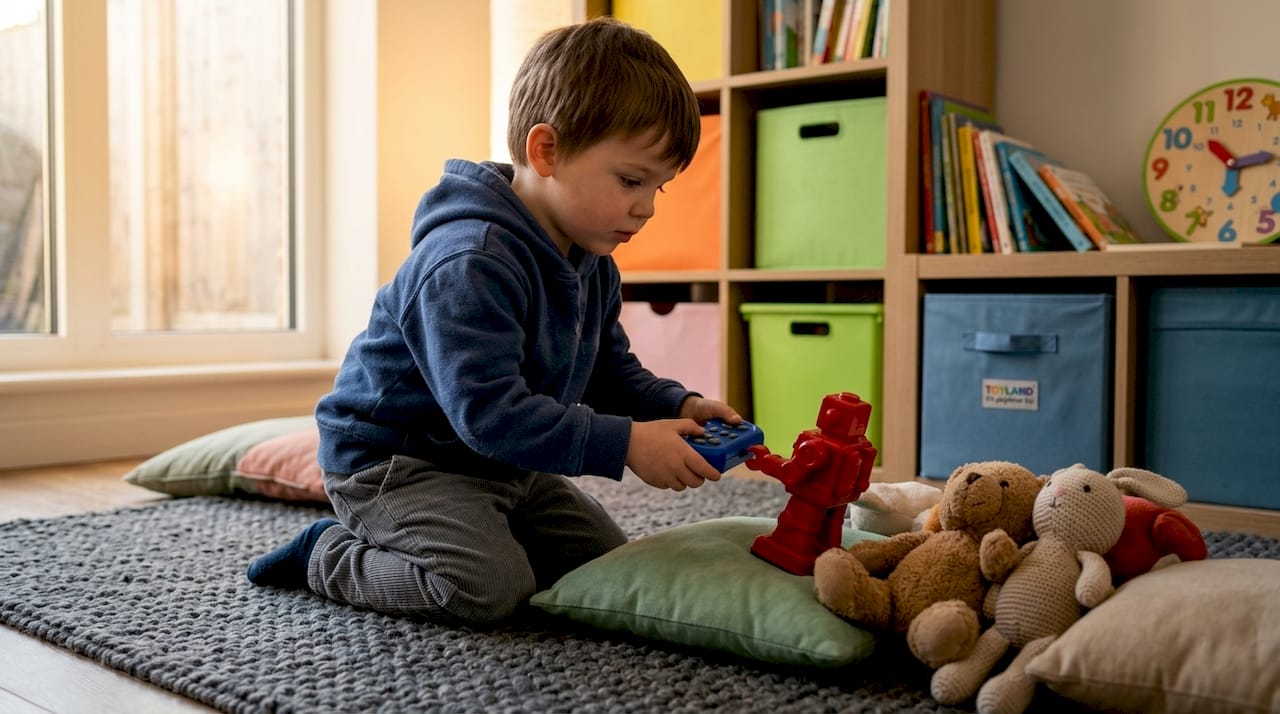
Free play with TETs produces measurable gains in problem-solving, computational thinking, and peer collaboration. This matters because those three skills form the foundation of STEM learning long before a child enters a classroom. When two kids share a single RC car controller, they negotiate turns, predict outcomes, and communicate strategy without any adult prompting.
Fine motor skills also develop through RC play. Gripping a controller, pressing triggers with precision, and steering a vehicle through an obstacle course all require the same small-muscle coordination that later supports writing and tool use. Spatial awareness grows in parallel, as children mentally map where their vehicle is relative to objects around it.
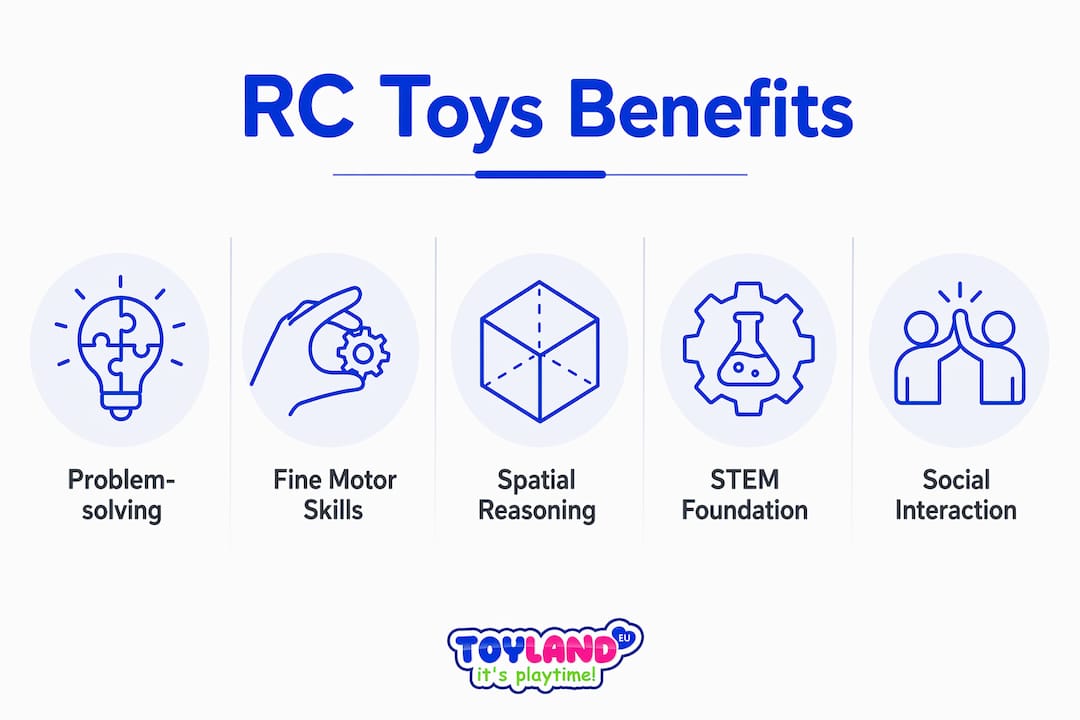
- Problem-solving: Children test routes, correct mistakes, and adapt strategies in real time.
- Computational thinking: Programmable toys like Bee-Bot and Coko Robot produce longer engagement and richer STEM play than simple remote-controlled pets.
- Collaboration: Shared RC play encourages turn-taking, communication, and joint decision-making.
- Fine motor control: Controller operation builds grip strength and precision.
- Spatial reasoning: Steering through physical environments develops 3D mental mapping.
Pro Tip: Set up a simple obstacle course using household objects. Navigating it with an RC car gives children a concrete problem to solve and a visible reward when they succeed.
What features should parents consider when buying RC toys?
Choosing the right RC toy means matching complexity, safety, and durability to your child’s age and environment. A toy that is too advanced frustrates; one that is too simple bores within a week.
Age and motor skill fit
Children under 3 lack the fine motor control to operate most standard RC controllers. Ages 3 to 5 suit simple two-button designs with limited range. Ages 6 and up can handle proportional steering, multiple speed settings, and programmable functions. Always check the manufacturer’s age recommendation, but also watch your child’s actual dexterity before purchasing.
Toy complexity: programmable vs. simple
| Feature | Simple RC toys | Programmable RC toys |
|---|---|---|
| Best age range | 3 to 6 years | 6 years and up |
| STEM learning potential | Low to moderate | High |
| Engagement duration | Short to medium | Long |
| Examples | Basic RC cars, RC pets | Cozmo, Bee-Bot, gesture-controlled stunt cars |
| Price range | Budget-friendly | Mid to premium |
Programmable and gesture-controlled options deliver more developmental return over time, even if the upfront cost is higher.
Safety and battery compartments
A 2025 UK safety report flagged a recalled RC robot sold via Amazon for having an unsecured Ni-Cd battery compartment that posed a chemical poisoning risk if a child accessed it. That recall is a reminder to physically check battery doors before every play session. Screw-fastened compartments are safer than snap-close designs for households with young children.
Pro Tip: Before handing any RC toy to a child under 6, press and pull on the battery compartment door yourself. If it opens without a tool, treat it as a hazard and secure it with tape or store the toy until the child is older.
Durability and play environment
Outdoor RC cars need sealed chassis and rubber tires. Indoor models can be lighter and lower-powered. Anti-gravity climbing cars and 4WD drift cars handle varied surfaces better than entry-level models, making them worth the extra cost if your child plays on carpet, tile, and pavement.
How do RC toys compare to screen time and traditional toys?
RC toys occupy a unique space between passive screen content and purely physical traditional toys. The comparison matters because parents often face a direct choice between these three categories.
- Physical engagement: RC toys require active hand-eye coordination and body movement. Screen-based games deliver 2D input on a flat surface. The 3D physical environment of RC play builds spatial skills that screens cannot replicate.
- Social interaction: Two children can race RC cars together in the same room, creating face-to-face negotiation and shared excitement. Most screen time, even multiplayer gaming, reduces direct eye contact and physical proximity.
- Developmental breadth: Traditional toys like blocks and puzzles build similar cognitive skills but lack the cause-and-effect feedback loop that a motorized vehicle provides instantly.
- Moderation still matters: Expert Dr. Diamond advises parents to evaluate frequency, social context, and how RC play fits into a broader active routine. RC toys are not a replacement for outdoor physical play or unstructured creative time.
- Best-use context: RC toys work best when they complement other play types rather than dominate the schedule. An hour of RC racing followed by outdoor running or drawing gives children a balanced developmental diet.
The honest answer is that RC toys beat passive screen time on almost every developmental metric, but they work best as one component of a varied play routine.
What does recent research reveal about RC toys and learning?
The most striking recent findings move RC toys from the toy box into therapy rooms and special education settings, which signals how seriously researchers now take their educational value.
A 2025 pilot study embedded the robot Cozmo into Applied Behavior Analysis (ABA) therapy for children with autism spectrum disorder (ASD). The results showed measurable gains in theory-of-mind and emotion recognition, two skills that are notoriously difficult to teach through traditional methods. Embedding developmental tasks within robot-assisted play increases motivation and scaffolded learning, especially for children with developmental challenges. That finding has direct implications for parents of neurotypical children too: structured RC play produces better outcomes than unstructured use.
| Research area | Key finding | Source year |
|---|---|---|
| STEM behaviors in toddlers | TETs foster computational thinking and collaboration | 2026 |
| Autism therapy with Cozmo | Gains in theory-of-mind and emotion recognition | 2025 |
| Powered mobility devices | Improved communication and cognition in motor-disabled toddlers | 2026 |
| Programmable vs. simple toys | Open-ended toys produce longer, richer STEM play | 2026 |
A separate 2026 study of 12 toddlers using FDA-cleared powered mobility devices found gains in communication and cognition that went beyond motor skills alone. Children who could independently control their movement became more curious, more communicative, and more engaged with their environment. That is the educational value of RC toys in its purest form: giving a child agency over their physical world changes how they think and interact.
For parents browsing a guide to buying remote control toys, these findings suggest one clear principle. Choose toys that give your child genuine control and genuine challenge, not just passive entertainment.
Key takeaways
RC toys deliver the strongest developmental returns when they are age-appropriate, physically safe, and used in structured or social play contexts rather than in isolation.
| Point | Details |
|---|---|
| Developmental breadth | RC toys build problem-solving, fine motor skills, spatial reasoning, and early STEM thinking simultaneously. |
| Programmable beats simple | Open-ended toys like Bee-Bot and Cozmo produce longer engagement and richer learning than basic remote-controlled pets. |
| Safety check every time | Physically verify battery compartment security before each play session to prevent chemical exposure risks. |
| Structure multiplies benefits | Embedding RC play into structured activities or social play produces measurably better cognitive and social outcomes. |
| Balance over replacement | RC toys complement screen time and traditional toys best when used as one part of a varied daily play routine. |
Why I think parents underestimate what RC toys actually teach
Most parents buy an RC car for the smile on their child’s face at unboxing. That is a perfectly good reason. But after spending years watching how children actually interact with these toys, I am convinced the developmental story is the more interesting one.
What strikes me most is the failure loop. A child steers an RC car into a wall, backs up, tries a different angle, and succeeds. That sequence, repeated dozens of times in a single play session, builds a tolerance for failure and a habit of iteration that structured classroom activities rarely produce. You cannot replicate that with a worksheet.
I also think the therapy research around Cozmo should change how parents think about RC toys for all children, not just those with developmental challenges. If a toy robot can improve theory-of-mind in children with ASD, it is doing something cognitively real. That should raise your expectations for what a well-chosen RC toy can do during ordinary play.
My practical advice: involve yourself occasionally. Race your child. Set a challenge together. Shared RC play turns a solo activity into a social one, and the developmental benefits multiply when an adult models persistence and problem-solving alongside the child.
— Thane
Explore Toylandeu’s RC toy collection for kids
Toylandeu carries RC toys built specifically for the developmental and safety standards discussed in this article. The gesture-controlled stunt car uses hand movements instead of a traditional controller, which lowers the barrier for younger children while still building coordination and spatial thinking. The 360-degree rotation design keeps engagement high across multiple play sessions.
For children who want more physical challenge, the anti-gravity climbing car runs on walls and ceilings, turning any room into a track. Both toys are designed with secure battery compartments and durable chassis suited for active play. Toylandeu ships worldwide with free delivery, so finding the right RC toy for your child is straightforward regardless of where you are.
FAQ
What age is best for a first RC toy?
Children aged 3 to 5 do best with simple two-button RC toys that have limited speed and range. Ages 6 and up can handle proportional steering and programmable functions that deliver stronger STEM learning benefits.
Do RC toys actually help with STEM skills?
Yes. A 2026 study found that free play with technology-enhanced toys including RC devices fosters computational thinking, problem-solving, and collaboration in children as young as 3.
Are RC toys safer than screen time for kids?
RC toys require active physical engagement and face-to-face social interaction, which gives them a developmental edge over passive screen content. Experts recommend using both in moderation as part of a balanced play routine.
What safety features should I check on an RC toy?
Always verify that battery compartments are screw-fastened rather than snap-close. A 2025 UK safety recall flagged an RC robot with an unsecured battery door that posed a chemical poisoning risk to young children.
Can RC toys help children with autism?
A 2025 pilot study using Cozmo in ABA therapy showed measurable improvements in theory-of-mind and emotion recognition in children with ASD, suggesting that structured robot-assisted play has genuine therapeutic value.