

10 Minute Classroom Tested Puppet Play for Parents & Teachers
The fastest way in is a sock, a paper bag, or two fingers with a face drawn on them. Simple puppets like these turn into short, repeatable shows that build language, emotional expression, and fine motor skills in children roughly aged about 3 to 8, and the whole thing can start in under ten minutes with supplies already sitting in a kitchen drawer.
TL;DR:
- Puppets help children practice sequencing and storytelling, especially through repetitive, cumulative stories that reinforce memory and structure.
- Creating simple puppets at home with items like socks or paper bags takes less than 15 minutes and can incorporate curriculum themes easily.
- Short puppet sketches with minimal props and open-ended prompts encourage improvisation, child agency, and emotional expression during sessions.
- Structured sessions that model, guide, and briefly reflect foster skill transfer and confidence, particularly for autistic, multilingual, or shy children.
- Ready-made plush puppets and stage sets from Toylandeu™ can supplement homemade puppets, supporting quick-start sessions and varied storytelling options.
Table of Contents
- How Puppet Play Supports Child Development
- Easy DIY Puppets and Materials You Can Make Today
- Short Puppet Show Ideas and Five Scripts to Copy
- Running a Session: Scaffolding, Reflection, and Age Adaptations
- Building a Puppet Theater From What’s Already Around
- What Classroom Research Says About Puppet Sessions
- A Few Things I’ve Learned Watching Kids With Puppets
- Where to Find Puppets and Craft Kits for Your Next Session
- Sources
- FAQ
- Recommended Reads
How Puppet Play Supports Child Development
A puppet gives a child permission to say things they might not say as themselves. That’s the real engine behind why puppet play works for language, emotion, and motor skills all at once, and it’s why so many preschool classrooms lean on it constantly.
When a child retells a story through a puppet, they practice sequencing events in order, which strengthens narrative comprehension. Cumulative stories, the kind where each new character adds onto a repeating chain of events, are particularly good for this because the repetition scaffolds the sequencing and retelling practice without the child needing to memorize much.
Puppets also give kids a low-stakes way to express feelings they might otherwise bottle up. A child who won’t say “I’m scared” out loud will often let a puppet say it for them. This makes puppet play especially useful for children with additional needs, including autistic children who benefit from an indirect, character-based outlet, and it works well for multilingual learners who are still building confidence in a new language.
The crafting side matters too. Cutting, gluing, and manipulating a puppet’s mouth or arms builds the same fine motor control kids need for handwriting later on. For a deeper look at what different puppet types offer, this guide to puppet toys breaks down the options by age and skill focus.
Easy DIY Puppets and Materials You Can Make Today
You don’t need a craft store trip to get started. Most of these builds use items already at home, and several take less than a short time from start to finish.
- Sock puppets: an old sock, buttons or felt for eyes, yarn for hair, and a hot glue gun (adult-operated) for older kids or fabric glue for younger ones. About 15 minutes.
- Paper bag puppets: a small paper lunch bag, markers, scissors, and construction paper scraps. The bag’s fold becomes the mouth. About 10 minutes.
- Popsicle-stick puppets: printed or hand-drawn character cutouts glued to a wooden stick. About 5 minutes if the cutouts are pre-cut.
- Finger puppets: felt scraps, fabric glue, and a template traced around a finger. About 10 minutes per puppet.
- Silhouette puppets: black card stock, scissors, and a stick or straw taped to the back, used against a light source. About 10 minutes.
These craft categories line up with the kinds of easy puppet activities that classroom teachers use as curriculum hooks, tying puppet-making into counting, shapes, or seasonal themes without extra prep.
Watch scissors closely with kids under 5, and swap small buttons for pom-poms or fabric paint dots if anyone in the group still mouths objects. For sensory-sensitive children, skip glitter and scratchy fabrics and stick with soft felt.
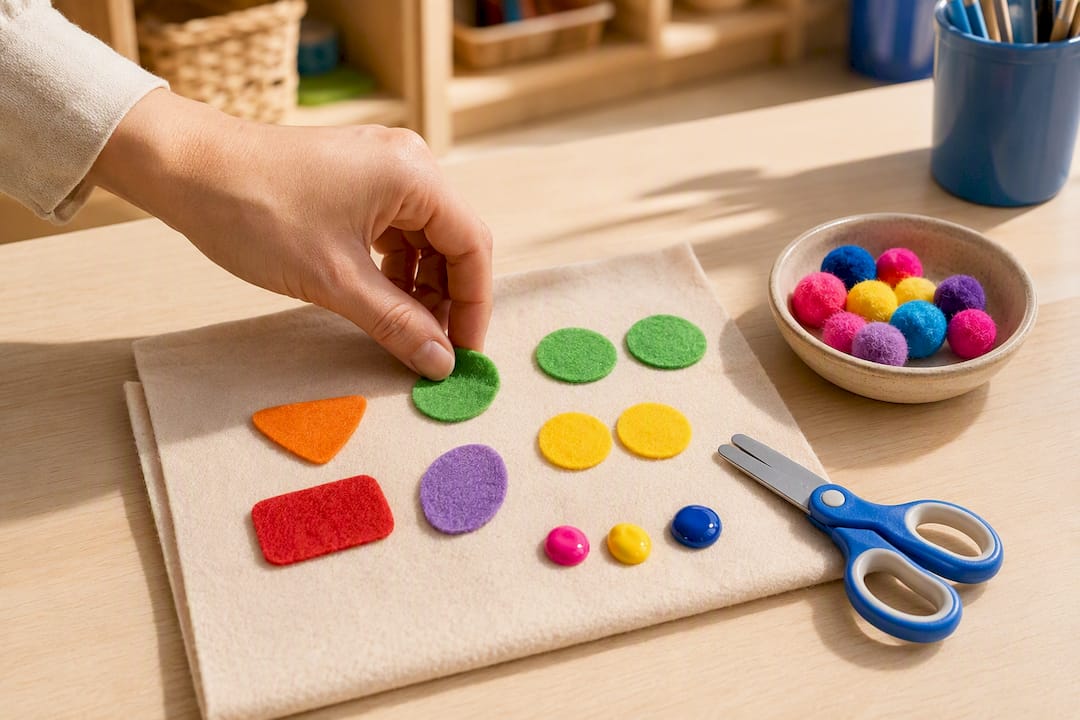
Pro Tip: Precut felt shapes and puppet bases the night before a group session. Handing kids ready-to-assemble pieces cuts chaos and gets you into the actual play part twice as fast.
Short Puppet Show Ideas and Five Scripts to Copy
Long, memorized scripts aren’t the goal here. Short, repeatable sketches that leave room for a child to ad-lib tend to build character work and storytelling instinct better than anything scripted line by line, which is why bare-stage improvisation shows up so often in practitioner materials on puppetry.
A good sketch runs two to four minutes, uses one clear problem, and leans on repetition or call-and-response to keep young audiences locked in. Sound effects (a knock, a growl, a “boing” for jumping) do a lot of heavy lifting without needing props.
Five formats worth trying:
- The cumulative chain — one animal knocks on a door, then two, then three, each repeating the last line before adding a new twist. Move Over, Rover! is a classic example of this structure and works well because the repetition supports sequencing.
- The lost item — a puppet loses something (a hat, a shoe) and asks the audience to help spot it, building call-and-response.
- The problem/solution sketch — one puppet has a problem (can’t sleep, is hungry), a second puppet offers three wrong solutions before the right one lands.
- The mystery knock — offstage sounds happen one at a time, and the puppet guesses who’s coming before the reveal.
- The feelings swap — two puppets each show a different emotion about the same event, prompting kids to talk about why.
Pick one, run it twice with slightly different endings, and let the child holding the puppet fill in gaps. That’s often where the real learning happens.
Running a Session: Scaffolding, Reflection, and Age Adaptations
Structure beats improvisation on day one. Practitioner guidance recommends opening the very first session with a safety and skills demonstration, showing kids how to hold a puppet, move its mouth, and hand it off gently before any story starts.
A solid session sequence looks like this:
- Warm-up: a quick puppet greeting game, no story yet.
- Modeled story: the adult shows a “puppet action leads to story action” example, like a puppet knocking, then reacting to what’s behind the door.
- Guided play: kids try a small piece of that structure themselves.
- Reflection: narration, pair and share, or a fishbowl format where a few kids perform while others watch and reflect.
Introduce only one new story-making strategy per session rather than piling on ideas at once. That single-strategy approach is what lets skills build session over session instead of resetting each time.
For quieter kids, let them narrate from the side instead of performing. For multilingual learners, gestures and sound effects carry more weight than dialogue. Autistic children often do best with a predictable routine and advance notice before transitions. A quick emotional check-in before the show helps everyone settle, and this list of emotional regulation activities pairs well as a five-minute warm-up.
Pro Tip: End every session with one sentence of reflection, even from a shy child: “What did your puppet want?” is enough to lock in the learning.
Building a Puppet Theater From What’s Already Around
A cardboard box with a cutout window works as well as a store-bought theater. Prop a table on its side, drape a blanket over it, and you’ve got an instant stage without a single dollar spent.
- Collage a backdrop on card stock using construction paper, torn magazine scraps, or seasonal cutouts.
- Use a flashlight behind a sheet for silhouette shows with the puppets you built earlier.
- Keep sound effects simple: keys jingling, a spoon on a pot, crinkled paper for footsteps.
- Store puppets in one labeled basket and use small cue cards so kids know when to enter or exit.
These low-lift formats echo the open-box and shadow-story setups that library and classroom programs have used for decades. If you want sturdier building blocks for a backdrop frame, a set of compatible building bricks can double as stage scenery pieces kids help design themselves.
What Classroom Research Says About Puppet Sessions
Teachers who use puppet play as a literacy tool tend to follow a specific rhythm: model once, let kids try, then reflect briefly. That first-session sequence, safety demonstration followed by a modeled puppet-action story, sets expectations before any child improvises on their own.
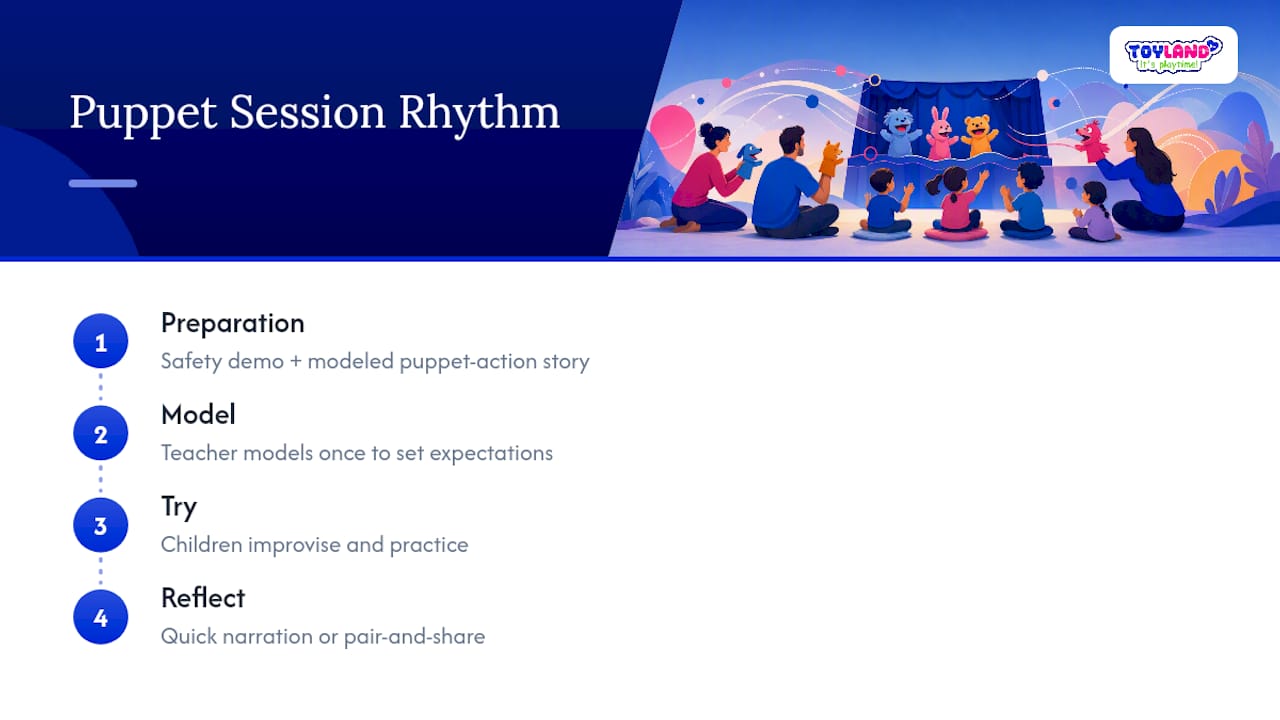
The reflection piece matters more than most people assume. A quick narration (“Tell me what happened”) or a pair-and-share moment where two kids compare their puppet’s choices does more for retention than a longer post-show discussion. Fishbowl formats, where a small group performs while the rest of the class watches and comments after, work especially well once kids have a session or two of confidence built up.
Introducing just one new story strategy per session, rather than several, lets that skill transfer into writing and independent storytelling later. It’s a small constraint that pays off over weeks, not days.
A Few Things I’ve Learned Watching Kids With Puppets
The biggest mistake I’ve seen is adults over-scripting. Kids do more, say more, and stay more engaged when a puppet’s line isn’t fully written for them. At your next session, hand over a puppet with zero script and just one prompt: “What does your puppet want right now?” Watch what happens.
— Thane Holland
Where to Find Puppets and Craft Kits for Your Next Session
Building your own puppets is half the fun, but sometimes you need a ready-made character to start a show tonight, not next weekend. Toylandeu™ stocks a wide range of plush toys that work as instant hand puppets and soft characters, useful when you want a polished piece alongside the sock-and-paper-bag builds from earlier in this guide.
Beyond ready-to-use plush characters, a catalog of over 30,000 items includes building sets that double as stage scenery and dolls that pair well with story-based play. Orders include worldwide shipping, and multi-currency checkout supports international buyers. Check age ranges listed on each product page before buying for younger kids, since puppet and plush sizing varies by set. Browse the full catalog to grab a character or two before your next puppet session and skip a step of prep entirely.
Sources
- Retelling with Puppets | Pennsylvania Center for the Book
- Story making through puppet play | Teach with Arts Connection
- 15 Puppet Activities For Preschoolers: Ideas, Crafts, And Stories - Teaching Expertise
- Storytelling with Puppets — ALA Store
FAQ
What Are Some Fun Activities for Puppet Play?
Cumulative chain stories, lost-item games, and feelings-swap sketches all work well because they use repetition and call-and-response to hold a young child’s attention. Pairing a short script with a homemade sock or paper-bag puppet turns a five-minute activity into a full language and social-emotional exercise.
What Are Some Good Ideas for a Puppet Show?
Keep the show under four minutes with one clear problem, like a lost hat or a puppet who can’t sleep, and let sound effects do most of the work instead of elaborate sets. Open-box theaters and shadow-story formats, both documented in classroom puppetry resources, fit almost any small space.
What Are the 5 Basic Types of Puppets?
The most common types used with young children are sock puppets, paper bag puppets, popsicle-stick puppets, finger puppets, and silhouette puppets. Each one uses different materials and skill levels, and a full breakdown of twelve teaching-friendly puppet examples covers variations beyond these five.
What Are Some Easy Puppet Ideas for Kids?
Paper bag puppets and finger puppets are the fastest builds, often ready in under ten minutes with markers, scissors, and glue. These simple preschool puppet activities also connect naturally to counting or shape lessons, so the craft time doubles as a curriculum moment.
Does Toylandeu™ Sell Ready-Made Puppets?
Toylandeu™ carries plush toys that work well as instant hand puppets, along with dolls and building sets useful for stage props. Current prices and full product details are available on the Toylandeu™ website.
Recommended Reads
- What Is a Puppet Toy? Meaning, Benefits, and Types
- Examples of Puppets for Teaching: 12 Types That Work
- Wooden Puppets Crafting Guide 2026
- DIY Toys and Paper Play Ideas for 2025