

Students: Study With Music? 279 Student Trial and a Simple Self Test
Yes, often, but it depends on three things: what kind of task you’re doing, whether the music has lyrics, and how your particular brain handles background sound. Routine review tends to go fine with music playing; dense reading or writing usually doesn’t. The rest of this comes down to matching the audio to the task and testing your own results instead of guessing.
TL;DR:
- Listening to self-selected music generally does not impair comprehension and can boost mood during routine study tasks, but the effects vary based on personal preference.
- Lyrics in music increase mental workload and interfere with language-based tasks such as reading dense material or writing essays, especially if the language is understood.
- Instrumental, familiar tracks played at low volume are best for tasks requiring focus, while silence or background noise suits complex problem solving or language-heavy work.
- Testing individual responses with simple A/B comparisons is more reliable than relying on generalized advice, as personal experiences with music during studying differ.
- Using music as a warm-up or reward rather than a constant background improves focus and prevents distraction during demanding or novel tasks.
Table of Contents
- Is It OK to Study With Music Playing? What the Evidence Shows
- When Music Helps and When It Hurts
- How to Choose Study Music and Set Up Your Space
- Does Music Help With ADHD or Other Focus Differences?
- Building Music Into Your Study Routine
- Quick Takeaways on Studying With Music
- Why Testing Yourself Beats Following the Hype
- Set Up a Study Space That Works With You, Not Against It
- Sources
- FAQ
Is It OK to Study With Music Playing? What the Evidence Shows
The strongest recent evidence says self-selected music does not hurt reading comprehension for most students, and it can protect your mood while you work. A 2025 randomized study of 279 university students found that listening to music of their own choosing produced no measurable drop in reading comprehension scores compared to silence or background noise, and the music group reported better mood throughout the task. That’s a meaningfully sized trial for this kind of research, and it directly challenges the old assumption that any music while reading automatically drags down comprehension.
Practice already reflects this. A 2026 report found that roughly 67% of students listen to music specifically to improve focus, and about 75% use it to stay motivated during study sessions, according to UNLV’s research on student music habits. Those numbers describe behavior, not proof that music causes better outcomes. Plenty of students who feel more focused with music playing are actually just less bored, which is a real benefit, but a different one than “learning faster.”
The picture gets more complicated once lyrics and working memory enter the equation. A 2023 review found that music containing lyrics increases the load on working memory and can interfere directly with tasks that involve language processing, like reading unfamiliar material or drafting an essay, because lyrics compete for the same mental resources your brain uses to process written words. Earlier research on working memory backs this up: background audio, especially audio with words, can measurably shrink the mental workspace available for verbal tasks, according to foundational cognition research on music and memory.
Here’s the honest limitation in all of this: most studies test “self-selected” music, meaning students picked songs they already liked and knew well. That detail matters enormously and rarely makes it into the summary you’d read elsewhere.
- Self-selected, familiar music behaves differently than a random playlist or unfamiliar genre.
- Lyrics in your native language interfere more than lyrics in a language you don’t understand.
- Sample sizes in this field are still modest, so individual results vary more than headlines suggest.
- Mood effects (feeling calmer, less bored) are often easier to detect than performance effects (scoring higher).
The prevalence gap: Around 67% of students use music for focus and 75% for motivation, yet those are self-reports about habit, not controlled measures of whether the music actually improved test scores. Widespread use and proven benefit are two different claims.
None of this means you should trust a blanket rule either way. It means the honest answer is conditional, and testing your own response to music beats following anyone’s general advice, including this article’s.
When Music Helps and When It Hurts
Not all studying is the same task, and that’s the piece most advice skips. Music’s effect swings hard depending on what your brain is actually doing.
Routine, low-language tasks tolerate music well. Flashcard review, math drills, repetitive problem sets, and organizing notes rarely demand the kind of deep verbal processing that lyrics disrupt. For these tasks, music mostly does one job: it makes a boring task feel less boring, and that alone can extend how long you’re willing to stick with it.
Language-heavy tasks are the riskiest pairing. Essay writing, reading dense or unfamiliar material, translating, or learning new vocabulary all lean on the same mental machinery that lyrics hijack. This is exactly the mechanism the 2023 review on lyrics and working-memory interference describes: words competing with words for the same limited processing space.
Complex problem solving needs a case-by-case call. Advanced math proofs, coding logic, or anything requiring you to hold several steps in mind at once can suffer if the music itself demands attention, whether from lyrics, unpredictable structure, or a tempo that keeps shifting. Calm, familiar instrumental tracks tend to cause the least disruption here, while anything new or lyrically dense tends to cause the most.
A few concrete pairings make this easier to apply:
- Flashcard review or repetitive drills: Lyrics are fine. Pick anything upbeat that keeps energy up.
- Reading a new textbook chapter: Skip lyrics entirely. Silence or plain instrumental works better.
- Drafting an essay: Favor silence, or at most a very quiet, familiar instrumental track.
- Solving unfamiliar math or coding problems: Test silence first, since heavy working-memory tasks are where music is most likely to backfire.
- Reviewing material you already know well: Music, even with lyrics, usually causes little harm because the task itself is less demanding.
Pro Tip: Use instrumental piano or ambient tracks for review sessions, and drop to silence the moment you sit down to draft or solve something new. Switching mid-session isn’t a sign you did something wrong. It’s just matching the tool to the task.
How to Choose Study Music and Set Up Your Space
Getting the setup right matters as much as picking the right genre. A few small choices determine whether music helps you focus or quietly drains your attention.
- Go instrumental first. Solo piano, ambient, lo-fi instrumental, or steady electronic tracks without vocals in a language you speak are the safest starting point, since research on music and cognition consistently flags volume, tempo, and unpredictability as the real culprits behind distraction, not simply “music” as a category.
- Keep volume low to moderate. Loud music competes for attention regardless of genre. If you catch yourself turning the volume up to “block out” a noisy room, that’s usually a sign you need a different environment, not louder music, according to applied guidance on music versus noise.
- Pick familiar over novel. A song you’ve heard fifty times fades into the background. A brand-new track pulls your ears toward it, waiting to see what happens next.
- Avoid abrupt transitions and ad breaks. A jarring commercial or a sudden genre switch resets your attention every single time. Offline playlists or ad-free stations solve this cleanly, and a curated calm-music resource can save you the trial and error of building one from scratch.
- Choose longer-form tracks with consistent dynamics. Ambient sets built for sustained listening minimize the sudden peaks and drops that snap your focus away from the page.
- Know when to switch to non-music alternatives. White noise, brown noise, or nature sounds can outperform music entirely when your goal is masking a noisy environment rather than boosting mood, since they carry no melody or lyrics to compete for attention.
Pro Tip: If you notice yourself singing along, reaching for the volume knob repeatedly, or humming a hook after the song ends, that’s your signal the track is pulling focus rather than supporting it. Swap it out immediately rather than fighting through it.
Does Music Help With ADHD or Other Focus Differences?
The evidence here is genuinely mixed, and that’s worth saying plainly instead of pretending there’s a clean answer. Some people with ADHD report that music, especially something rhythmic and engaging, helps them get started and stay in their seat longer. Others find the same music pulls their attention away from the task entirely. Controlled research on this specific question remains limited, so individual testing matters more here than almost anywhere else in this topic.
A simple self-test settles the question faster than any general advice can:
- Pick a task you do often, like reviewing notes or working through practice problems, so the comparison stays fair.
- Run one 25 to 30 minute block with music and one without, on different days if possible, to reduce fatigue as a factor.
- Track two things: how focused the session felt (a quick 1 to 10 rating) and one objective measure, like flashcards answered correctly or pages completed.
- Compare the two blocks honestly. If music made you feel better but performance dropped, that’s still useful information. It just means music belongs in warm-ups and breaks rather than deep-focus time.
- Adjust the variables one at a time. Try instrumental only, then a stimulating playlist just for the first five minutes, before concluding music simply doesn’t work for you.
If you land on “stimulating music helps me start, but I need quiet to finish,” you’re not an outlier. That pattern shows up often enough that it’s worth building directly into your routine.
Building Music Into Your Study Routine
Music works best as a tool you deploy at specific moments, not a constant soundtrack running the whole session, as playful learning strategies highlight in resources like CodeBusters Escape Room | Educational escape rooms learning benefits.
- Warm-up (3 to 5 minutes): Play something upbeat and familiar right before you sit down to work. This raises alertness and energy without asking your brain to process anything yet.
- Focused blocks: During a timed study block, say a 25 minute Pomodoro sprint, switch to calm instrumental music for routine review, or drop to silence entirely once the task shifts to writing or unfamiliar problem solving.
- Reward breaks: At the end of a completed block, play a favorite song, lyrics and all, as a short reset before the next sprint. This is where music’s motivational value shines with zero cognitive downside, since you’re not trying to learn anything during it.
Two sample sessions show how this plays out. A light review night might look like: five minutes of upbeat warm-up, then 25 minutes of instrumental lo-fi while running flashcards, then a two-song reward break. A deep-work night for an essay draft looks different: the same warm-up, then silence for a 30 minute writing block, then a reward break, then back to silence for the next block.
Pro Tip: Treat the reward song as non-negotiable. It’s the piece most students skip when they’re behind schedule, and it’s often the exact thing that keeps a study session from falling apart by hour two.
Quick Takeaways on Studying With Music
- Skip lyrics for reading, writing, or anything language-heavy.
- Test yourself with a simple A/B comparison before trusting anyone’s blanket advice, including this one.
- Use music as a warm-up and a reward, not a constant background track.
- Default to instrumental, familiar tracks over anything new or lyrically dense.
- Keep volume low enough that you never catch yourself turning it up to compete with the room.
- Switch to white noise or nature sounds when the goal is blocking noise rather than boosting mood.
| Task type | Music with lyrics | Instrumental music | Silence |
|---|---|---|---|
| Flashcards or drills | Fine | Fine | Fine |
| Reading new material | Avoid | Caution | Best |
| Essay drafting | Avoid | Caution | Best |
| Familiar review | Fine | Fine | Fine |
| Complex problem solving | Avoid | Caution | Best |
One-line summary: the research says self-selected music won’t hurt most routine studying and may help your mood, but lyrics and complex tasks are where the risk actually lives.
Why Testing Yourself Beats Following the Hype
Most advice on this topic swings too hard in one direction. Either music is framed as a productivity hack that works for everyone, or it’s dismissed as pure distraction that serious students should avoid entirely. Both versions oversell certainty the research doesn’t have.
What’s underappreciated is how much the “self-selected” detail in these studies matters. The 279-student trial on reading comprehension worked because participants chose music they already liked. That’s not a minor footnote. It’s arguably the whole finding. Hand someone unfamiliar music, or music in a genre they dislike, and you’re running a different experiment with a different likely outcome.
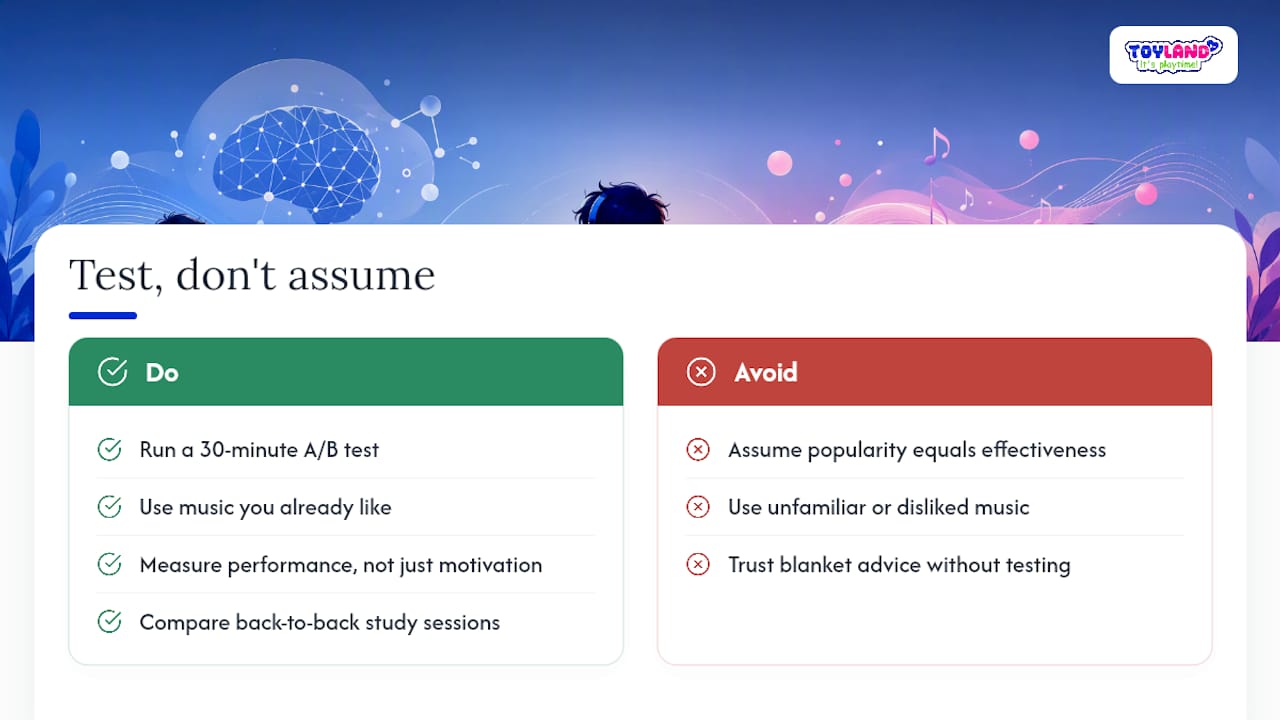
The other thing worth saying bluntly: prevalence isn’t proof. Three out of four students using music for motivation tells you what people do, not what works best. Motivation and performance are separate outcomes, and conflating them is where a lot of casual advice on this topic goes wrong.
If there’s one genuinely practical habit hiding in all this research, it’s the A/B test. Most students never actually check whether music helps them personally. They just assume it does because it feels good in the moment, or assume it doesn’t because a teacher once said so. Thirty minutes of honest comparison settles more than any article can, this one included.
— Thane Holland
Set Up a Study Space That Works With You, Not Against It
Music is one lever. The physical study environment is another, and it’s one Toylandeu™ can actually help with. A five minute hands-on break with a small building set or a STEM kit resets attention better than scrolling your phone, and it costs you nothing in focus once you sit back down.

A toy retailer stocks a large catalog of tens of thousands of items with worldwide shipping, so building a study corner that supports focus can be convenient without searching many sites. If you want a quick, low-effort break between Pomodoro blocks, browse the STEM Toys collection for hands-on kits that reset your brain without pulling you into a screen, or check out Building Block Sets and MOC Kits for something you can pick up and put down in under ten minutes. Pair that with a calming instrumental playlist from a resource like Toylandeu™'s guide on what music calms children, and you’ve built a study environment tuned to how your attention actually works. Browse the current catalog and see what fits your routine.
Sources
- From Mozart to Fleetwood Mac: music listening is not detrimental to reading comprehension in university students
- Should We Turn off the Music? Music with Lyrics Interferes …
- Many students listen to music to focus and stay motivated while they study — but it doesn’t always help
FAQ
Do people with ADHD focus better with music?
Some do, and some don’t. The evidence is mixed and largely individual, so the most reliable approach is running a short self-test comparing a focused block with music against one without, tracking both how focused you felt and how much you actually completed.
Is silence or music better for studying?
It depends on the task. Silence tends to win for reading comprehension, essay writing, and complex problem solving, while music, especially instrumental, does not detrimentally affect performance on more routine review tasks and can improve mood along the way.
Is it true that some people can’t study without music?
Some students genuinely feel less able to concentrate in total silence, often because music reduces boredom or masks a fidgety mind. That’s a real preference worth honoring, but it’s separate from whether music improves actual test performance, so testing yourself on both fronts is the honest way to check.
Is music good for studying overall?
For most students doing routine or moderately demanding work, self-selected instrumental music causes no measurable harm and can support mood and motivation. For language-heavy or working-memory-intensive tasks, silence or very minimal instrumental sound tends to perform better.