

Is Giving Kids Allowance Ok? A Parent's 2026 Guide
TL;DR:
- Giving kids an allowance teaches financial responsibility when it is structured, consistent, and involves regular money discussions.
- Starting around age 4 or 5 with a small, fixed amount helps children develop good money habits early without spoiling motivation.
Giving kids an allowance is one of the most effective ways to teach financial responsibility, and the answer to whether it’s ok is a clear yes, provided you apply a few key principles. Nearly 80% of American parents give their children some form of allowance, recognizing it as a practical tool for building money skills early. The formal term for this practice is children’s financial education, and allowance is its most hands-on method. Done thoughtfully, it builds budgeting habits, teaches delayed gratification, and opens conversations about money that last a lifetime.
Quick Summary
Giving kids an allowance is beneficial when it is structured, consistent, and paired with regular money conversations. The best models separate core household chores from the allowance amount and use optional paid tasks to teach income-earning. Starting around age 4 or 5 builds habits early. The allowance itself matters less than the dialogue it creates.
TL;DR
- Allowance is ok and beneficial when managed well.
- Separate chores from allowance to avoid punitive money dynamics.
- Start as early as age 4 or 5 with a small, fixed amount.
- Use save, spend, and share jars to teach allocation.
- Conversations about money matter more than the model you choose.
Table of Contents
- Is giving kids allowance ok?
- What is the best way to give kids an allowance?
- At what age should parents start giving an allowance?
- How does allowance influence financial literacy and motivation?
- How can parents effectively manage allowance to maximize learning?
- Key Takeaways
- Perspective
- FAQ
Is giving kids allowance ok?
Allowance is defined as a regular, fixed sum of money given to a child to practice managing money. It is not a reward and not a wage. That distinction matters more than most parents realize. When allowance functions as a financial education tool rather than payment for compliance, it teaches children how to budget, save, and make spending decisions with real consequences.
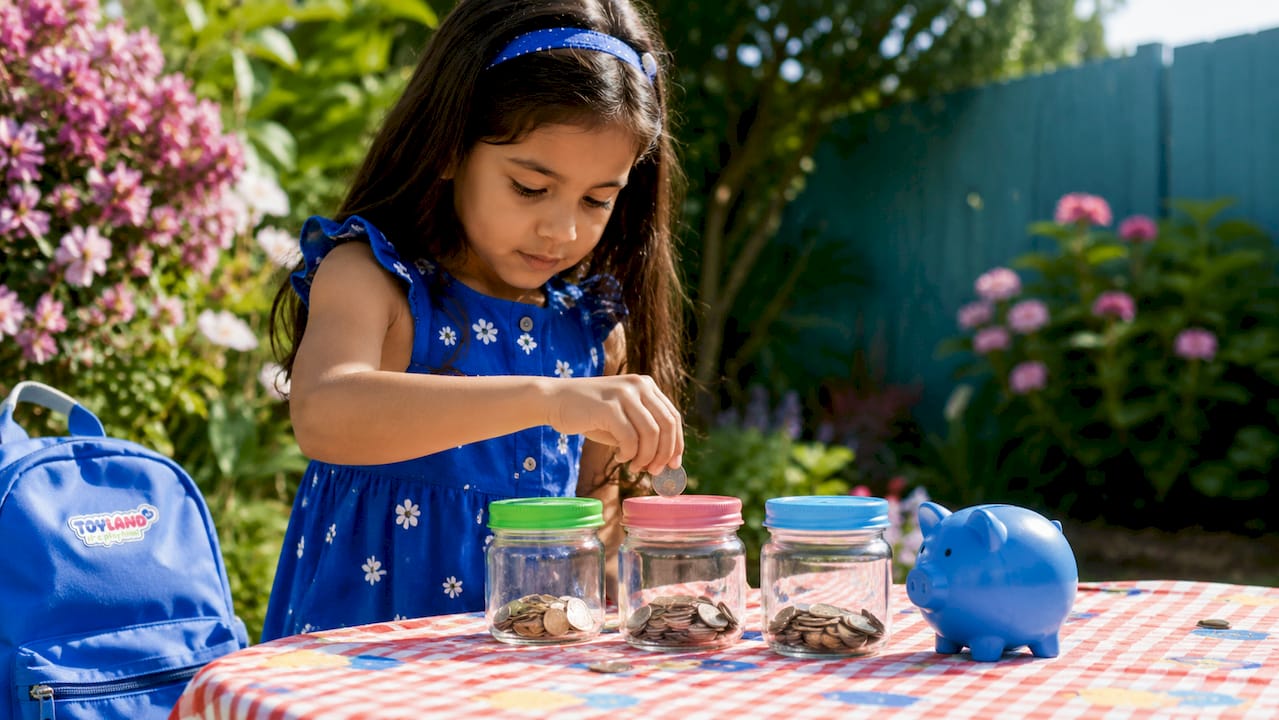
79% of American parents currently give their children an allowance, with 64% requiring chores for pay, 27% using a mixed approach, and 20% attaching no strings at all. That spread shows there is no single dominant model. What the research does show is that the structure behind the allowance predicts outcomes far more than the dollar amount.
Ron Lieber, author and personal finance journalist, emphasizes allowance as a financial education tool that should stay separate from household contributions. His reasoning is straightforward: mixing money with chores turns family responsibilities into transactions, and that creates friction. The goal is financial competency, not a paycheck system.
What is the best way to give kids an allowance?
Four main allowance models exist, and each carries distinct trade-offs.
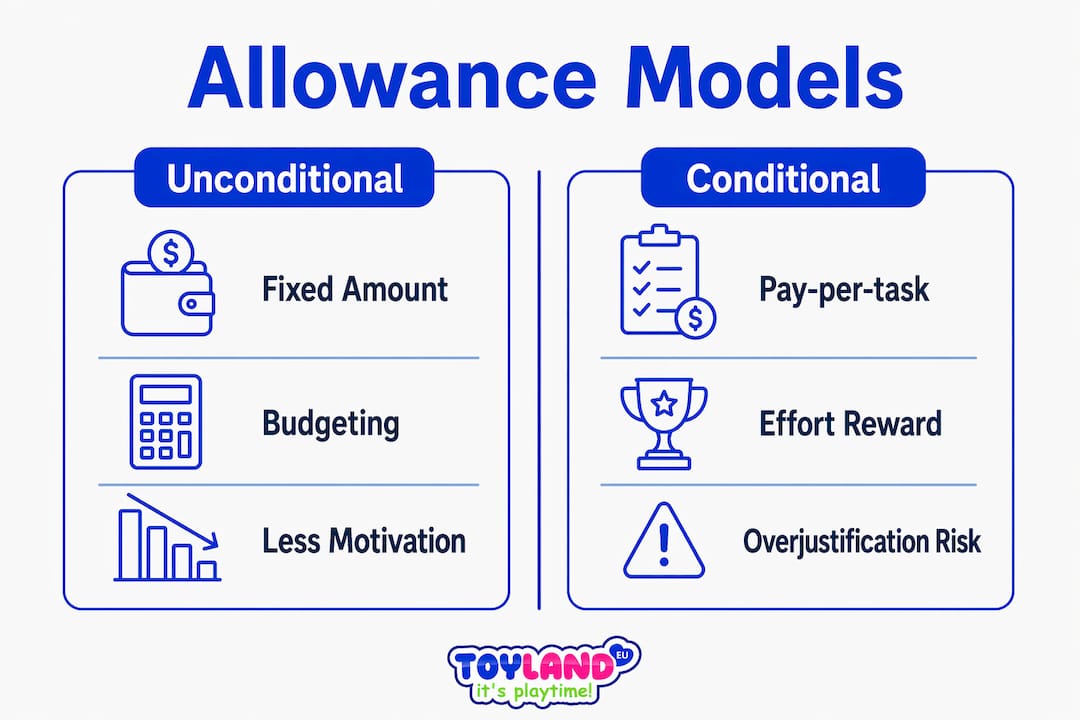
| Model | How it works | Key benefit | Key risk |
|---|---|---|---|
| Unconditional | Fixed amount, no conditions | Builds budgeting habits | May lack work-income connection |
| Chores-for-pay | Allowance tied to chore completion | Links effort to income | Can reduce intrinsic motivation |
| Pay-per-task | Each task has a set price | Teaches earning | Creates transactional family culture |
| Hybrid | Fixed allowance plus optional paid extras | Balances both lessons | Requires consistent management |
Unconditional allowances promote budgeting skills but can disconnect money from effort if parents never discuss where money comes from. Children who receive money without context tend to spend it without reflection.
Pay-per-task models risk triggering the overjustification effect, a well-documented psychological phenomenon where external rewards reduce a child’s internal drive to help. Once you pay a child to set the table, they may stop doing it for free.
The hybrid model carries the lowest known risk of motivational or entitlement issues. Core chores like making the bed or clearing dishes stay unpaid, because they are part of being a family member. Optional tasks like washing the car or organizing the garage become paid opportunities that teach income-earning without undermining family culture.
Pro Tip: Write a short list of “family jobs” (unpaid) and “extra jobs” (paid) and post it on the fridge. The visual separation reinforces the concept for kids of all ages.
At what age should parents start giving an allowance?
The right age to start is earlier than most parents expect. Experts suggest starting as early as age 4 or 5, often timed around when a child begins school. At that age, children can grasp basic concepts like “this costs more than I have” and “if I save this week, I can buy that next week.”
A few practical guidelines by age:
- Ages 4 to 6: Start with a small, fixed unconditional allowance. Around $20 per month is a common starting point, adjusted to your family’s budget. Focus on physical cash so the money feels real.
- Ages 7 to 10: Introduce the save, spend, and share allocation system. Add simple conversations about needs versus wants.
- Ages 11 to 14: Shift toward a hybrid model. Introduce optional paid tasks. Begin discussing savings goals for larger purchases.
- Ages 15 and up: Increase the allowance to cover more personal expenses. Introduce basic banking concepts and, if appropriate, a debit card with limits.
Starting early builds the habit of managing money before the stakes get high. A child who practices with $5 a week at age 6 is far better prepared for a part-time job at 16 than one who never handled money independently.
You can find more detail on age-appropriate amounts in this 2026 allowance guide from Toylandeu™.
How does allowance influence children’s financial literacy and motivation?
Allowance alone does not produce financially literate kids. Studies show that children receiving unconditional allowances without educational structure tend to have lower financial literacy than those involved in regular money discussions. The allowance is the vehicle. The conversation is the engine.
Economist Lewis Mandell highlights parental engagement as the single most important factor in successful allowance outcomes, more important than the model itself. A parent who sits down monthly to review a child’s spending teaches more in 10 minutes than any system does passively.
Physical cash is more educational for younger children than digital transfers because it makes costs and saving feel concrete. Watching a pile of coins shrink after a purchase is a lesson no app fully replicates for a six-year-old.
Common pitfalls to avoid:
- Tying allowance to behavior: Using money as punishment or reward for non-financial behavior confuses the lesson. Strictly tying allowance to chore completion can turn money conversations punitive and increase family conflict.
- Bailing kids out: When a child spends their allowance on day one and asks for more, saying no is the lesson. Rescuing them removes the consequence.
- Skipping the conversation: Handing over money without discussion produces spenders, not savers.
Pro Tip: After each allowance payment, ask your child one question: “What are you saving for right now?” That single question builds the habit of goal-directed saving.
Teaching children about roles and responsibilities alongside money management creates a fuller picture of how contribution and reward connect in real life.
How can parents effectively manage allowance to maximize learning?
Effective allowance management follows a small set of consistent practices. The structure matters more than the amount.
- Keep core chores unpaid. Assign household responsibilities that every family member shares. These are not tied to money. This preserves intrinsic motivation and family culture.
- Set a fixed, predictable allowance. Pay on the same day each week or month. Consistency teaches children that income is reliable and plannable.
- Use the save, spend, share system. Starting small creates opportunities to teach budgeting and charity using three labeled jars or envelopes. A common split is 60% spend, 30% save, 10% share.
- Offer optional paid tasks. Create a short list of above-and-beyond jobs with set prices. This teaches the income-earning connection without contaminating core chores.
- Use allowance as a conversation starter. Discuss needs versus wants, saving goals, and giving decisions regularly. The true value of allowance lies in generating teachable moments, not in the money itself.
- Never bail them out. If a child runs out of money before the next payment, that is the lesson working as intended.
For parents still deciding whether to start, this parent’s guide to allowance from Toylandeu™ covers the foundational decision in plain terms.
Key Takeaways
Giving kids an allowance builds financial literacy when it is structured, consistent, and paired with regular conversations about money.
| Point | Details |
|---|---|
| Allowance is beneficial | It teaches budgeting, saving, and spending decisions through real experience. |
| Separate chores from allowance | Keep core household tasks unpaid to preserve motivation and family harmony. |
| Start early | Age 4 or 5 is the recommended starting point, with a small fixed amount. |
| Conversations drive outcomes | Parental engagement predicts financial literacy more than the allowance model. |
| Use the three-jar system | Dividing money into save, spend, and share teaches allocation from the start. |
What I’ve learned after years of watching allowance systems succeed and fail
Most parents overthink the model and underthink the conversation. I’ve seen families run elaborate chore charts with point systems and weekly audits, and I’ve seen parents hand over a $5 bill every Sunday with a single question: “What are you saving for?” The second approach almost always produces better results.
The research backs this up, but so does common sense. Children learn money by talking about money, not by receiving it silently. The allowance creates the opportunity. You have to show up for it.
One thing I’d push back on is the idea that you need to get the model perfect before you start. Starting imperfectly at age 5 beats starting perfectly at age 10. A child who has managed money for five years, even messily, arrives at adolescence with instincts that no classroom lesson can replicate.
The non-financial benefits are real too. Kids who manage their own money develop confidence in decision-making, learn to tolerate delayed gratification, and practice saying no to impulse purchases. Those are life skills, not just money skills. Start the conversation. Adjust as you go.
— Thane Holland
Toylandeu™ learning toys that make great savings goals
One of the best ways to motivate a child to save is to give them something worth saving for. Toylandeu™ carries a wide range of educational and creative kits that work perfectly as savings goals for kids of all ages. When a child sets their sights on the Montessori Drawing Kit or a colorful drawing scroll kit, the allowance system gains a concrete purpose. Saving for something meaningful teaches patience and planning far better than saving in the abstract. Toylandeu™ offers free worldwide shipping and over 30,000 products, so there is always something at the right price point for your child’s savings goal.
FAQ
Is giving kids allowance ok at a young age?
Yes. Experts recommend starting as early as age 4 or 5, when children can grasp basic money concepts. A small, fixed amount paired with simple conversations builds strong habits early.
Should allowance be tied to chores?
Tying allowance strictly to chores risks making money conversations punitive and can reduce a child’s intrinsic motivation to help at home. The hybrid model, which separates core chores from a fixed allowance, works better for most families.
How much allowance should a child receive?
A common starting point is around $20 per month for younger children, adjusted to your family’s budget and the child’s responsibilities. The amount matters less than the consistency and the conversations around it.
What is the three-jar allowance system?
The three-jar system divides a child’s allowance into save, spend, and share portions using labeled jars or envelopes. A typical split is 60% spend, 30% save, and 10% share, teaching allocation from the first payment.
Does allowance actually improve financial literacy?
Allowance improves financial literacy only when paired with regular parental conversations about money. Children who receive allowance without educational structure can end up with lower financial literacy than those who receive none at all.
Recommended Reads
- What’s a Good Allowance for a Kid? 2026 Guide — Toylandeu™
- Should I Give My Kid an Allowance? A 2026 Guide — Toylandeu™
- Children and Chores: A Parent’s Guide to Raising Helpers — Toylandeu™