

How to Pick a Bouncy House for Your Kid's Party
TL;DR:
- Choosing the right bouncy house requires accurate space measurements, understanding age and weight limits, and verifying safety certifications. Proper setup, anchoring, and supervision are essential to prevent injuries and ensure safety during use. Prioritize certified, quality materials and ask for official documentation to guarantee a safer, more enjoyable experience.
Picking a bouncy house sounds simple until you are standing in your backyard wondering why the thing is sagging, or worse, watching two kids collide because you rented something three sizes too small. Knowing how to pick a bouncy house before you commit to a purchase or rental saves you real money, real stress, and most importantly, keeps your kids safe. This guide covers everything that matters: space requirements, age-appropriate sizing, material quality, safety certifications, setup logistics, and the mistakes most parents make only once.
Table of Contents
- Key takeaways
- Table of contents
- What to assess before you pick a bouncy house
- Choosing the right size, capacity, and features
- Material quality and safety certifications
- Setup, anchoring, and maintenance
- Common mistakes and how to avoid them
- My honest take as someone who has seen it go wrong
- Keep the fun going with Toylandeu
- FAQ
Key takeaways
| Point | Details |
|---|---|
| Measure first, shop second | Allow 3 to 5 feet of side clearance and 15 to 18 feet of vertical clearance before choosing any model. |
| Age limits are non-negotiable | Children under 3 years old or under 42 inches tall should not use standard bounce houses. |
| Certifications reveal quality | Look for ASTM F2374-23 or EN14960 labels. Vague compliance claims are a red flag. |
| Match capacity to your crowd | Overcrowding is the most common cause of injuries, not equipment failure. |
| Test before the party | A trial inflation at least one day before your event catches blower and anchoring problems early. |
Table of contents
- What to assess before you pick a bouncy house
- Choosing the right size, capacity, and features
- Material quality and safety certifications
- Setup, anchoring, and maintenance
- Common mistakes and how to avoid them
- My honest take as someone who has seen it go wrong
- Fun beyond the bounce: Toylandeu picks for party day
- FAQ
What to assess before you pick a bouncy house
Before you browse a single product listing, you need three numbers: your available footprint, your youngest guest’s age, and your expected guest count. Get these wrong and nothing else matters.
Measuring your space accurately
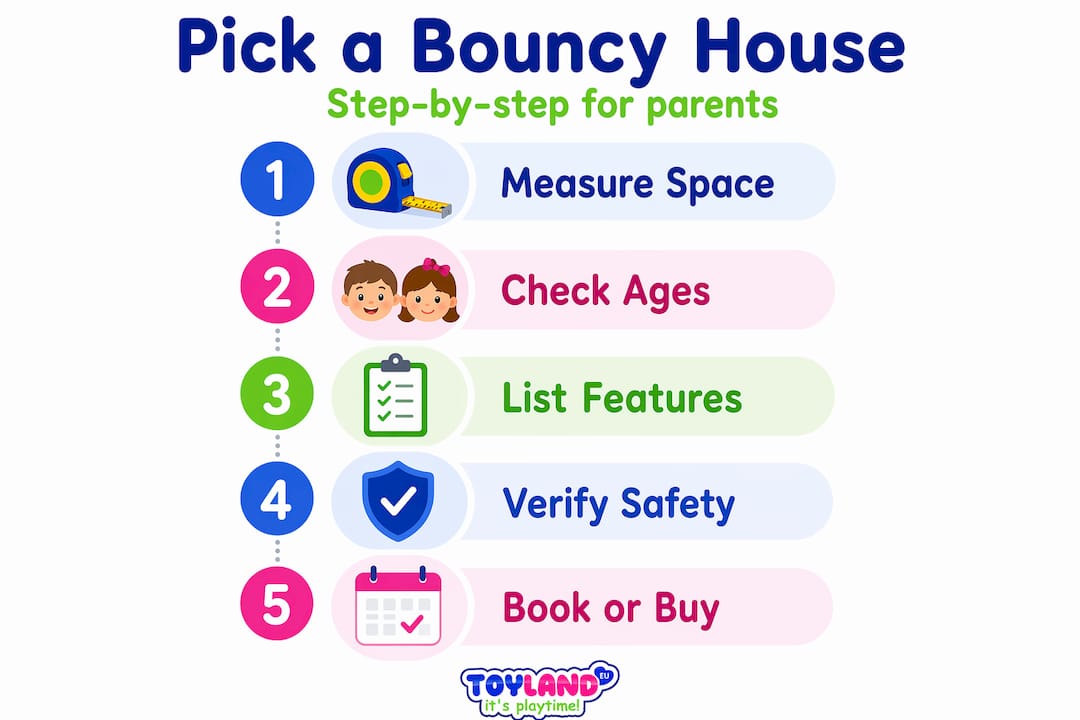
Walk the area where the bouncy house will sit. Measure the flat, clear surface available, then subtract what you need for safety margins. Proper bounce house setup requires 3 to 5 feet of clearance on every side, plus 15 to 18 feet of vertical clearance to account for the blower unit, tether lines, and any overhead obstacles like tree branches or utility lines. A 13x13 foot bounce house therefore needs a real footprint closer to 23x23 feet. Most backyards are tighter than parents realize.
Clearance also does more than prevent injuries from kids bouncing outside the unit. Poor airflow around the unit can trap heat inside on sunny days, raising internal temperatures to uncomfortable and potentially unsafe levels. Shade access matters too.
Age groups and weight limits
Children under 3 years old or shorter than 42 inches should not use standard bounce houses. Their bones are still developing and their coordination is not reliable enough to prevent falls from other bouncing kids. If you have toddlers at your event, designate a separate activity for them. Most rental units carry a posted weight limit per session, often between 500 and 800 pounds total. Divide that by the average child weight for your age group to find your safe simultaneous user count. Never guess.
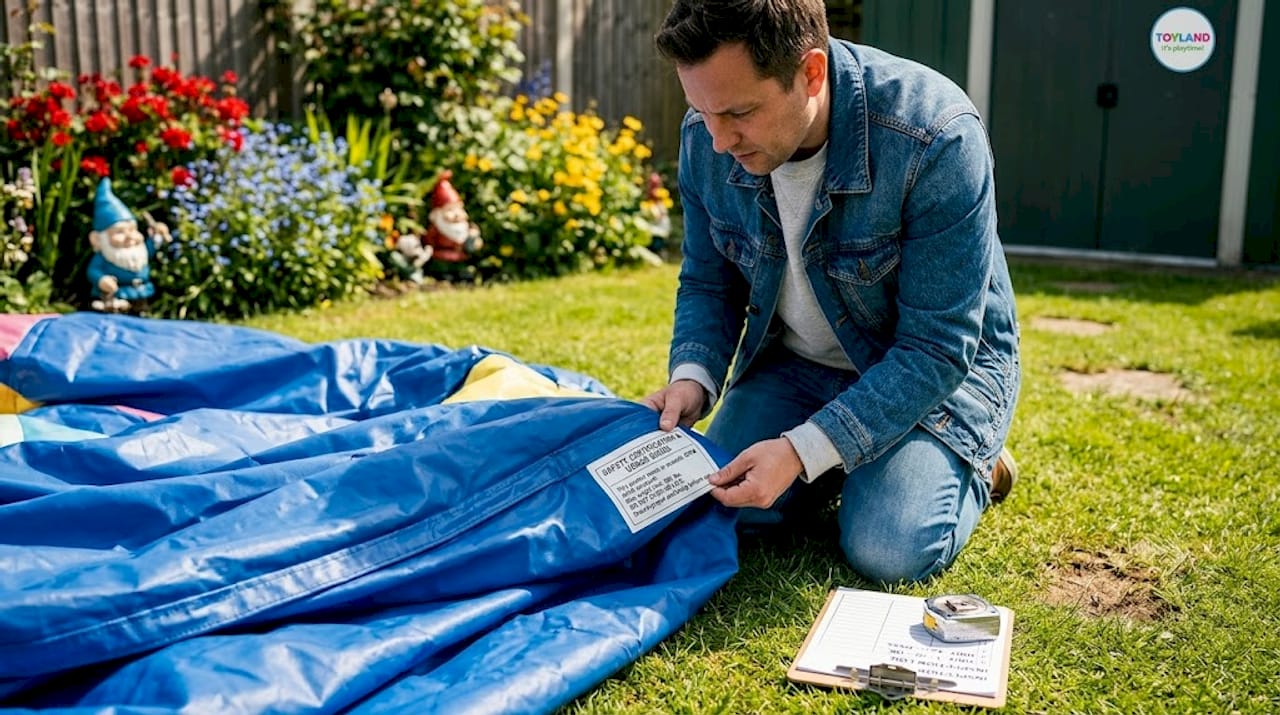
Pro Tip: Write down your three numbers (footprint, youngest age, max users) before you talk to any rental company or open any product page. Vendors who pressure you to skip any of these details are not worth your business.
Choosing the right size, capacity, and features
Once you know your space and guest profile, matching a unit to them becomes straightforward. The table below gives you a practical starting point.
| Size | Dimensions (approx.) | Max simultaneous users | Best age range |
|---|---|---|---|
| Small | 10x10 ft | 4 to 6 children | 3 to 7 years |
| Medium | 13x13 ft | 6 to 8 children | 5 to 10 years |
| Large | 15x15 ft or bigger | 8 to 12 children | 7 to 12 years |
| Combo (slide/obstacle) | 18x18 ft or bigger | 6 to 10 children | 6 to 12 years |
One mistake parents make repeatedly: they rent the biggest unit they can find, then let 20 kids pile in at once. The most frequent cause of bounce house injuries is not equipment failure. It is mixing children of significantly different sizes and weights inside the same unit at the same time. A 10-year-old and a 4-year-old bouncing together is genuinely dangerous.
Features: slides, obstacles, and themes
Combo units with slides and obstacle courses add excitement, but they also add footprint, setup time, and complexity. A slide attached to the unit requires extra lateral clearance, and the entry and exit points become chokepoints when multiple kids try to use them simultaneously. Themed designs are mostly cosmetic, but some premium themed units use heavier materials that affect inflation time and blower requirements.
If your group spans a wide age range, consider renting two smaller units rather than one large combo. It costs more upfront but reduces collision risk considerably and gives younger kids a space they can actually use safely.
Material quality and safety certifications
This is where most parents do not spend enough time. The bouncy house market is full of units that look identical in photos but perform very differently in real use.
What the materials actually tell you
The best bounce houses use PVC-coated polyester rather than vinyl-only construction. PVC-coated polyester is more resistant to UV degradation, holds up better under repeated inflation cycles, and resists tearing at stress points. Look for a minimum thickness of 13 to 18 ounces per square yard for residential units, and 18 ounces or more for anything used commercially.
Double-stitched, heat-welded seams with reinforced stress points significantly improve structural integrity compared to glue-bonded or single-stitched seams, which tend to fail after moderate use. Run your hand along the seams before accepting any rental unit. If a seam feels rough, uneven, or shows signs of previous patching, that is a warning sign.
Safety certifications you should actually verify
- ASTM F2374-23: The current American standard for inflatable amusement rides. This is the one to look for on any unit used in the U.S.
- EN14960: The European standard. Relevant if you are sourcing internationally or comparing specs.
- CPAI-84: A fire resistance standard for inflatables. Particularly relevant for indoor use or events in enclosed spaces.
Do not accept a vendor’s verbal claim that a unit “meets safety standards.” Ask to see the actual label sewn into the unit or request the test documentation. Professional-grade bounce houses include continuous air pressure monitoring that alerts users when inflation drops by more than 10%, a feature almost never found in consumer-grade units. That difference matters more than color or theme.
Pro Tip: Search the unit’s model number plus “ASTM test report” before you finalize any rental or purchase. Legitimate manufacturers make this documentation available.
Setup, anchoring, and maintenance
Even the best bouncy house becomes a liability if it is set up incorrectly. Follow these steps every single time.
-
Clear the site completely. Remove rocks, toys, sticks, and any sharp debris. Lay a tarp or foam pad if the ground is rough. Uneven ground causes the unit to lean, which stresses seams and throws bouncing kids off balance.
-
Use the correct power circuit. Operating a bounce house blower requires a dedicated 15-amp circuit. Long or inadequately gauged extension cords cause voltage drops that can overheat or burn out the motor. Run the shortest, heaviest-gauge cord possible. A 12-gauge cord is the minimum for most residential blowers.
-
Verify blower sizing. An undersized blower causes sagging and motor burnout. When checking blower specs, look at CFM at static pressure, not free-air rating, since the free-air number is always optimistic.
-
Anchor using ground stakes, not just sandbags. Proper stakes should be at least 18 inches deep, set at a 45-degree angle. Sandbags shift up to three times more than stakes during wind gusts and are not a reliable substitute in open areas.
-
Check wind speed before and during use. Stop use when sustained winds reach 20 mph or higher. Wind-related collapses are one of the most preventable causes of serious bounce house injuries. Keep a weather app open during outdoor events.
-
After the event, clean before storing. Wipe down interior surfaces, check for small punctures, and store the unit loosely rolled in a cool, dry space. Never store it tightly compressed in a hot garage. Heat degrades PVC over time and compression permanently creases the material, which weakens it at the fold lines.
Common mistakes and how to avoid them
Even well-intentioned parents trip over a short list of predictable errors. Here is what to watch for:
- Ignoring weight and age mixing. Putting big kids and small kids in the same unit at the same time is the leading cause of collision injuries. Run separate bounce sessions by age group if your party includes a wide range.
- Skipping the test inflation. Never accept a rental unit the morning of your event without testing it first. Set it up the day before. A blower problem or slow leak discovered at 7 a.m. on party day has no good solution.
- Trusting “no deposit” deals without reading the terms. Rental deposits typically range from 20% to 50%, and skipping them can mean stricter cancellation policies or surprise fees. Read every line of your rental contract.
- Skipping supervision. Bounce houses are statistically safe with injury rates around 0.3% when protocols are followed, but that number assumes an adult is actively watching at all times. Supervision is not optional.
- Choosing a unit based on appearance. Themes and colors sell units, not certifications and material specs. Always prioritize documented safety compliance and material quality over aesthetics.
If you want a broader breakdown of the bouncy house safety essentials every parent should know before the setup begins, Toylandeu has a dedicated guide that goes deep on supervision and rules.
My honest take as someone who has seen it go wrong
I have talked to enough parents after a bounce house incident to know that the regret is always the same: they trusted the price or the pictures instead of asking the right questions.
The flashy combo unit with the dual slide always looks incredible in the photos. What you do not see in those photos is the undersized blower that came with it, the single-stitched seams that gave out by mid-afternoon, or the six-foot section of slack in the tether because the stakes pulled out of soft soil. I have seen all of it.
My honest advice: spend 80% of your decision time on certifications, material specs, and your actual space measurements. Spend 20% on features. A plain, well-built, properly anchored 13x13 bounce house with an ASTM label will give your kids a safer and more enjoyable experience than a cheaper combo unit with vague compliance claims. You also want to review the 2026 bounce house safety tips to stay current on updated guidelines.
The parents who get this right are not the ones who researched the most themes. They are the ones who asked the vendor for the ASTM documentation and actually got it.
— Thane
Keep the fun going with Toylandeu
A bouncy house is a highlight, but a great kids’ party has layers. Once the bouncing winds down, having a creative activity ready keeps energy focused and kids genuinely engaged. Toylandeu offers a wide selection of hands-on creative kits designed for exactly this kind of moment: the post-bounce cooldown where you need something that holds attention without a screen.
The Montessori drawing kit is a proven hit for kids aged 3 to 8, with structured prompts that encourage independent creativity. For something with more color and sensory appeal, the clay modeling kit gives kids 24 colors to work with and zero mess anxiety for parents. Both ship internationally with free worldwide delivery. Browse Toylandeu’s full range of children’s learning kits to build a party day that lasts well beyond the bounce.
FAQ
How do I pick a bouncy house for a small backyard?
Measure your flat, usable space and subtract 3 to 5 feet of clearance on every side plus 15 to 18 feet of vertical clearance. A small 10x10 foot unit is typically the right fit for compact outdoor spaces.
Are bouncy houses safe for young children?
Children under 3 years old or shorter than 42 inches should not use standard bounce houses. With proper supervision and same-age grouping, injury rates stay around 0.3% for children who meet the age and size requirements.
What safety certifications should a bounce house have?
Look for ASTM F2374-23 on any unit used in the United States. Ask the vendor to show you the physical label on the unit or provide written test documentation before you accept delivery.
What is the best bouncy house size for a birthday party of 15 kids?
Plan for simultaneous use of no more than 8 to 10 kids at a time and rotate groups by age. A large 15x15 foot unit accommodates 8 to 12 children safely. Running two shorter sessions is safer than overcrowding one large unit.
Should I pay a deposit for a bounce house rental?
Yes. Rental deposits between 20% and 50% are standard and protect both parties. Skipping a deposit often comes with stricter cancellation terms or higher last-minute fees, so read the full contract before signing.