

Are Electric Water Guns Safe for Kids in 2026?
TL;DR:
- Electric water guns are safest for children aged 8 and above when they have tool-secured batteries, adhere to safety standards, and feature non-realistic designs to prevent confusion with firearms. Parental supervision and proper maintenance, such as emptying tanks and avoiding exposure to direct sunlight, are essential for safe play. Choosing certified models and age-appropriate features minimizes risks related to batteries, material quality, and legal issues.
Electric water guns have exploded in popularity, and with that surge comes a surge in parental worry. If you’re wondering whether electric water guns are safe for your child, you are not alone. Parents across the country are asking the same question, and the answer is genuinely nuanced. Some models are thoughtfully designed with real safety protections built in. Others cut corners in ways that create real hazards, including battery risks, physical injury, and even troubling legal situations. This guide cuts through the noise and gives you exactly what you need to make a smart, safe choice for your family.
Table of Contents
- Key Takeaways
- Are Electric Water Guns Safe? Understanding the Risks
- Safety standards and certification explained
- Age-appropriate use and safe play guidelines
- Electric vs. manual water guns: a practical comparison
- My take on electric water gun safety
- Safe outdoor toys at Toylandeu
- FAQ
Key Takeaways
| Point | Details |
|---|---|
| Battery safety is the top risk | Electric water guns must have tool-secured battery compartments to meet ASTM F963-23 standards and prevent ingestion hazards. |
| Realistic designs carry legal risk | Guns that look like real firearms have triggered police responses and legal charges, even when used by children. |
| Certification marks matter | Only buy models that comply with ASTM F963-23; uncertified toys skip safety testing entirely. |
| Age and size should guide your pick | Younger children need lighter, simpler models; electric water guns are generally better suited for ages 8 and up. |
| Maintenance prevents hidden hazards | Emptying tanks after use and storing guns away from sunlight prevents mold, cracked plastic, and sharp edges. |
Table of Contents
- Are electric water guns safe? Understanding the risks
- Safety standards and certification explained
- Age-appropriate use and safe play guidelines
- Electric vs. manual water guns: a practical comparison
- My take on electric water gun safety
- Safe outdoor toys at Toylandeu
- FAQ
Are Electric Water Guns Safe? Understanding the Risks
The short answer is yes, with the right model and the right supervision. But that qualifier carries real weight. The safety of electric water guns depends on three factors that parents often underestimate: battery design, the gun’s appearance, and material quality.
Battery hazards are real
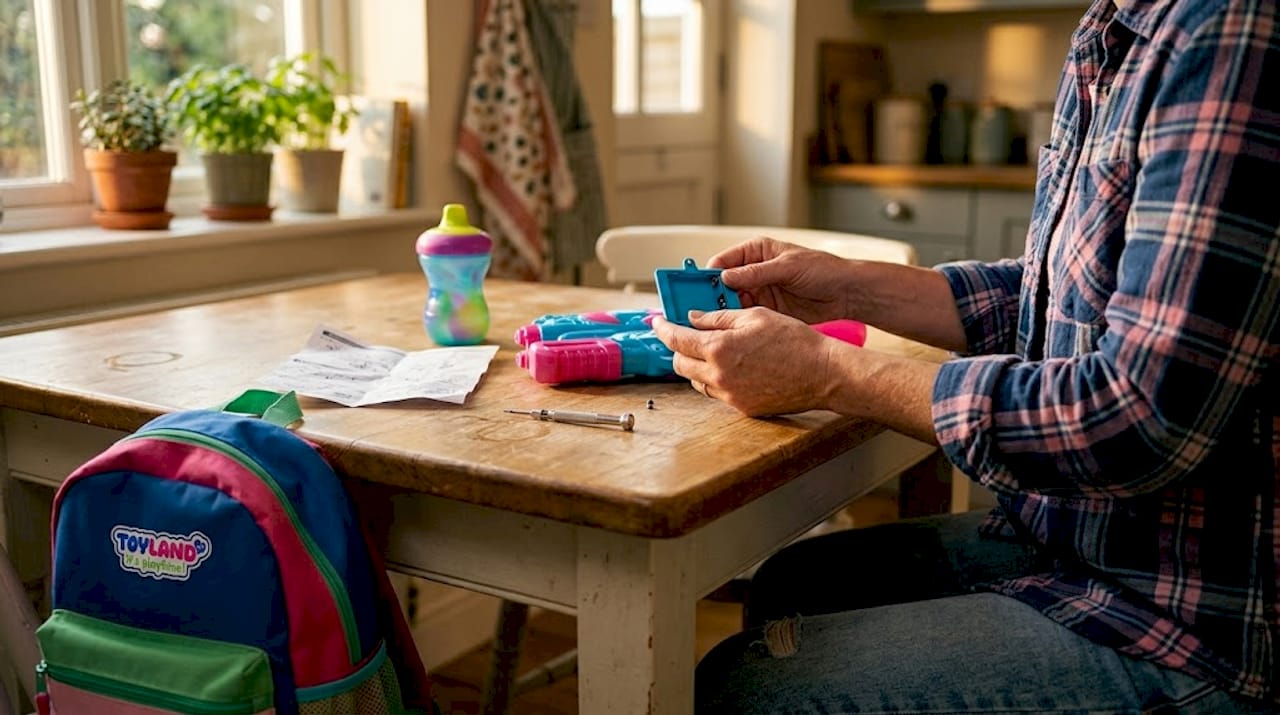
Electric water guns run on batteries, which introduces risks that simple pump water guns do not have. The most serious concern is battery ingestion. Small batteries, particularly button cells, are extremely dangerous if swallowed by young children. Battery compartments must require a tool to open, which is a hard requirement under ASTM F963-23. Any model where a child can pop open the battery door with their fingers fails this baseline standard.
Beyond ingestion, overheating is a genuine concern. ASTM F963-23 demands testing to verify toys do not experience thermal runaway in battery or motor stall conditions. Cheap, uncertified models skip this testing entirely.
Pro Tip: Before buying any electric water gun, flip it over and check the battery compartment. If it opens without a screwdriver, put it back on the shelf.
The appearance problem
This one surprises many parents. Realistic-looking water guns have triggered genuine emergencies. A high school senior in Indiana was charged with felony intimidation after police mistook a realistic water gun for a real firearm. That is not a rare edge case. It is part of a documented pattern.
Federal law requires blaze orange tips on realistic models, but dark colors, realistic shapes, and firearm-like sizes still create dangerous confusion. A child carrying a realistic-looking water gun in public puts themselves and others at risk in ways that have nothing to do with water.
Material quality and physical injury risk
Not all plastics are created equal. ABS plastic degrades with UV exposure, causing cracks and sharp edges that can cut children’s hands. Exposed metal components on budget models can corrode and create hazards over time. A water gun that feels solid in April may become genuinely dangerous by August if it’s made with low-grade materials.
Here is a quick checklist of electric water gun hazards to watch for:
- Battery compartment that opens without tools
- Realistic firearm appearance with dark or black coloring
- Thin or brittle plastic that cracks under normal play stress
- No visible certification marks (ASTM, CE, or equivalent)
- Water pellet functionality, which is illegal in several cities including Lincoln, Nebraska
Safety standards and certification explained
Understanding the regulatory framework is one of the most useful things you can do as a parent. The U.S. mandatory toy safety standard, ASTM F963-23, took effect in April 2024. Any toy sold legally in the U.S. market must comply with it.
Here is what that standard actually requires for electric water guns:
| Requirement | What it means for your child |
|---|---|
| Tool-secured battery doors | Children cannot access batteries without an adult’s help |
| Impact and drop testing | The toy must not shatter into sharp pieces under normal play |
| Thermal runaway prevention | The motor and battery must not overheat during use or stall |
| Mechanical hazard testing | No pinch points, sharp edges, or entanglement risks |
| Chemical content limits | Plastics and paints must meet toxicity thresholds |
Compliant products are tested to withstand rough handling, accidental drops, and extended use without creating new hazards. Uncertified models, often sold at very low prices through unverified online marketplaces, skip all of this.
The U.S. Consumer Product Safety Commission has also been expanding its scope. Their new federal water beads safety standard targeting expansion bead hazards shows how regulations continue to evolve in response to real-world injuries. If you are considering a water gun that uses any type of gel bead or expanding pellet, that category carries its own set of serious risks.
Pro Tip: Look for “ASTM F963” printed on the packaging or product label. If you cannot find it, ask the retailer for documentation or shop from vendors who make compliance visible and easy to verify.
For a broader look at toy material safety, Toylandeu has a practical parent-focused guide worth reading before any toy purchase.
Age-appropriate use and safe play guidelines
Electric water guns are not universally appropriate for all ages. The rule of thumb used by most safety experts: manual squirt guns work well from ages 3 and up with supervision, while electric models are generally better suited for children 8 and older.
The reason comes down to two things. First, electric models are heavier due to the battery pack and motor. A full tank on a large electric gun can weigh two to three pounds, which is a lot for a five-year-old to control safely. Second, the higher water pressure some electric models generate can sting when aimed at close range, particularly at eyes or ears.
Choosing the right model for your child’s age involves a few considerations:
- For ages 6 to 8: Look for lightweight electric models with smaller tanks (under 400ml). Avoid guns with continuous fire modes, which can overwhelm younger children and lead to misuse.
- For ages 8 to 12: Most mid-range electric water guns suit this group well. Pay attention to ergonomics. The grip should feel secure in your child’s hand, not oversized.
- For teens and adults: Higher-capacity electric guns with longer range are appropriate. This is also the group most likely to encounter the realistic-appearance problem, so stick to brightly colored designs.
Supervision rules make a big difference regardless of age. Set clear boundaries: no aiming at faces, no shooting at non-participants, and no use near electrical outlets or electronics. These are not overprotective rules. They are the practical basics.
For storage and maintenance, emptying and drying tanks after every use prevents mold growth inside the reservoir, and keeping guns out of direct sunlight stops the plastic from becoming brittle and cracking. A little care goes a long way toward keeping the toy safe across an entire summer.
For a curated look at age-matched picks, check Toylandeu’s guide to best safe water guns for 2026.
Electric vs. manual water guns: a practical comparison
Parents sometimes assume electric models are strictly superior. The truth is more interesting. Each type has clear strengths and real weaknesses that make them better suited to different situations.
Electric models eliminate pump fatigue, which is a genuine advantage for older kids who want sustained play without physically tiring out. The motor delivers a consistent stream at the same pressure shot after shot. For backyard battles lasting an hour or more, that consistency matters.
But electric models introduce failure points that manual guns simply do not have. Battery charging, moisture exposure, and motor corrosion are all real concerns. Drop a manual water gun in a pool. No problem. Drop an electric one in a pool and you may have a ruined toy and a safety concern. Sealed electric units that cannot be repaired are particularly wasteful when they fail, and they do eventually fail.
Manual water guns are heavier to operate in terms of physical effort, but they are simpler, lighter, and nearly indestructible under normal play. A five-dollar pump squirt gun can outlast a forty-dollar electric model if the electric one is poorly sealed.
| Feature | Electric water gun | Manual water gun |
|---|---|---|
| Ease of use | High, no pumping required | Moderate, requires repetitive pumping |
| Battery risk | Present, requires managed care | None |
| Moisture damage risk | Higher, motor can corrode | Low, fully waterproof by design |
| Repairability | Low on sealed units | High, minimal moving parts |
| Best age range | 8 and up | 3 and up with supervision |
| Cost over time | Higher due to batteries and parts | Lower, very durable |
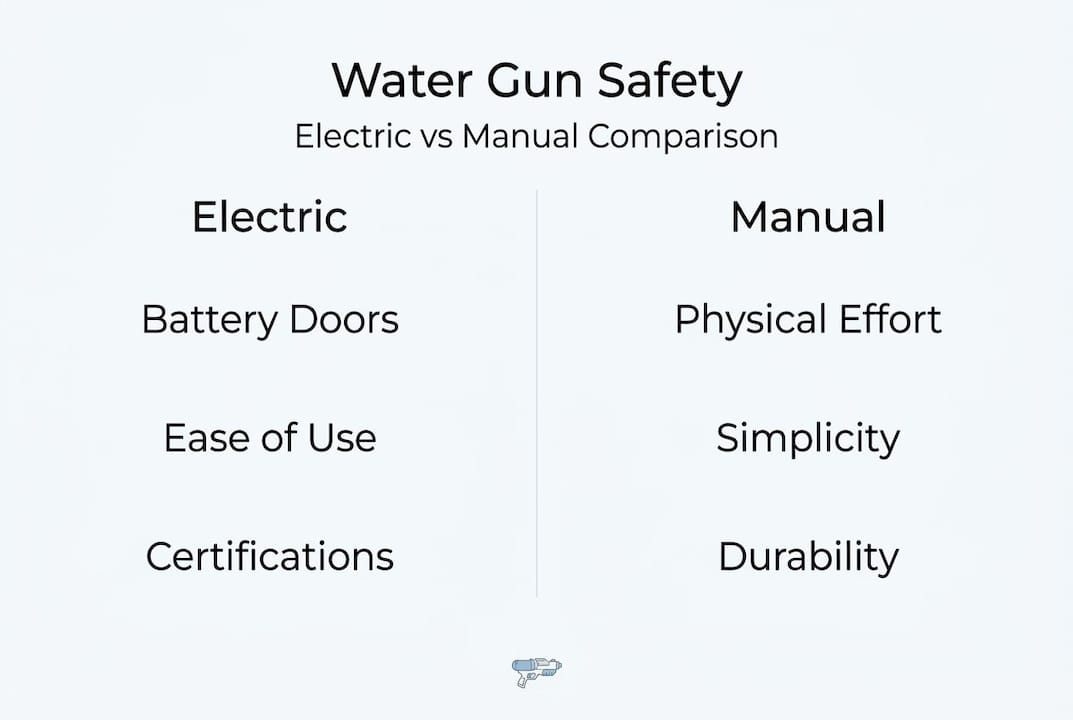
The verdict is not that one type is safer than the other in absolute terms. Manual guns suit younger children and casual play. Electric models suit older kids who want a more immersive experience, provided you choose a certified, well-built model.
My take on electric water gun safety
I’ve spent a lot of time looking at how parents approach toy safety decisions, and electric water guns consistently sit in a blind spot. Most parents focus on age labels on packaging and stop there. That is not enough with electric toys.
What I’ve found actually matters, beyond the label, is the battery compartment. Parents overlook this one detail more than any other, and it is arguably the highest single risk in any battery-powered toy designed for outdoor wet play. Water and batteries are a bad combination. If that compartment is not properly sealed and tool-secured, you are introducing a hazard that the fun factor does not justify.
I’ve also seen parents underestimate the realistic appearance issue. It is easy to dismiss as an edge case until you read about what happened to that teenager in Indiana. My honest recommendation is to avoid any water gun that a reasonable adult might mistake for a real firearm, regardless of how cool it looks. Bright colors are not just for little kids. They are a practical safety feature.
The best purchases I’ve seen parents make are informed ones. They read the electric water gun safety guide before buying, they check for ASTM compliance, and they set play rules before handing the toy over. That combination, not any single product feature, is what actually keeps kids safe.
Buy thoughtfully, supervise early, and revisit the rules as your child grows. The toy that is safe at eight may need new boundaries at twelve.
— Thane
Safe outdoor toys at Toylandeu
Toylandeu carries a wide range of outdoor toys built with safety and fun in mind, and the team vets products for compliance with recognized safety standards before listing them. If you are shopping for a water gun or any summer outdoor toy, that filtering process saves you the guesswork.

Beyond water toys, Toylandeu’s catalog includes options for kids who love fast-moving outdoor play. The RC gesture-controlled stunt car is a standout pick for kids ages 8 and up who want something exciting that also builds coordination. For families who want an outdoor toy with educational depth, the STEM robotics car kit introduces real programming concepts through hands-on play. Both ship internationally with Toylandeu’s free worldwide shipping policy, making it easy to find vetted, age-appropriate toys wherever you are.
FAQ
Are electric water guns safe for young children?
Electric water guns are generally safer for children aged 8 and up. Younger children face risks from heavier designs, higher water pressure, and battery compartment hazards that do not apply to simple pump models.
What makes an electric water gun ASTM compliant?
ASTM F963-23 requires tool-secured battery compartments, impact testing, and thermal runaway prevention. A compliant model must pass all of these tests before it can be legally sold in the U.S.
Can realistic-looking water guns cause legal problems?
Yes. A realistic water gun led to felony intimidation charges in Indiana when police could not distinguish it from a real firearm. Always choose brightly colored, clearly toy-like designs.
Are water pellet guns the same as water guns?
No. Water pellet guns that shoot gel beads or expanding pellets are a separate category. They are illegal within some city limits due to injury risks. Standard water guns that shoot only water are distinct and legal everywhere.
How do I maintain an electric water gun to keep it safe?
Empty and dry the tank after every use, store it away from direct sunlight, and never submerge the battery compartment in water. These steps prevent mold, brittle plastic, and electrical damage.