

Why Collect Vintage Toys: Nostalgia, Culture, and Value
TL;DR:
- Vintage toy collecting is driven by nostalgia, cultural preservation, and market growth, attracting a wider audience beyond enthusiasts. Collectors focus on authenticity, provenance, and condition, with the secondhand market expanding rapidly and maintaining stability through emotional and cultural values. Building a collection around personal memories and knowledge ensures long-term enjoyment and potential financial stability.
Collecting vintage toys is defined as the deliberate acquisition and preservation of playthings from past decades for emotional, cultural, or financial reasons. The practice has moved well beyond hobbyist circles. Collectibles grew 32% globally in 2025, driven by adult buyers and licensed franchises like Pokémon and Star Wars. That growth signals something real: why collect vintage toys is no longer a question only enthusiasts ask. It is a question the broader market is answering with its wallet.
Quick Summary
Vintage toy collecting is motivated by three interlocking forces: nostalgia and emotional memory, cultural preservation, and financial value. The secondhand toy market grew 14% in 2025, adult “kidult” buyers now represent nearly 30% of global toy purchases, and institutions like the National Museum of Toys and Miniatures actively seek 1980s pieces for cultural exhibits. Whether you are starting your first collection or deepening an existing one, the motivations are well-supported by data and lived experience.
TL;DR
- Nostalgia and emotional memory are the primary drivers of vintage toy collecting.
- Vintage toys serve as cultural artifacts that document social history.
- Condition, original packaging, and provenance determine real market value.
- The secondhand toy market is growing fast and attracting mainstream buyers.
- Community, display, and intergenerational sharing add lasting personal value.
Table of Contents
- Why collect vintage toys: the core motivations
- Cultural significance and storytelling
- Financial value and market dynamics
- Benefits beyond ownership
- Key Takeaways
- Perspective
- Explore Toylandeu’s collectible range
- FAQ
Why Collect Vintage Toys: Nostalgia, Memory, and Community
Nostalgia is the single most documented reason adults pursue vintage toy collecting. Adult “kidult” buyers make up nearly 30% of toy buyers globally, and emotional connection is the primary driver of that spending. This is not passive sentimentality. It is an active psychological process where physical objects reconnect adults to formative experiences.
The psychology is straightforward. Holding a 1984 Kenner Star Wars figure or an original My Little Pony from Hasbro triggers the same neural pathways associated with positive childhood memory. Collectors describe it as a form of emotional grounding, a way to access joy that modern life rarely replicates. That feeling is not accidental. It is why vintage toy demand is emotionally driven rather than speculative, unlike modern collectibles that spike and crash on hype cycles.
Pop culture franchise reboots amplify this effect. When Mattel relaunches Masters of the Universe or when a new Transformers film arrives, demand for original 1980s pieces spikes. Collectors who already own those pieces benefit financially. New collectors enter the market chasing the emotional connection the reboot reactivated. The cycle sustains itself.
Community is the underrated benefit here. Collector groups on platforms like Reddit, Facebook, and dedicated forums such as the Vintage Toy Chest create spaces where shared fandom becomes social identity. Members trade knowledge on authentication, restoration, and sourcing. That social layer transforms a solitary hobby into a shared cultural practice.
- Nostalgia reconnects adults to specific, joyful periods of their lives.
- Franchise reboots from studios like Lucasfilm and Hasbro regularly refresh collector interest.
- Online communities provide authentication knowledge and sourcing networks.
- Emotional handover between generations sustains collecting across age groups, as parents reintroduce franchises to children.
Pro Tip: Start your collection with one franchise or era you genuinely loved as a child. Focused collections are easier to research, authenticate, and display than broad accumulations.
How vintage toys preserve cultural history
Vintage toys are cultural artifacts. They document what children were taught to value, fear, and aspire to in specific decades. A 1960s GI Joe reflects Cold War masculinity. A 1980s Strawberry Shortcake doll captures a specific aesthetic and marketing philosophy aimed at girls. These objects tell stories that written history often misses.
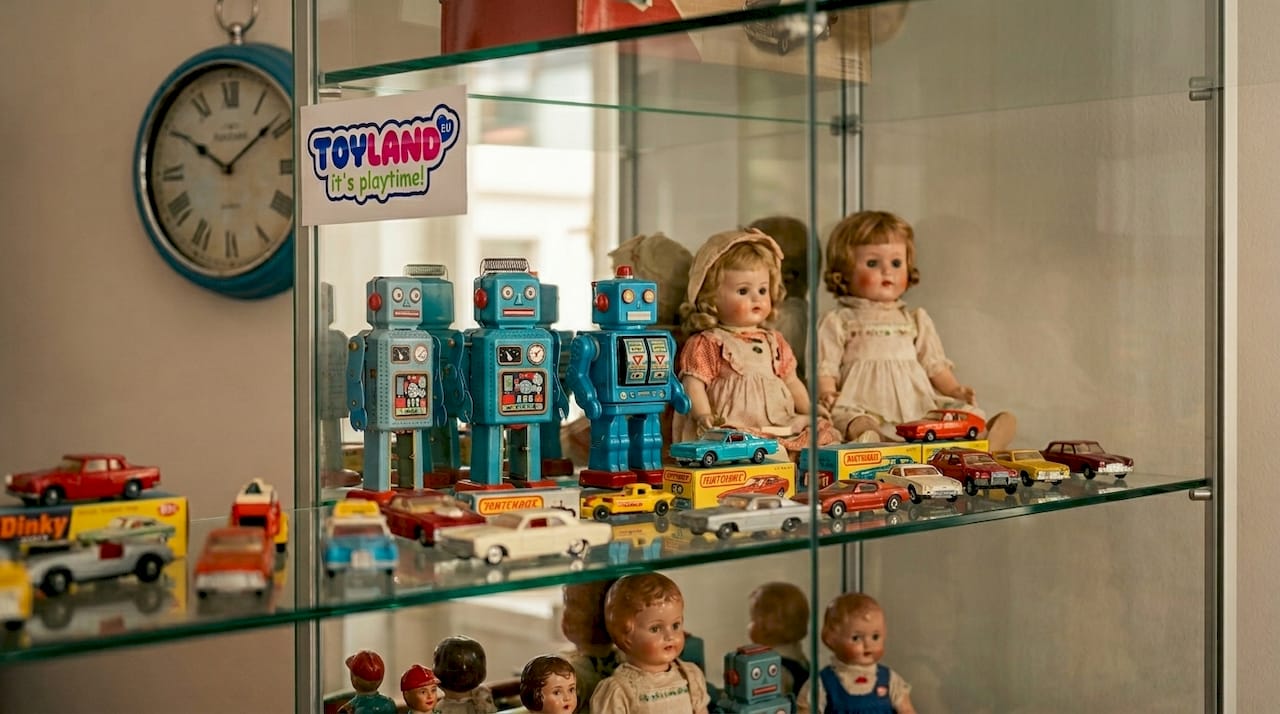
The institutional world recognizes this. The National Museum of Toys and Miniatures is actively seeking 1980s toys for a 2027 exhibit focused on cultural and pop-culture significance. The museum requests photographs, provenance documentation, and maker’s marks. That request is a direct acknowledgment that private collectors are the primary custodians of this material history.
Here is what makes a toy culturally significant beyond personal sentiment:
- Era specificity. The toy must be clearly tied to a documented period of social or pop culture history.
- Provenance. Knowing where the toy came from, who owned it, and how it was used adds narrative depth that museums and serious collectors prize.
- Maker’s marks and documentation. Original boxes, instruction sheets, and manufacturer stamps authenticate both origin and era.
- Condition relative to use. A played-with toy tells a different story than a mint example. Both have cultural value, but for different reasons.
- Franchise or cultural connection. Toys tied to films, television programs, or social movements carry broader interpretive weight.
“Museums seek toys with photos, maker’s marks, and backstory to enrich narratives about childhood and pop culture.” — National Museum of Toys and Miniatures
Collectors who document their pieces carefully are not just protecting financial value. They are performing a genuine act of cultural stewardship. The best retro toys from the 1980s are already being studied as primary sources for understanding that decade’s consumer culture.
What determines vintage toy collection value?
Vintage toy collection value is determined by condition, completeness, provenance, and market demand. Not sentiment. Not franchise popularity alone. The market is more disciplined than most beginners expect.
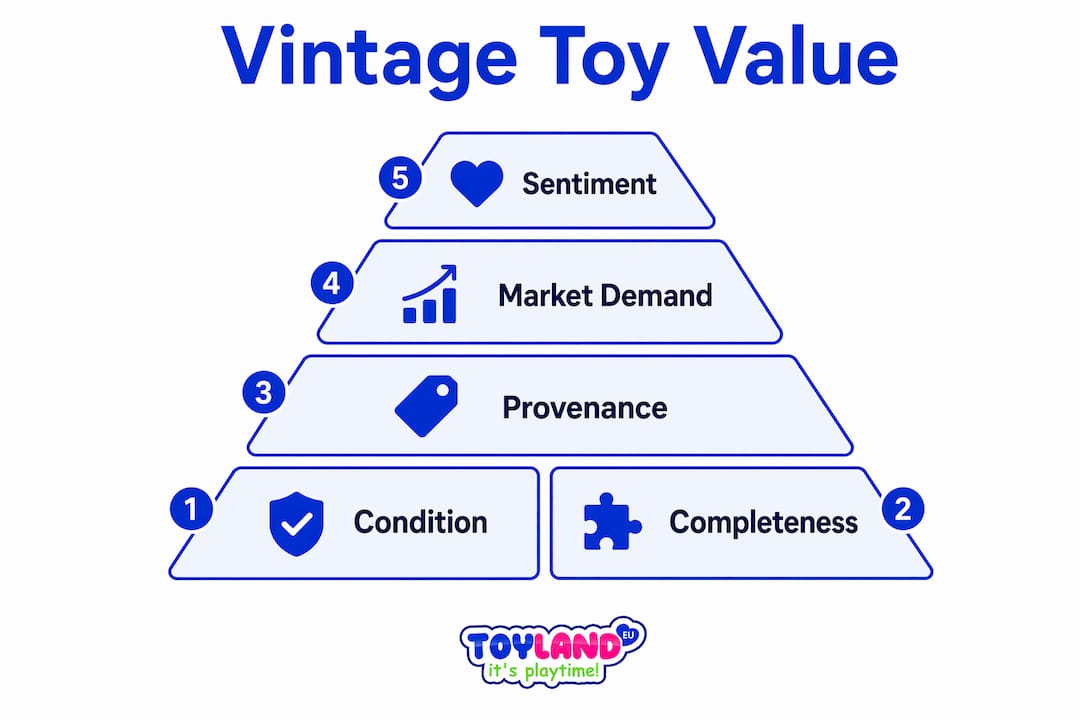
| Factor | High value | Lower value |
|---|---|---|
| Condition | Mint, unplayed, original packaging (NOS) | Played, missing parts, no box |
| Completeness | All accessories, instructions included | Incomplete set, no documentation |
| Provenance | Documented history, receipts, photos | Unknown origin |
| Market demand | Active buyer pool, recent sold prices | Niche interest, few active buyers |
New old stock (NOS) items command premium prices, but final value depends on market demand, not just condition. A mint-in-box toy from an obscure 1970s line may sell for less than a played-with example from a franchise with an active collector base. This surprises new collectors who assume pristine condition automatically equals high value.
The secondhand market is growing fast. Secondhand toy sales grew 14% in 2025, now accounting for 7.3% of total global toy and game sales. That growth reflects mainstream acceptance of vintage toy collecting as an economic activity, not just a hobby. Platforms like eBay, Mercari, and specialized auction houses such as Hake’s Auctions provide transparent price discovery.
Pro Tip: Always assess value using completed sold listings on eBay, not asking prices. Asking prices reflect hope. Sold prices reflect reality. The gap between the two is often significant for vintage toys.
Missing parts or lack of provenance can reduce market interest even when the franchise is popular. Collectors who want to invest in vintage toys should prioritize storage in acid-free materials, avoid direct sunlight, and photograph every piece with its documentation before acquiring it.
Benefits beyond ownership: community, display, and fulfillment
The benefits of vintage toy collecting extend well past the objects themselves. Collectors consistently report that the hobby delivers social connection, creative expression, and emotional well-being in ways that passive consumption cannot replicate.
- Community belonging. Collector clubs, conventions like Toy Fair and San Diego Comic-Con, and online forums create genuine social networks built around shared knowledge and enthusiasm.
- Display creativity. Curating and displaying a toy collection is a form of visual storytelling. Collectors design themed shelves, dioramas, and shadow boxes that transform objects into personal galleries.
- Emotional well-being. Meaningful hobbies with clear goals, such as completing a set or finding a specific variant, provide structure and satisfaction that supports mental health.
- Intergenerational connection. Sharing a collection with children or grandchildren creates a bridge between personal history and present relationships. It turns objects into conversations. Toys that make great gifts often carry this dual function, serving both the collector and the next generation.
The joy factor that drives collectibles growth globally is not abstract. It is the sum of these specific, tangible benefits that collectors experience daily.
Key Takeaways
Vintage toy collecting delivers lasting value when nostalgia, cultural awareness, and market discipline work together.
| Point | Details |
|---|---|
| Nostalgia drives demand | Emotional memory sustains collector interest and market pricing over decades. |
| Cultural value is documentable | Provenance, maker’s marks, and era context transform toys into historical artifacts. |
| Condition determines price | NOS items command premiums, but sold prices on active markets set real value. |
| The market is growing | Secondhand toy sales grew 14% in 2025, reflecting mainstream economic viability. |
| Community multiplies enjoyment | Collector networks, display creativity, and intergenerational sharing extend the hobby’s rewards. |
Why I think most beginners get vintage toy collecting backwards
Most people who start collecting vintage toys focus on financial return first and emotional connection second. That is the wrong order, and it usually leads to poor decisions. I have watched collectors buy mint-in-box pieces from franchises they have no personal connection to, chasing price appreciation, only to sell at a loss when the hype cycle fades.
The collectors who build genuinely valuable collections, financially and personally, start with what they loved. They learn the market for that specific category deeply before expanding. A collector who grew up with 1980s Kenner action figures and spends two years understanding that market will consistently outperform someone who scans trending lists and buys broadly.
The collectibles and blind-box boom among Gen Z and Millennials shows that emotional connection is not a weakness in a collector. It is the foundation of sustained interest. Markets reward patience and knowledge. Both come more naturally when you genuinely care about what you are collecting.
My advice for 2026: pick one era, one franchise, or one toy type. Learn it completely. Then decide whether the financial case supports deeper investment. That sequence protects you from expensive mistakes and keeps the hobby enjoyable for the long term.
— Thane
Start your collection with Toylandeu
Toylandeu carries over 30,000 toy products, from retro-inspired designs to modern collectibles that bridge generations of play. Whether you are building a display collection or searching for a piece that sparks a specific memory, the catalog covers remote-controlled vehicles, action figures, STEM kits, and more, all with free worldwide shipping. The RC Gesture-Controlled Stunt Car is a strong example of how modern toy engineering captures the same sense of wonder that made vintage RC toys collector favorites in the 1980s. Toylandeu ships globally, supports multiple currencies, and makes it straightforward to find toys that matter, whether you are buying for a collection or passing something meaningful to the next generation.
FAQ
Why do people collect vintage toys?
People collect vintage toys primarily for nostalgia, cultural significance, and financial value. Adult “kidult” buyers now represent nearly 30% of global toy purchases, with emotional connection cited as the leading motivation.
How do I start a toy collection on a budget?
Start with one specific franchise or era you know well, and buy played-with examples rather than mint pieces. Sold listings on eBay provide accurate price benchmarks so you avoid overpaying at the beginning.
What makes a vintage toy valuable?
Condition, completeness, provenance, and active market demand determine vintage toy value. New old stock items in original packaging command the highest prices, but a popular franchise with an active buyer pool often outweighs pristine condition alone.
Are vintage toys a good investment?
Vintage toy demand is steady and emotionally driven rather than speculative, which makes it more stable than modern collectibles. The secondhand toy market grew 14% in 2025, signaling real economic momentum rather than short-term hype.
How do I preserve vintage toys for long-term value?
Store pieces in acid-free materials away from direct sunlight, keep original packaging and documentation intact, and photograph every item with its provenance details. Complete sets with original packaging dramatically increase market value over time.
Recommended
- Why toys make great gifts: fun, learning, memories – ToylandEU
- Why Collectibles & Blind-Box Toys Are Trending with Gen Z & Millennials in 2025 – ToylandEU
- Blast from the Past: Top Retro Toys from the 1980s! – ToylandEU
- Top Retro 90s Toys That Still Rock in 2025 | Nostalgia & Collectibles – ToylandEU