

1C ≈ 1 Hour: RC Battery Charging Time for Hobbyists
Most RC packs charge at about 1C, which means roughly one hour per pack, plus 10 to 20 percent overhead for balancing and inefficiency. A typical LiPo balance charge lands somewhere between 30 and 75 minutes depending on pack size and rate, while a NiMH pack on a fast charger usually takes 60 to 90 minutes. Set your charger to the correct chemistry mode, match the cell count, and use the balance lead every time. That combination gets you a safe, predictable charge no matter what pack you’re running.
TL;DR:
- Charging a 1C lithium polymer pack typically takes about 60 to 75 minutes, including overhead for balancing and inefficiencies.
- NiMH packs require 60 to 90 minutes for fast charging at 0.5C to 1C, with trickle charging taking up to 16 hours.
- Using a charger with proper chemistry mode, correct cell count, and balance function reduces risks and ensures predictable charging times.
- Cold weather, aging packs, and cell imbalance can extend charge times beyond the typical estimates.
- Regularly monitoring capacity and pack condition helps detect wear and avoid safety risks from damaged or over-aged batteries.
Table of Contents
- How to Calculate RC Battery Charging Time Yourself
- Typical Charge Times by Battery Chemistry
- LiPo Charging Rules That Actually Matter
- NiMH and NiCd Charging: What’s Different
- Choosing a Charger and Getting the Settings Right
- Your Charging Routine and How to Fix a Slow Charge
- What I’ve Learned About Charging Trade-offs in the Field
- Rechargeable RC models and battery options are widely available from various sellers.
- Sources
- FAQ
How to Calculate RC Battery Charging Time Yourself
Forget guessing. The math behind charge time is simple enough to do in your head at the field.
First, convert your pack’s capacity from milliamp-hours to amp-hours by dividing by 1,000. A 2200 mAh pack becomes 2.2 Ah. A 5000 mAh pack becomes 5 Ah. From there, the formula for charge time is capacity in Ah divided by charge current in amps, which gives you hours. Add 10 to 20 percent on top for balancing and normal charger inefficiency, since real-world charging never hits the theoretical number exactly.
Here’s how that plays out with a few common packs:
- 2200 mAh pack at 1C (2.2A): roughly 1 hour, closer to 65 to 70 minutes with overhead.
- 5000 mAh pack at 1C (5A): about 1 hour in theory, but expect 65 to 75 minutes in practice once you factor in balancing.
- 5000 mAh pack at 2C (10A): roughly 30 minutes, but this trades speed for cell wear over time.
C-rate is just a multiplier on that base current. 1C means “charge at a rate equal to the pack’s capacity.” 2C doubles that current and roughly halves the time. Charge new packs at 1C for their first 20 to 30 cycles before experimenting with faster rates.
Typical Charge Times by Battery Chemistry
Charge time depends heavily on what’s inside the pack. LiPo, NiMH, and NiCd chemistries behave differently under load and expect different charger settings.
| Chemistry | Typical rate | Approximate charge time | Notes |
|---|---|---|---|
| LiPo | 1C balance charge | 60 to 75 minutes | 2200 mAh pack at 1C ≈ 1 hour before overhead |
| LiPo | 2C to 3C | 20 to 40 minutes | Occasional use only on rated packs |
| NiMH | 0.5C to 1C fast charge | 60 to 90 minutes | Uses delta-peak detection to cut off |
| NiMH | 0.1C trickle | 14 to 16 hours | Overnight charging, gentler on cells |
| NiCd | 0.5C to 1C with delta-peak | 60 to 90 minutes | Older chemistry, still found in some vintage packs |
A few things push those numbers around in the real world:
- Cold weather slows chemical reactions inside the cells, extending charge time.
- Aged packs with higher internal resistance take longer and run warmer while charging.
- Heavy cell imbalance forces the charger to spend extra time correcting individual cells before it can finish.
None of these factors are dramatic on their own, but stack two or three together at a winter bash and your “one hour” charge can stretch past 90 minutes.
LiPo Charging Rules That Actually Matter
LiPo packs deliver the power RC hobbyists want, but they punish carelessness. A few non-negotiable habits keep your packs safe and your charge times predictable.
- Balance charge every single cycle. The balance lead lets your charger read and correct each cell’s voltage individually, preventing one weak cell from being overcharged while the others sit undercharged.
- Max charge voltage is 4.20V per cell. Going higher risks swelling, venting, or worse.
- Storage voltage is 3.80 to 3.85V per cell. If you won’t fly or drive a pack for more than a day or two, put it in storage mode instead of leaving it fully charged.
- 1C is the baseline rate. Going to 2C or 3C occasionally on a rated pack is fine for race-day prep, but stay below 5C for anything outside a controlled competition setting.
Pro Tip: Keep a small logbook or spreadsheet of returned mAh after each charge. A pack that consistently returns far less than its rated capacity is telling you it’s wearing out, sometimes before it shows any visible damage.
NiMH and NiCd Charging: What’s Different
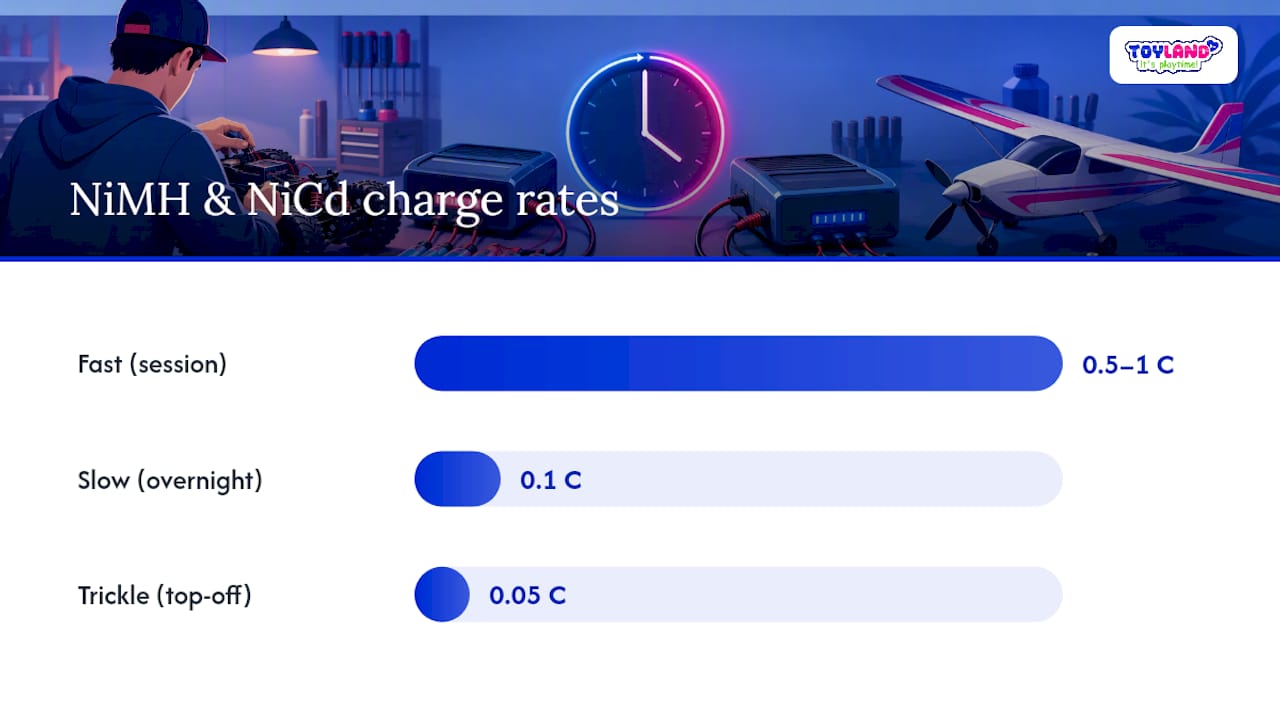
NiMH and NiCd packs are more forgiving than LiPo, but they still reward the right charger settings.
Both chemistries rely on delta-peak detection to know when they’re full. The charger watches for a small voltage drop after the pack peaks, then cuts the current automatically. That’s what makes fast charging at 0.5C to 1C safe for these chemistries without babysitting the process.
- Fast charge at 0.5C to 1C for a 60 to 90 minute session.
- Use a slow 0.1C rate for overnight charging when you’re not in a hurry.
- Trickle charging at roughly 0.05C is fine for occasional top-offs, but don’t leave packs on trickle indefinitely.
- Watch for a pack that runs hot early in the charge or won’t hold a peak. Both are signs of aging cells.
NiMH and NiCd don’t need balance leads the way multi-cell LiPo packs do, which simplifies the charger setup considerably.
Choosing a Charger and Getting the Settings Right
A cheap wall-wart charger will bottleneck even a great battery. The charger and its power supply need to match your ambitions.
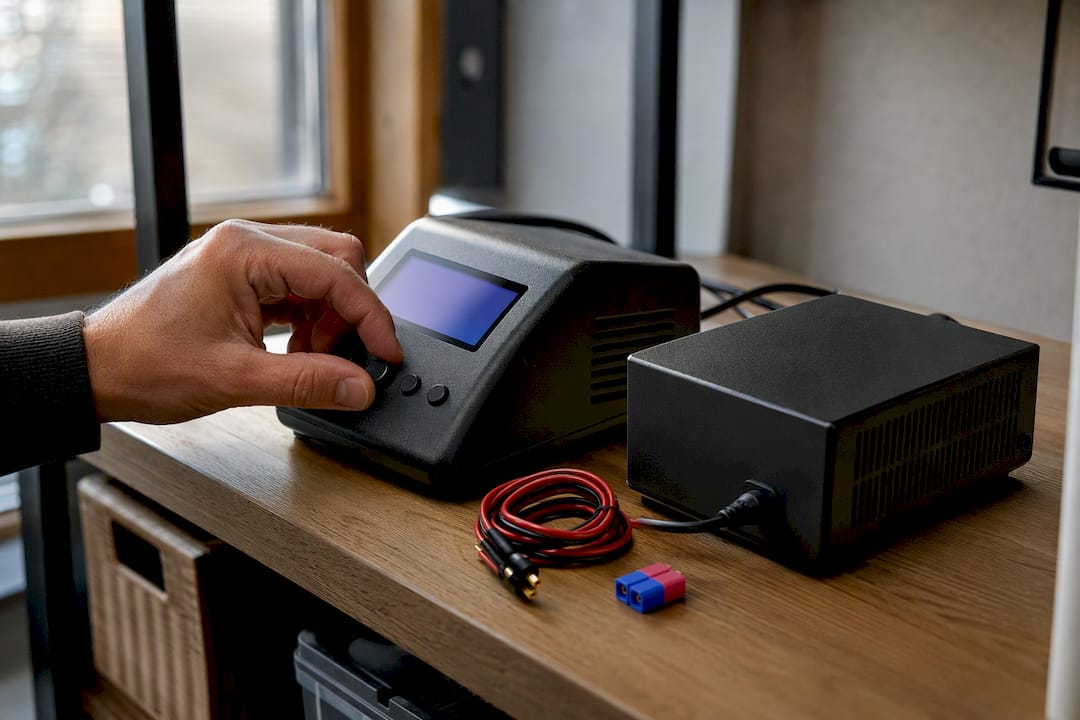
Look for a charger with balance charging, an accurate adjustable current setting, a mAh counter, and selectable cell count and chemistry modes. A charger capped at 50 watts simply can’t push 5A into a 5000 mAh pack no matter what you dial in, and a weak USB power source will throttle your charge time regardless of the charger’s rated output.
Setting one up correctly takes four steps:
- Select the chemistry mode (LiPo, NiMH, or NiCd) that matches your pack.
- Set the cell count so the charger knows how many cells it’s balancing.
- Enable balance charge mode for any multi-cell LiPo pack.
- Set the current to 1C, or your pack’s rated maximum if you’re intentionally charging faster.
Getting any one of those wrong doesn’t just slow the charge, it can trip a safety cutoff or, worse, damage the pack.
Your Charging Routine and How to Fix a Slow Charge
A consistent routine removes most of the guesswork from the process. Let packs cool to near room temperature before charging since a hot pack straight off the track charges less efficiently and more riskily. Inspect the pack and connectors, plug in the balance lead, set 1C, and monitor the first few minutes to confirm the charger reads the right cell count.
- Charger running slow? Check the power supply first. A weak PSU is the most common bottleneck.
- Pack won’t reach full voltage? Warm it to room temperature and retry.
- Balance never finishes? Inspect the balance lead and connector pins for corrosion or a loose pin.
- Suspect a worn pack? Compare returned mAh against rated capacity.
A pack that returns significantly less capacity than it’s rated for, or one that runs unusually hot, is nearing the end of its life. Retire any pack that shows swelling, a burnt smell, or visible leakage immediately. No charge time savings are worth the risk of pushing a damaged cell.
What I’ve Learned About Charging Trade-offs in the Field
I run packs at 1C for casual weekend sessions because slower charging means longer pack life, and there’s no deadline pressing on a Saturday afternoon at the park. Race day is different: I’ll accept 2C on rated packs to keep pit time short, but only on packs I trust. Rotating three or four packs and logging cycles beats fast-charging one pack over and over, and carrying a spare eliminates most of the pressure to push a charge rate you shouldn’t.
— Thane Holland
Rechargeable RC models and battery options are widely available from various sellers.
Once you’ve got the charging math down, the next question is usually what to charge. Many rechargeable RC models use packs that follow the same rules covered above, so the charge times you just calculated apply directly to what you buy.

Every product page lists battery specs and recommended charge rates, so you can match your charger settings before the box even arrives. If you’re shopping for a first RC vehicle or replacing a tired pack, the gesture-controlled stunt car is a solid entry point with a straightforward rechargeable setup, and the rechargeable off-road buggy works well for beginners who want something durable enough for regular field use. Check the listing for your model’s pack size, confirm your charger’s cell-count setting matches, and you’re ready to run.
Sources
- How to Charge RC LiPo Batteries (Beginner’s Guide) | So Dialed
- Beginners guide to LiPo batteries — FPVFC
- How Long Does a RC Car Battery Take to Charge? - RC Tech Tips
FAQ
How Do I Know When My RC Battery Is Fully Charged?
A quality charger with balance mode will stop automatically once every cell hits its target voltage, and most chargers show a “charge complete” indicator along with the total mAh returned.
How Long Should I Charge My RC Car Battery?
Most packs charged at 1C take about an hour, plus 10 to 20 percent overhead, so budget 65 to 75 minutes for a typical LiPo and 60 to 90 minutes for NiMH.
How Long Can I Leave an RC LiPo Battery Fully Charged?
Don’t leave a LiPo sitting at full charge for more than a day or two. Use storage mode to bring it down to 3.80 to 3.85V per cell if you won’t use it soon.
How Long Does It Take to Charge a 7.2 Volt RC Battery?
Charged at 0.5C to 1C, expect roughly 60 to 90 minutes depending on capacity and charger output.