

RC Range Explained: What It Means and How to Improve It
RC range is the practical, reliable control distance between your transmitter and receiver under real-world conditions. Not the theoretical maximum printed on a box. Not the distance a radio wave could travel in a vacuum. The number that matters is how far you can drive before your car stops responding predictably.
- Toy-grade RTR models typically deliver a usable range suitable for close indoor or backyard play, significantly shorter than hobby-grade systems.
- Hobby-grade 2.4 GHz systems routinely reach reliable control distances well over typical backyard ranges in open, unobstructed conditions, as reported by experienced hobbyists.
- Long-range sub-GHz systems (868/915/900 MHz) can reach multiple kilometers under ideal conditions, as discussed here.
- In the U.S., all RC transmitters must comply with FCC Radio Control Radio Service (RCRS) rules, which cap authorized emission bandwidth at 8 kHz and assign specific channels to surface craft.
Toylandeu™ carries a broad selection of 2.4 GHz RC cars and accessories for readers interested in upgrading or purchasing new gear.
Key Takeaways
RC range is a system-level metric, and antenna placement plus receiver sensitivity are the highest-impact, lowest-cost variables to address before spending on new hardware.
| Point | Details |
|---|---|
| Range means reliable control | Range is the distance where control stays consistent, not where the signal technically reaches. |
| Hobby 2.4 GHz reaches 100–500 m | Open, unobstructed conditions with a properly routed antenna are required to hit that ceiling. |
| Antenna and mounting fix first | Re-routing the antenna outside the body costs nothing and often doubles practical range. |
| FCC rules cap transmitter power | RCRS allocates 30 channels to surface craft; illegal power mods risk federal fines. |
| Long-range systems need certification | Sub-GHz modules (868/915 MHz) must carry FCC ID labeling to operate legally in the U.S. |
Table of Contents
- Quick Summary
- TL;DR
- What Does RC Range Actually Measure?
- Typical Ranges for Common RC Setups
- What Affects Your RC Range? The System Checklist
- Frequencies, Protocols, and Compatibility Basics
- Transmitters, Binding, and Settings That Actually Matter
- How to Increase Your RC Car’s Range Safely and Legally
- U.S. Regulatory Context: FCC Rules and the RCRS
- Troubleshooting Dropouts and Weak Range
- The Part Most Hobbyists Skip
- Ready to Upgrade Your RC Setup?
- Sources
- FAQ
Quick Summary
RC range measures reliable control distance under real conditions. Hobby 2.4 GHz systems typically reach 100–500 m outdoors. Toy-grade models cap out around 30–100 ft. Long-range sub-GHz systems can reach kilometers. Antenna placement, receiver sensitivity, and protocol choice matter more than raw transmitter power. Illegal power mods violate FCC rules and rarely work as expected.
TL;DR
- Range = reliable control distance, not theoretical radio reach
- Hobby 2.4 GHz: 100–500 m open air; toy-grade: 30–100 ft
- Antenna routing and receiver placement are the cheapest, highest-impact fixes
- Never boost transmitter power beyond FCC limits
- Use certified long-range systems (868/915 MHz) for kilometer-scale control
Table of Contents
- What “range” actually measures
- Typical ranges by setup
- What affects your range
- Frequencies, protocols, and compatibility
- Transmitters, binding, and key settings
- How to increase range safely and legally
- U.S. regulatory context: FCC and RCRS
- Troubleshooting dropouts and weak range
- Hobbyist perspective
- Key Takeaways
- Useful sources
- FAQ
What Does RC Range Actually Measure?
Range is not the distance your radio signal can reach. It is the distance at which your car still responds to every steering and throttle input without hesitation, glitching, or going into failsafe. That distinction trips up a lot of beginners.
Control link vs. raw radio reach. Your transmitter broadcasts commands; your receiver decodes them and passes signals to the ESC and servo. The control link is the round-trip reliability of that exchange. A signal can technically reach 800 m while the control link becomes unreliable at 200 m because of a poorly routed antenna or interference from a nearby Wi-Fi router.
Line-of-sight (LOS) and why obstacles hurt surface RC. LOS means an unobstructed straight line between transmitter and receiver. Concrete walls, chain-link fences, parked cars, and even dense vegetation absorb and scatter 2.4 GHz signals. Surface RC is uniquely vulnerable because the receiver sits low to the ground, often inside a plastic body shell, surrounded by metal chassis components that act as partial shields.
RSSI and failsafe behavior. RSSI (Received Signal Strength Indicator) is the real-time measure of how strong the incoming signal is at the receiver. When RSSI drops below a threshold, the receiver triggers failsafe, a pre-programmed response to lost signal. Most hobby-grade systems default to holding the last command, cutting throttle, or steering straight. Knowing your failsafe setting before you drive far matters. A car that holds throttle at full speed when signal drops is a hazard.
Pro Tip: Set and test your failsafe before every session at a new location. Drive 10 ft, turn off the transmitter, and watch what the car does. If it keeps moving, reconfigure failsafe immediately.
Typical Ranges for Common RC Setups
Real-world range varies enormously by equipment class. The table below reflects community-reported practical ranges under open, unobstructed conditions. Obstacles, interference, and antenna condition can cut these numbers significantly.
| Setup Type | Typical Range | Latency / Feel | Best Use Case |
|---|---|---|---|
| Toy-grade RTR (27 MHz or basic 2.4 GHz) | 30–100 ft | Noticeable lag | Backyard, indoor play |
| Hobby 2.4 GHz (spread-spectrum) | 100–500 m | Crisp, low latency | Parking lots, tracks, open fields |
| Analog FPV rig (2.4 GHz control + 5 GHz video) | 100–500 m | Low latency control | Short-range FPV bashing |
| Long-range sub-GHz (868/915/900 MHz) | 1–5+ km | Very low latency | Open terrain, long-range builds |
Two caveats worth keeping in mind. First, these numbers assume a properly routed, full-length antenna and a receiver mounted outside the body shell. Second, legal power limits in the U.S. apply to every category, so the “long-range” band does not mean unlimited distance.
What Affects Your RC Range? The System Checklist
Range is an integrated system metric. No single component controls it. Boosting transmitter power alone rarely delivers the gains hobbyists expect, because the weakest link in the chain sets the ceiling.
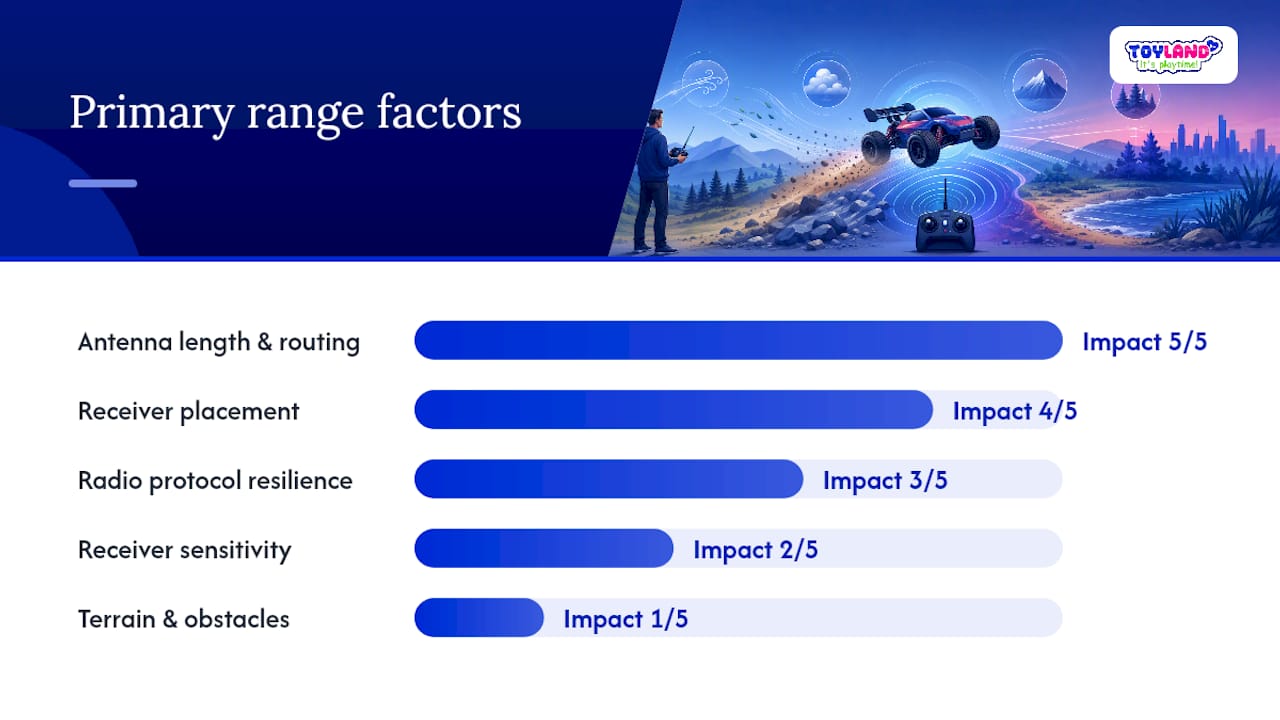
Here are the primary factors, roughly ordered from highest to lowest practical impact:
- Antenna length and routing. A coiled or shortened antenna loses significant range. The antenna must be the correct electrical length for its frequency and routed vertically, outside the car body.
- Receiver placement. A receiver buried inside a metal chassis or pressed against a LiPo pack is partially shielded. Mount it high, outside the shell where possible.
- Radio protocol and spread-spectrum resilience. Modern 2.4 GHz systems use frequency-hopping spread spectrum (FHSS) or direct-sequence spread spectrum (DSSS) to resist interference. Older AM/FM systems on 27 or 75 MHz have no such protection.
- Receiver sensitivity. A more sensitive receiver decodes weaker signals reliably, extending effective range without touching transmitter power.
- Terrain and obstacles. Open asphalt gives you the full rated range. A parking garage cuts it by 60–80%.
- Interference. Wi-Fi routers, Bluetooth devices, and other 2.4 GHz RC cars all compete for the same spectrum. Crowded environments shrink your usable range.
- Battery voltage stability. A transmitter running on depleted AA batteries transmits at lower power. A receiver fed by a sagging BEC voltage may reset or glitch mid-run.
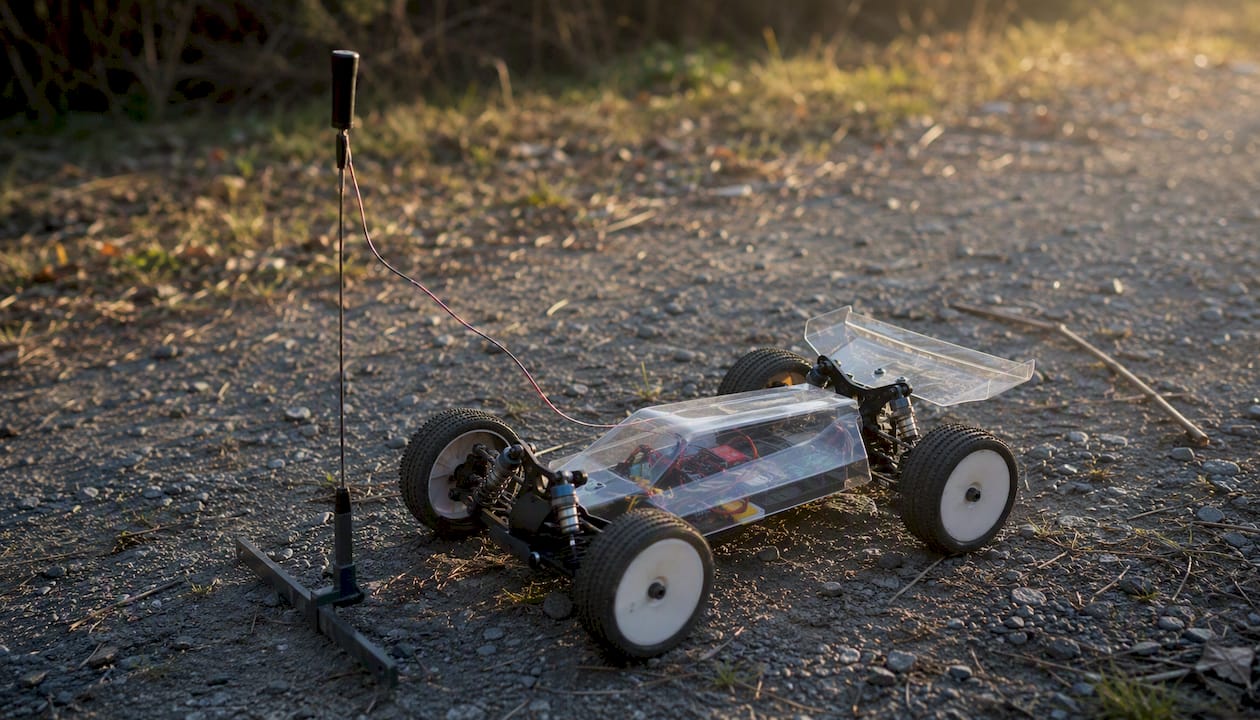
Pro Tip: Before buying any hardware upgrade, re-route your antenna. Run it straight, vertical, and outside the body. This single fix costs nothing and often doubles practical range in hobby-grade setups.
The temptation to add a DIY amplifier to a cheap transmitter is real, but community engineers consistently flag these hacks as based on incorrect RF assumptions and potentially illegal. Fix the antenna and receiver first.
Frequencies, Protocols, and Compatibility Basics
Understanding which frequency band your system uses tells you a lot about its range ceiling and interference resistance.
2.4 GHz dominates modern hobby RC because spread-spectrum technology lets dozens of drivers operate simultaneously without stepping on each other. Binding a transmitter to a specific receiver creates a unique encrypted handshake, so your car responds only to your controller. Typical range in open conditions: 100–500 m.
Legacy bands (27 MHz and 72–76 MHz) still appear in older toy-grade models and vintage hobby gear. The FCC’s RCRS allocates 30 of its 86 total channels specifically to surface craft. These lower frequencies penetrate obstacles better than 2.4 GHz but require crystal-matched transmitter/receiver pairs and offer no interference protection. Two drivers on the same channel will crash each other’s cars.
Long-range sub-GHz ecosystems (868 MHz in Europe, 915 MHz in the U.S., 900 MHz broadly) use robust digital protocols with RSSI telemetry and redundancy built in. Systems like Team BlackSheep (TBS) Crossfire operate in this band and are designed for multi-kilometer control. They require a compatible receiver and a module bay on your transmitter.
| Band | Frequency | Interference Protection | Typical Surface RC Range |
|---|---|---|---|
| Legacy AM/FM | 27 / 72–76 MHz | None | Limited range suitable for local control due to crystal matching |
| Modern spread-spectrum | 2.4 GHz | FHSS / DSSS | Extended range achievable under optimal conditions with proper setup |
| Long-range sub-GHz | 868 / 915 / 900 MHz | Digital protocol + RSSI | 1–5+ km |
Binding compatibility matters. A Spektrum transmitter binds only to Spektrum DSM2/DSMX receivers. FrSky uses its own ACCST or ACCESS protocol. Tactic uses AFHSS. Mixing brands without a compatible module will result in no bind at all, not just reduced range.
Transmitters, Binding, and Settings That Actually Matter
Binding is the process of pairing your transmitter to a specific receiver so they recognize each other exclusively. A proper bind is not just a convenience step. A loose or incomplete bind produces intermittent dropouts that look exactly like range problems, even at close distances.
Key transmitter-side checks every hobbyist should run:
- Antenna position. Hold pistol-grip transmitters with the antenna pointing up and away from your body. Stick transmitters should have antennas extended fully and oriented perpendicular to the direction of travel for maximum signal toward the car.
- Battery voltage. Transmitters running on low AA or AAA batteries transmit at reduced power. Use fresh alkalines or a charged NiMH pack, and check voltage before long sessions.
- Power mode settings. Some advanced transmitters allow power output adjustment. In the U.S., stay within FCC-certified limits. Increasing output beyond the certified level is illegal.
- Firmware updates. Spektrum and FrSky both release firmware updates that improve protocol stability and binding reliability. Outdated firmware can cause intermittent dropouts.
- Failsafe configuration. Set this in the transmitter menu, not just the receiver. Verify it physically before driving.
Manufacturer ecosystems vary significantly in how these settings are accessed. Traxxas uses its TQi app and Link module for telemetry and failsafe setup. Spektrum’s DX series handles failsafe through the transmitter menu. FrSky’s Taranis and Ethos-based radios offer granular control over output power and protocol. Tactic’s TTX series uses a simpler interface suited to beginners. Kyosho bundles transmitters with their RTR models that are pre-bound and ready to run. Hobbywing’s ESC and transmitter interaction, demonstrated in a practical setup video by pro driver Adam Drake, shows how neutral range and throttle calibration on the ESC side directly affect how the car responds at the edge of control range.
For a broader primer on TX/RX terminology, the Toylandeu™ RC buying guide covers RTR, ARR, and ARF setups clearly.
How to Increase Your RC Car’s Range Safely and Legally
Start cheap. Most range problems are antenna and placement issues, not hardware failures.
- Inspect and re-route the antenna. Pull the antenna wire fully outside the body shell. Run it straight and vertical. Coiling or routing inside the chassis dramatically reduces range. If the antenna sleeve is cracked or the wire is kinked, replace it before anything else.
- Reposition the receiver. Mount it as high as possible, away from the motor, ESC, and LiPo. Metal and carbon fiber chassis components shield the receiver. A foam pad and zip tie can move it outside the body entirely.
- Check all connectors and coax. Loose JST or Deans connectors cause voltage drops that reset receivers mid-run. Inspect solder joints on antenna coax if your system uses one.
- Verify transmitter battery health. Swap in fresh batteries or a fully charged pack. Test voltage under load, not just at rest.
- Upgrade to a diversity receiver. Diversity receivers use two antennas and switch to whichever has the stronger signal in real time. This is the single most cost-effective hardware upgrade for hobby-grade 2.4 GHz systems.
- Update firmware and protocol. If your transmitter supports a newer protocol (e.g., upgrading from DSM2 to DSMX on Spektrum, or ACCST to ACCESS on FrSky), the newer protocol typically offers better link resilience.
- Consider a certified long-range module. For kilometer-scale control, a TBS Crossfire or similar FCC-certified sub-GHz module installed in a JR-bay-compatible transmitter is the legal path. These systems include RSSI telemetry so you can monitor link quality in real time.
Never attempt to boost transmitter output power beyond its FCC certification. DIY amplifier hacks on consumer remotes are frequently based on incorrect RF assumptions, rarely deliver meaningful gains, and can violate federal law. The FCC can issue fines for illegal transmission. Improving your receiver and antenna is always the safer, more effective first step.
How to run a simple field range test:
- Bind your car and set failsafe to cut throttle on signal loss.
- Place the car on flat, open ground with no obstacles.
- Walk away from the car while operating it, in 50 m intervals.
- Note the distance where steering or throttle first feels sluggish or glitchy.
- Record that distance as your baseline. After each upgrade, repeat the test and compare.
Pro Tip: If your system has RSSI telemetry, log the RSSI value at each 50 m interval. A drop below 40–50 dBm (system-dependent) typically predicts imminent signal loss. This gives you a safety margin before failsafe triggers.
For readers looking at outdoor-ready models that handle antenna placement well, the Toylandeu™ outdoor RC car robot is a solid starting point.
U.S. Regulatory Context: FCC Rules and the RCRS
The FCC’s Radio Control Radio Service governs RC transmitters in the United States. The RCRS allocates 86 total channels, of which 30 are designated for model surface craft. Every RCRS transmitter must operate within an authorized emission bandwidth of 8 kHz.
These rules exist to prevent RC transmitters from interfering with licensed services, including aviation, emergency communications, and commercial radio. Operating outside certified power limits is not a gray area.
Increasing transmitter power beyond its FCC certification is a federal violation. Products sold in the U.S. must carry FCC ID labeling. Before buying any “range extender” or high-power module, verify its FCC ID on the FCC’s public database at fcc.gov. If a seller cannot provide an FCC ID, do not buy it.
Practical compliance checklist:
- Check the FCC ID label on your transmitter and receiver.
- Verify that any long-range module you purchase is FCC-certified for the U.S. 915 MHz band.
- Avoid third-party “boosters” sold without certification documentation.
- When in doubt, contact the manufacturer directly and ask for the FCC grant of authorization.
Troubleshooting Dropouts and Weak Range
Most range problems trace back to one of four causes: antenna issues, battery sag, interference, or a bad bind. Work through this checklist before replacing hardware.
- Antenna first. Is the antenna wire fully extended, routed outside the body, and undamaged? A single kink in the wire can cut range by half. Antenna correction and receiver repositioning resolve the majority of common range complaints.
- Transmitter battery under load. Measure voltage while pressing full throttle on a stationary car. If voltage sags below the transmitter’s rated minimum, replace the pack.
- RSSI or telemetry monitoring. If your system supports it, watch RSSI values during a test run. A sudden drop at a consistent location suggests a fixed interference source (a router, a power line) rather than a hardware fault.
- Swap to a known-good receiver or transmitter. If you have a spare, swap it in. If range immediately improves, the original component is faulty.
- Inspect connectors and solder joints. A cold solder joint on the receiver power lead causes intermittent resets that look like range dropouts. Wiggle connectors while the system is powered and watch for glitches.
- Check for interference sources. Run a quick site sweep: turn off nearby Wi-Fi routers, move away from power lines, and test again. If range improves dramatically, interference was the culprit.
- Re-bind the system. A corrupted bind causes intermittent dropouts at any distance. Re-binding takes two minutes and costs nothing.
When to suspect hardware failure: if dropouts occur at very short range (under 10 m) after all the above checks, the receiver or transmitter module is likely defective. When to suspect environment: if range is fine at one location but poor at another, interference or terrain is the cause. When to suspect configuration: if the car responds normally at close range but enters failsafe unpredictably, check failsafe threshold settings.
The Part Most Hobbyists Skip
There is a persistent belief in the RC community that range is primarily a transmitter power problem. It is not. The evidence points consistently in the other direction: protocol quality, receiver sensitivity, and antenna geometry account for the vast majority of real-world range variation. A $15 antenna fix outperforms a $200 transmitter upgrade when the root cause is a coiled wire stuffed inside a plastic body.
Long-range builds confirm this. Achieving kilometer-scale control is not about cranking up power. It requires a balanced system: a sub-GHz certified module, a matched receiver, a properly routed antenna, a stable power supply, and a configured failsafe. Practical long-range builds emphasize that a single change rarely produces dramatic gains without complementary modifications. The hobbyists who document their RSSI logs and test methodically get there faster than those who swap hardware by instinct.
One concrete example: re-routing a receiver antenna from inside a carbon fiber chassis to a vertical position outside the body shell, combined with a fresh transmitter battery pack, took a hobby 2.4 GHz setup from roughly 80 m of reliable range to over 250 m on the same parking lot. No new hardware. For kilometer-scale control, a TBS Crossfire module build on an open field achieved consistent link quality well beyond 1 km, with RSSI telemetry confirming a stable link throughout.
Test first. Document the baseline. Change one variable at a time. That discipline separates hobbyists who actually improve their setups from those who spend money without progress.
Ready to Upgrade Your RC Setup?
Whether you are just getting started or looking to push your range further, Toylandeu™ carries a wide selection of 2.4 GHz RC cars and outdoor-ready models. The RC gesture-controlled stunt car is a popular ready-to-run option for hobbyists who want a capable car without building from scratch. Browse the full catalog at Toylandeu™ for RC cars, accessories, and more.
Sources
- Radio Control Radio Service (RCRS) | Federal Communications Commission
- Common RC systems - ArduPilot
- How to increase the Range of your RC Car – Radio Control Tips
- What technology offers the longest range for RC controls - Drones Stack Exchange
FAQ
How far can a 2.4 GHz RC car go?
Most hobby-grade 2.4 GHz systems reach 100–500 m in open, unobstructed conditions with a properly routed antenna. Toy-grade 2.4 GHz models typically cap out at 30–100 ft due to lower-quality receivers and antennas.
How do you increase the range of an RC car remote?
Start by re-routing the receiver antenna outside the body shell in a vertical orientation, then check transmitter battery voltage and re-bind the system. Hardware upgrades like diversity receivers or certified sub-GHz modules come after these free fixes.
What is failsafe and what happens when RC signal is lost?
Failsafe is a pre-programmed response your receiver triggers when the control link drops below a reliable threshold. Most hobby systems default to cutting throttle and holding steering neutral, but you must configure and physically test this setting before driving at range.
Are RC range boosters legal in the United States?
Only if they carry a valid FCC ID for the U.S. frequency band they operate on. Uncertified boosters that increase transmitter power beyond FCC limits are illegal under RCRS rules and can result in federal fines.
What is the difference between toy-grade and hobby-grade RC range?
Toy-grade models use basic receivers and short antennas that limit reliable control to 30–100 ft. Hobby-grade systems use spread-spectrum protocols, better receiver sensitivity, and full-length antennas that extend reliable range to 100–500 m outdoors.