

2026 U.S. Rule: Why a $40 Toy Can Carry Duties Despite 'Free' Shipping
Yes, plenty of online toy retailers offer free worldwide shipping, and Toylandeu™ is one of several that advertise it. The catch is that “free shipping” usually refers only to postage, not the full landed cost; duties, taxes, and brokerage fees can still land on your doorstep unless the seller explicitly prepays them through a Delivered Duties Paid option.
TL;DR:
- Free international shipping often only covers postage; duties, taxes, and customs fees usually remain extra unless explicitly prepaid by the seller.
- Verify shipping terms by checking for clear duty prepayment statements, landed cost estimates at checkout, and visible tracking information.
- The default DDU shipping means buyers pay duties upon delivery, while DDP includes duties in the purchase price, affecting total landed costs.
- Shipping times for free international toy orders tend to be longer, often spanning several weeks, especially during peak seasons or with customs delays.
- Many “worldwide” shipping claims exclude certain countries or remote areas; testing the checkout with your real address clarifies eligibility.
Table of Contents
- Where to find toys with free worldwide shipping: seller types and listing signals to trust
- What ‘free worldwide shipping’ usually covers, and what it doesn’t
- How to get free or low-cost international shipping on toys
- Shipping logistics and customs changes that affect free worldwide shipping
- Safety and seller trust checklist when buying toys shipped internationally
- Typical shipping timeframes for free international toy deliveries
- Geographic restrictions or excluded countries for free worldwide shipping
- Comparing shipping methods: courier versus postal service for free international orders
- How packaging size and weight affect eligibility for free worldwide shipping
- Combining orders or shopping multiple sellers to hit free-shipping minimums
- Hidden costs and fees beyond duties on international toy orders
- Why “free worldwide shipping” claims deserve a second look
- Toylandeu™: shop collections that ship worldwide with free-shipping terms
- FAQ
- Sources
Where to find toys with free worldwide shipping: seller types and listing signals to trust
Free worldwide shipping on toys comes from a handful of seller types, each with different tradeoffs. Large global marketplaces often absorb postage costs into the product price and spread them across millions of orders. Specialized international toy e-tailers often build free shipping into their business model as a standing offer rather than a seasonal promotion. Brand-direct stores sometimes offer it too, usually tied to a minimum order value.
Knowing the seller type only gets you halfway. The real test is what the listing and checkout page tell you about who pays duties, how the package travels, and what happens if something goes wrong.
Look for these signals before you trust a “free worldwide shipping” claim:
- An explicit statement that duties are prepaid (DDP) or a clear note that the buyer is responsible for them on delivery.
- A landed-cost estimate shown at checkout, not just a shipping fee of $0.
- A visible returns policy and a way to contact the seller directly, not just a contact form that bounces.
- A tracking number issued at purchase, so you can follow the package instead of guessing.
Testing this yourself takes two minutes. Add the toy to your cart, enter your actual shipping address, and watch what happens at the final checkout screen. If the total jumps unexpectedly once you add your country, that is the seller’s way of telling you duties are not included. If the total stays flat and a line item says something like “import fees included,” you are likely looking at a DDP arrangement. Reputable sellers price in CPSIA compliance and clear labeling as part of their cost structure, which also tends to correlate with more transparent shipping terms. A seller that hides the destination-country total until after you have entered payment details is a seller worth skipping.
What ‘free worldwide shipping’ usually covers, and what it doesn’t
“Free shipping” is a postage promise, not a total-cost promise. Three terms matter here, and sellers rarely explain the difference clearly.
Free postage means the carrier fee itself is waived or built into the product price. It says nothing about customs charges. Delivered Duties Paid (DDP) means the seller or shipping service prepays import duties and taxes before the package leaves origin, so the recipient owes nothing extra on delivery. Delivered Duty Unpaid (DDU) is the default for most international shipments: the postage might be free, but duties, VAT or GST, and any brokerage or handling fee are collected from you when the package arrives or clears customs.
- Import duties are calculated on the declared value of the toy and vary by country and product category.
- VAT, GST, or sales tax equivalents may apply on top of duties depending on the destination.
- Brokerage and handling fees are charged by the carrier or postal service for processing the customs entry, separate from the duty itself.
USPS calculates a Total Landed Cost (TLC) estimate that bundles taxes, duties, import fees, postage, and extra service charges into one number, and recipients typically pay that TLC on delivery unless the shipper already prepaid duties through DDP. That single detail explains most of the “why did I get charged extra” complaints you see about international toy orders.
The clearest signal a seller has thought this through is checkout language that names duties directly, phrases like “duties and taxes included” or “all fees prepaid,” rather than a vague “free international shipping” banner with no further detail.
How to get free or low-cost international shipping on toys
Getting genuinely free, low-surprise international shipping takes a bit of active comparison shopping rather than clicking the first free shipping badge you see.
- Hit the spend threshold. Many retailers set a minimum order value for free shipping, so bundling two or three smaller toys into one order often beats paying shipping on each separately.
- Hunt for promo codes and seasonal windows. Retailers frequently run free-shipping promotions around holidays; a code that waives shipping on an order under the usual threshold is worth five minutes of searching.
- Favor sellers that show landed cost upfront. A checkout that displays your total including duties before you pay is doing the work DDU sellers leave for you to discover later.
- Check if a postal-network option is available. Shipments that move through the international postal network are processed differently than courier shipments under current customs rules, which can affect both cost and delivery speed.
- Confirm the destination is actually served. Some “worldwide” claims exclude specific countries, so test the checkout with your real address before assuming the deal applies to you.
Pro Tip: Before finalizing payment, change your shipping address to your real one and let the page fully reload. Sellers with hidden duty charges almost always reveal them only after that step.
Shipping logistics and customs changes that affect free worldwide shipping
A rule change in 2026 reshaped how low-value toy shipments are treated at the border, and it is worth understanding before you assume any “free shipping” badge means a flat price.
U.S. Customs and Border Protection issued an interim final rule suspending the de minimis exemption, which previously let shipments valued at $800 or less enter duty-free through non-postal channels. Under the suspension effective June 24, 2026, many low-value parcels that once cleared without duties now face standard entry processing, which can mean added duties and brokerage costs that were not part of the calculation before. That change hits exactly the kind of order a toy buyer makes: a single $30 to $80 item shipped from overseas.

USPS offers its own answer for sellers who want to avoid passing that surprise to the buyer. Through prepaid import duties, certain services including First-Class Package International, Priority Mail International, and Priority Mail Express International let the sender pay duties upfront for a subset of eligible destination countries, so the recipient owes nothing extra on delivery. Not every destination qualifies, and not every seller uses the option even where it is available.
Customs paperwork matters just as much as who pays. USPS requires specific, item-level descriptions on every outbound customs form, rejecting vague entries like “gift” in favor of precise language such as “remote-controlled toy car.” A toy with a sloppy or generic description is far more likely to sit in a customs queue while an officer tries to figure out what it actually is.
| Customs term | What it means for a toy buyer |
|---|---|
| De minimis suspension | Many low-value toy shipments now face standard duty assessment instead of automatic duty-free entry |
| DDP (Delivered Duties Paid) | Seller prepays duties; buyer pays only the listed price |
| DDU (Delivered Duty Unpaid) | Buyer pays duties, taxes, and handling on delivery |
| Total Landed Cost (TLC) | USPS estimate combining postage, duties, taxes, and fees into one number |
Safety and seller trust checklist when buying toys shipped internationally
Shipping terms are only half the picture. A toy that arrives on time and duty-free is still a bad purchase if it is unsafe or misrepresented.
Consumer-safety research has repeatedly flagged that overseas direct fulfillment can reduce accountability when something goes wrong, since the seller may be difficult to trace once the sale is complete. The Trouble in Toyland report specifically recommends checking seller identity and safety documentation before buying from an unfamiliar overseas source, noting that an extremely low price with no manufacturer information is itself a warning sign.
Before buying, check for:
- A named manufacturer or importer, not just a storefront alias with no company details.
- Clear age grading and safety information on the product page, consistent with CPSIA expectations for the destination market.
- Traceable shipping with a real tracking number, plus a working returns and refund process.
- Visible contact details, including an address or support channel that responds.
Red flags include pricing that seems too low for the item described, a customs description or product title that just says “gift” or “toy,” missing or stock-photo-only images, and labeling that skips age range entirely. A quick look at age grading standards before buying helps you spot a mislabeled listing fast.
Pro Tip: If a listing’s only product photo is a generic stock image with no packaging shown, assume the seller hasn’t verified what’s actually in the box.
Typical shipping timeframes for free international toy deliveries
Free worldwide shipping almost always trades speed for cost. Retailers that waive shipping fees typically route packages through slower postal or economy courier networks rather than express services, since express shipping is expensive to subsidize at scale.
Expect a wider delivery window than you would get from a paid express option, often stretching across several weeks rather than a few days, particularly during peak shopping seasons when carrier volume spikes. Customs processing adds its own variability: a shipment with a vague or incomplete customs description can sit in a queue longer than one with a precise item listing, which is part of why USPS pushes sellers toward specific customs descriptions rather than generic ones.
If a delivery date matters, for a birthday or holiday, build in extra buffer time beyond whatever estimate the seller gives at checkout. Sellers offering free shipping rarely guarantee a delivery date the way paid express services do, and the estimate shown at checkout is typically a range rather than a firm commitment.
Geographic restrictions or excluded countries for free worldwide shipping
“Worldwide” is a marketing word, not a legal guarantee that every country is included. Retailers that advertise free global shipping commonly exclude a short list of destinations where carrier access is limited, customs processing is unusually complex, or shipping costs are too high to absorb profitably.
The only reliable way to know whether your country is covered is to run the checkout process with your real shipping address rather than trusting the banner on the homepage. If a destination is excluded, most checkout systems will either block the order, show a shipping fee where none was advertised, or limit you to a smaller selection of eligible products. None of these outcomes are obvious until you reach that final screen.
Some sellers also apply different rules by region even within a country, particularly for remote areas or territories that carriers treat separately from the mainland. If you are ordering for someone in a less common location, confirm shipping eligibility before assuming the “free worldwide shipping” claim applies to you exactly as advertised.
Comparing shipping methods: courier versus postal service for free international orders
Retailers generally choose between two shipping pathways when fulfilling free international orders, and the choice affects both your cost and your delivery experience.
Postal-network shipping, the kind handled by national postal services working together across borders, tends to be cheaper for sellers to subsidize, which is part of why it shows up so often behind “free shipping” offers. It is also the shipping mode that remains largely outside the de minimis suspension that now affects many non-postal shipments, since CBP’s rule change draws a distinction between postal and non-postal entry.
Courier shipping, through commercial carriers, usually moves faster and offers more detailed tracking, but it is more expensive to run, so sellers that offer “free” courier shipping are more likely to be covering that cost by building it into the product price rather than truly absorbing it.
Neither option is universally better. If speed and tracking detail matter most, courier service tends to deliver a better experience. If the lowest possible total price matters more and you can tolerate a longer wait, postal-network shipping is usually the better fit, especially for non-urgent gift orders.

How packaging size and weight affect eligibility for free worldwide shipping
Free shipping thresholds are rarely about price alone. Many retailers set weight and dimension limits behind the scenes, because oversized or heavy packages cost disproportionately more to ship internationally.
A small plush toy or a deck of cards fits easily within standard free-shipping limits. A large remote-controlled truck or a multi-box building set can push past a size or weight cutoff that isn’t always stated on the product page itself, triggering an added shipping charge at checkout even when the item itself qualifies on price.
This is one more reason to run the checkout test rather than trusting a blanket “free worldwide shipping” badge. If a bulky item suddenly adds a shipping line once you select your country, that’s a packaging-based limit kicking in rather than a geographic one. When you’re choosing between several similar toys, picking the more compact option, a folded play set over a pre-assembled one, for instance, can be the difference between free shipping and an unexpected fee.
Combining orders or shopping multiple sellers to hit free-shipping minimums
If a single toy doesn’t clear a retailer’s free-shipping threshold, the simplest fix is to add a second item rather than pay for shipping on a small order. A smaller companion toy, a set of batteries, or a gift accessory can round out an order to the minimum without meaningfully changing what you set out to buy.
Buying from multiple sellers can work too, but it comes with a tradeoff: each seller ships separately, so you are now tracking two delivery windows, two customs entries, and potentially two sets of duties rather than one. That can make sense when no single retailer has everything on your list, but it rarely reduces your total cost compared to consolidating an order with one seller that already offers free shipping above a reasonable minimum.
Before adding items just to hit a threshold, do the math: an extra $15 item to unlock free shipping is only a win if it replaces a shipping fee larger than $15, and if you actually want the item.
Hidden costs and fees beyond duties on international toy orders
Duties and taxes get most of the attention, but they are not the only charges that can show up after you’ve paid for a “free shipping” order.
Carriers and postal services sometimes add a handling fee for processing customs paperwork, separate from the duty itself, and this fee is often not disclosed until the package is already in transit or at the door. Some destination countries also apply a delivery surcharge for remote addresses, which has nothing to do with the toy’s price or the shipping method chosen at checkout.
USPS’s landed-cost estimate bundles postage, duties, taxes, and extra service fees into one figure precisely because these charges tend to arrive together rather than one at a time, which makes the estimate more useful than the “free shipping” line alone. If a seller’s checkout shows only a shipping cost of $0 with no mention of a landed-cost estimate, assume there is a gap between what you pay now and what you might owe on delivery, and budget accordingly.
Why “free worldwide shipping” claims deserve a second look
Free worldwide shipping is one of the easiest promises for a retailer to make and one of the hardest for a buyer to verify from the product page alone. The phrase describes postage, nothing more, and plenty of sellers lean on that ambiguity because a flat “$0 shipping” banner converts better than a checkout page that shows the real total.
What readers consistently underestimate is how much the de minimis suspension changes the math for small toy orders specifically. A $40 toy that used to clear customs duty-free under the old exemption may now carry duties that didn’t exist a year earlier, regardless of what the shipping badge says. The sellers worth trusting are the ones who address that directly, not the ones who simply keep repeating “free worldwide shipping” louder.
Some retailers advertise free worldwide shipping across their catalogs, and such claims are worth the same scrutiny applied to any seller: check the checkout screen, read the fine print, and treat postage and landed cost as two separate questions.
— Thane Holland
Toylandeu™: shop collections that ship worldwide with free-shipping terms
Certain toy retailers run storefronts offering free worldwide shipping across catalogs that span RC vehicles, STEM kits, plush toys, dolls, and building sets, rather than limiting the offer to a single category or seasonal promotion.
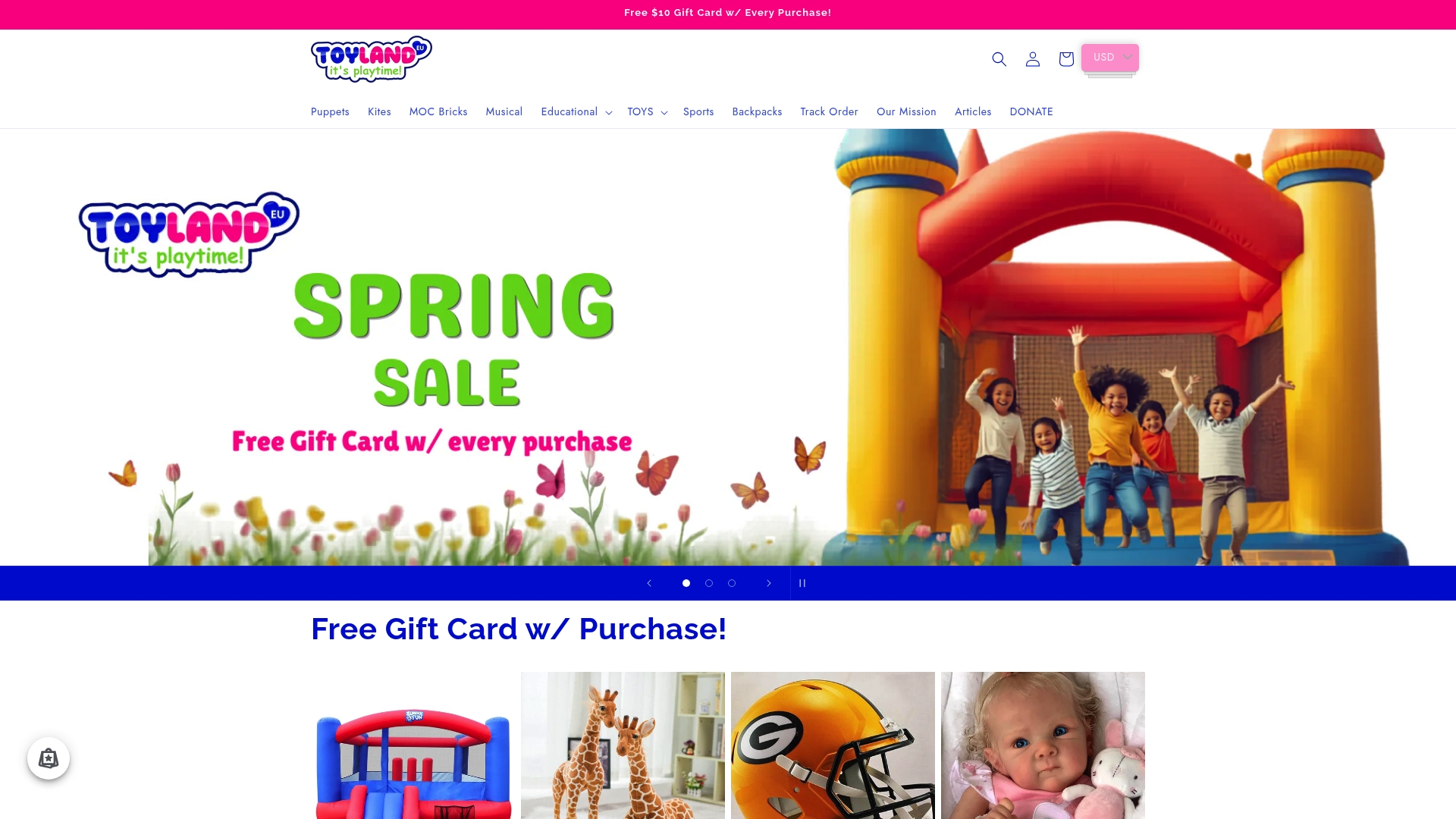
That breadth matters if you’re comparing options: instead of hunting across several storefronts to find one offer that covers the toy category you want, some sellers apply the same free-shipping terms across their full range. A handful of starting points:
- RC toys for remote-controlled cars, trucks, and planes.
- STEM toys for educational kits and science sets.
- Building block sets for compatible bricks and MOC kits.
- Dolls for a range of styles and ages.
As with any international order, the practical step is the same one outlined throughout this guide: add the item to your cart, enter your real shipping address, and confirm the checkout total before paying. That single check tells you whether duties are handled upfront or left for delivery, no matter which retailer you buy from.
Browse the full Toylandeu™ catalog to see current shipping terms applied to your destination.
FAQ
What is the 20 toy rule for kids?
The “20 toy rule” is a decluttering approach some parents use, limiting a child’s active toy collection to a small number of items and rotating others in and out of storage. It isn’t a safety or shipping regulation, just a household organization method some families find useful for managing toy clutter.
Is there a Toys R Us ship?
Toys R Us has operated under different ownership and store formats since its original bankruptcy, and current shipping availability depends on which version of the brand and which retail partner is selling the product. Check the specific retailer’s shipping policy directly rather than assuming a single, unified shipping program exists.
How can I get toys for free?
Outside of giveaways, contests, or loyalty programs that specific retailers run, there’s no reliable way to get toys at no cost; free shipping is different from a free toy, and most “free toys” offers are promotional bundles tied to a qualifying purchase. Watch for retailer loyalty perks and seasonal promotions rather than searching for genuinely free merchandise.
Does Toyworld have free shipping?
Shipping policies vary by retailer and region, and availability of free shipping depends on the specific store, order value, and destination country. Check the retailer’s own shipping policy page and run a test checkout with your actual address to confirm current terms.
What’s the difference between free shipping and duty-free delivery?
Free shipping means the carrier’s postage fee is waived or included in the product price, while duty-free delivery means no import duties or taxes are owed on top of that. A toy can have free shipping and still arrive with a customs bill unless the seller explicitly prepays duties through a DDP arrangement.
Sources
- Prepaid import duties | USPS
- Customs Bulletin Vol 60, July 8, 2026, No. 18
- Trouble in Toyland (PIRG) — consumer-safety report