

Measure First: Dollhouse Scale Guide with Ceiling First Chart
The hobbyist standard is 1:12, meaning one inch of miniature equals one foot of real life. Other scales worth knowing are 1:6 (playscale, used by fashion dolls), 1:16 and 1:18, 1:24 (half of 1:12), 1:48, and 1:144. Below you’ll find a full scale chart, a step by step method for measuring an unlabeled dollhouse, and the conversion math to size furniture and accessories correctly.
TL;DR:
- The most common dollhouse scale for realistic modeling is 1:12, which means one inch on the model equals one foot in real life, with other scales like 1:6 and 1:48 serving different purposes.
- To determine your dollhouse’s scale, measure the ceiling height in inches, compare it to real-world equivalents, and divide by the scale factor, with ceiling height being the most reliable indicator.
- When converting real furniture dimensions to miniature sizes, divide the real size by the scale ratio; for example, a 30-inch sofa becomes 2.5 inches at 1:12 scale.
- Space constraints often outweigh skill level in scale choice; 1:12 requires more room but offers the widest selection, while smaller scales like 1:24 and 1:48 suit compact displays.
- Always check product dimensions and scale labels before purchasing to avoid mismatched scales and ensure consistent, realistic miniature scenes.
Table of Contents
- What Do Dollhouse Scale Ratios Actually Mean?
- How to Determine the Scale of Your Existing Dollhouse
- The Conversion Formula for Sizing Any Miniature
- Choosing the Right Scale for Your Space and Skill Level
- Common Scale Mistakes and How to Fix Them
- How Toylandeu™ Helps You Shop by Scale
- Where Dollhouse Scales Actually Came From
- How Scale Affects Cost and What You Can Actually Find
- Getting Architectural Details and Textures Right
- Photographing Miniatures So the Scale Actually Reads
- The Part of This Guide Most Collectors Skip
- Sources
- FAQ
What Do Dollhouse Scale Ratios Actually Mean?
A ratio like 1:12 tells you how many times smaller the miniature is than the real object. In 1:12, one unit of measurement on the model equals 12 of that same unit in real life. That’s why the shorthand “one inch equals one foot” works so well for American hobbyists: there are 12 inches in a foot, so a 1:12 dollhouse door that stands 6.5 inches tall represents a real door that’s about 6.5 feet tall.
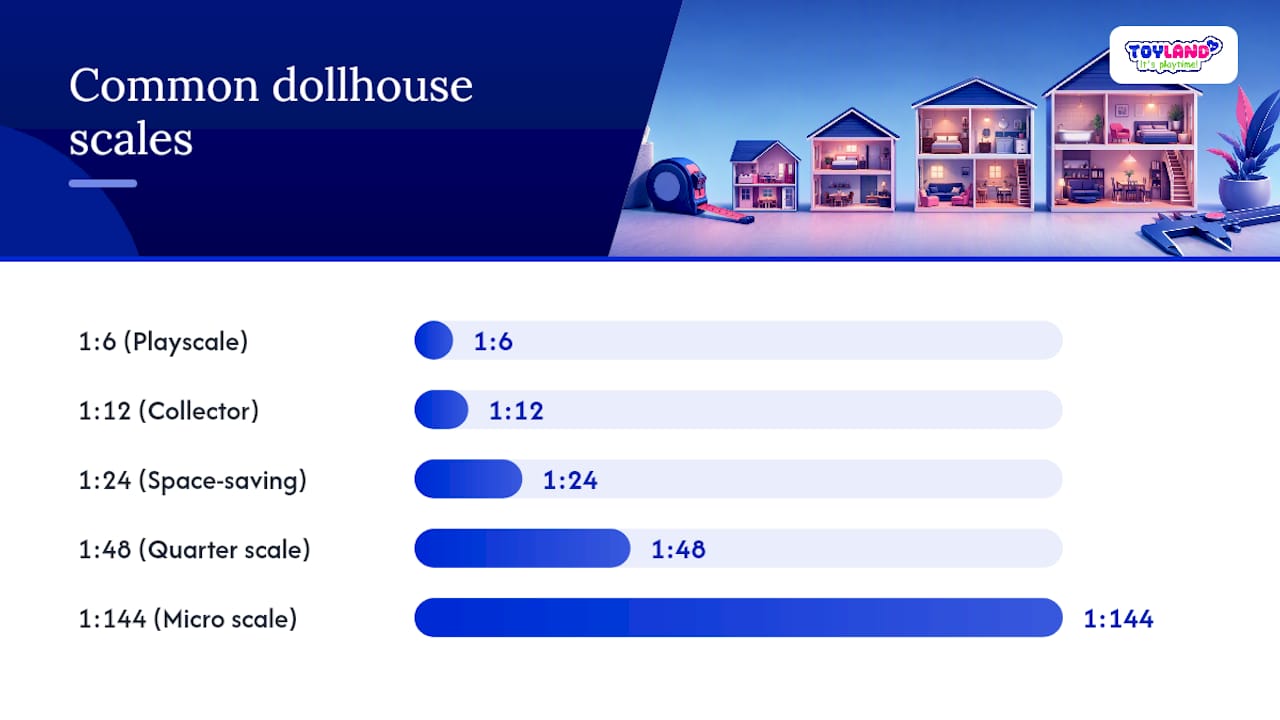
Common modern dollhouse scales include 1:6, 1:12, 1:16, 1:24, 1:48, and 1:144, with 1:12 sitting firmly as the most widely used collector standard. Each scale has settled into its own niche over decades of hobby history, and knowing which one you’re working with determines almost every purchase decision that follows.
A few things matter more than the numbers alone. Play scale (1:6) and collector scale (1:12) rarely mix, since a Barbie-sized figure looks absurd standing in a 1:12 kitchen. Quarter scale (1:48) shares its name and proportions with a segment of O-scale model railroading, which is why some railroad hobbyists cross over into dollhouse miniatures without much of a learning curve.
- Playscale (1:6) is built for handling and play, not architectural realism.
- 1:12 is the default for realistic room boxes, artisan furniture, and most collector kits.
- 1:24 and 1:48 trade detail for space savings, and they’re gaining ground with hobbyists working in small apartments.
Not every scale is a clean, standardized number. Some European artisans work in 1:10 or 1:18 variants that don’t match American conventions exactly, so a French or German miniature marked “1:10” won’t sit comfortably next to a 1:12 American piece even though the difference looks small on paper.
How to Determine the Scale of Your Existing Dollhouse
Ceiling height is the most reliable measurement you can take, because it tends to stay more consistent across manufacturers than decorative elements like windows or trim, which vary by design style. Doors and moldings get stylized. Ceilings don’t.
- Measure the first floor ceiling height from floor to ceiling in inches, using a tape measure or ruler. Take the reading in at least two spots if the house has any warping or uneven flooring.
- Cross check with door height or seat height if the ceiling reading feels ambiguous. A standard door in 1:12 runs roughly 6.5 inches; in 1:24 it drops to about 3.25 inches.
- Divide your real-world equivalent by your measurement to find the closest standard scale. If your ceiling measures 8 to 10 inches, you’re almost certainly looking at 1:12. If it lands at 4 to 5 inches, you’re in 1:24 territory. Around 2 to 2.5 inches points to 1:48.
If your numbers fall stubbornly between two standard scales, you’re likely holding a “fit-the-box” item, something sized to a packaging constraint rather than a real ratio. Treat those pieces as decorative filler rather than trying to force them into a scale family.
Pro Tip: Skip the decorative trim and molding when you’re trying to nail down scale. Manufacturers stylize those details constantly, but ceiling height stays remarkably consistent within a given scale family.
The Conversion Formula for Sizing Any Miniature
The formula is simple: miniature size = real size ÷ scale factor. If you’re converting a real 30 inch wide sofa into 1:12, divide 30 by 12 to get 2.5 inches. The same sofa in 1:24 becomes 1.25 inches, and in 1:6 it becomes 5 inches.
Here’s how that plays out across a few common pieces:
- A 78 inch tall doorway becomes 6.5 inches in 1:12, 3.25 inches in 1:24, and 13 inches in 1:6.
- A 60 inch dining table becomes 5 inches in 1:12 and 2.5 inches in 1:24.
- A 96 inch ceiling becomes 8 inches in 1:12 and 4 inches in 1:24, which lines up with the popular conversion chart hobbyists rely on for quick checks.
Since 1:24 is exactly half the linear size of 1:12, you can shortcut most conversions by simply halving your 1:12 number instead of running fresh division every time. When you’re rounding for actual crafting, round to the nearest sixteenth of an inch rather than a full decimal. Miniature lumber and trim typically come in those fractional sizes, and working in millimeters (roughly 25.4 per inch) can actually be easier for fine detail work since most hobby calipers read in both units.
Choosing the Right Scale for Your Space and Skill Level
Space is usually the deciding factor before skill ever enters the conversation. A 1:12 dollhouse with a full room set can easily take up a bookshelf’s worth of real estate, while a 1:48 diorama fits in a shadow box you could hang on a wall.
- 1:6 demands the most floor space per piece but forgives clumsy hands. Fine motor skill barely matters at this scale.
- 1:12 hits the sweet spot for detail and manageable size, and it has by far the largest catalog of furniture, wallpaper, and accessories.
- 1:24 rewards precision work and steady hands. Gluing a 1 inch chair leg is a different skill than gluing a half-inch one.
- 1:48 is for hobbyists who enjoy jeweler-level detail work and don’t mind tweezers becoming a permanent part of their toolkit.
Run through a quick checklist before committing: available display space, your comfort with fine detail work, your budget for accessories (1:12 pieces are widely available and often cheaper per item than rarer scales), and how much architectural detail you actually want to include. Fashion doll collectors usually gravitate toward 1:6 because it matches Barbie and similar lines, while model railroaders often already own 1:48 tools and scenery that transfer directly into quarter-scale dioramas.
Common Scale Mistakes and How to Fix Them
The most frequent mistake is buying furniture from a photo without checking listed dimensions. A chair that looks “dollhouse sized” in a thumbnail image could be built for 1:6, 1:12, or nothing standardized at all.
- Ignoring scale labels entirely. Always check the listing for an explicit ratio before adding to cart.
- Mixing scales in one room. A 1:12 sofa next to a 1:24 side table reads as visually wrong even to non-hobbyists.
- Trusting “fit-the-box” toy sets as though they follow a real ratio. Many manufacturers size items to packaging rather than a consistent scale.
One trick worth borrowing from set designers: forced perspective. Placing slightly smaller furniture or figures toward the back of a room box tricks the eye into perceiving more depth than the box actually has.
Pro Tip: Before you buy anything for a build in progress, keep your anchor measurement (usually ceiling height) written down somewhere you’ll actually check it. Compare every new piece against that number before it goes in the cart.
How Toylandeu™ Helps You Shop by Scale
Before you buy a single miniature, check the listing for an explicit scale field or full dimensions. If neither is listed, treat the photo as decoration, not data.
- Look for products where the scale ratio is stated outright, not implied by the image.
- Toylandeu™ carries 1:12 BJD dolls sized for standard collector houses and 1:6 fashion dolls for playscale builds.
- If you’re curious how scale conventions play out in another hobby entirely, the RC car scales guide breaks down the same ratio logic for remote control vehicles.
- Themed kits like the princess castle dollhouse are worth checking against your measurements before assuming they’ll match existing pieces.
The workflow that avoids most buying mistakes is short: measure your space or existing house, pick your scale, then filter listings by dimensions instead of by how a photo looks on your screen.
Where Dollhouse Scales Actually Came From
Dollhouse scale wasn’t designed top down by a standards committee. It grew out of separate traditions that eventually collided. European “baby houses” from the 1600s and 1700s were built to whatever size suited the cabinetmaker, often closer to 1:12 by accident than by intention, since that ratio happened to produce furniture proportional to the dollhouses’ owners’ actual homes.
The 1:12 standard solidified largely through the toy industry in the 20th century, when American and British manufacturers began mass-producing furniture and needed a shared ratio that let pieces from different companies work together. One inch to one foot was easy to communicate and easy to measure, so it stuck.
Playscale (1:6) has a different origin entirely. It traces back to fashion doll manufacturing, where dolls needed to be large enough for a child to dress and undress by hand. The ratio was chosen for usability, not architectural realism, which is why playscale houses and furniture have always felt more like play props than miniature replicas.
Smaller scales like 1:24 and 1:48 borrowed heavily from model railroading and military modeling, hobbies that had already standardized those ratios for entirely different reasons decades earlier. When dollhouse hobbyists needed compact formats, they simply adopted scales that already had a manufacturing base behind them instead of inventing new ones.
How Scale Affects Cost and What You Can Actually Find
Scale choice changes your budget more than most new hobbyists expect. Because 1:12 has the largest manufacturing base and the longest production history, it also has the deepest secondary market. You’ll find everything from mass-produced plastic chairs to hand-carved artisan pieces, which means price ranges are wide and options at every budget level actually exist.
Smaller scales flip that equation. A 1:48 miniature requires finer tooling and more precise handwork, so pieces often cost more per item despite using less material. Fewer manufacturers bother producing 1:48 furniture at all, which limits your options and pushes serious 1:48 collectors toward scratch-building their own pieces from scratch, wire, and paint rather than buying off the shelf.
Playscale (1:6) sits in an unusual middle ground. Material costs are higher because pieces are physically larger, but the fashion doll industry’s enormous production volume keeps basic playscale furniture affordable. Where 1:6 gets expensive is in artisan or licensed pieces built for adult collectors rather than children.
If budget is a real constraint, 1:12 remains the most economical entry point simply because supply is so much larger than demand in most categories. Rarer scales like 1:16 or 1:18 sit in an awkward spot: less common than 1:12, but without the manufacturing efficiencies that keep playscale affordable, so per-item prices often run higher than either neighbor.
Getting Architectural Details and Textures Right
Scaling a wall is easy. Scaling the texture of that wall is where most builds start to look wrong. Brick, wood grain, and stone all have a real-world grain size, and if you don’t shrink that grain along with the structure, the whole piece reads as fake even when the dimensions are technically correct.
A real brick measures roughly 8 inches long. In 1:12, that brick should print or mold at about 0.67 inches, not whatever size looks “about right” on a sheet of miniature brick paper. Wood grain follows the same logic: a plank that looks properly grained on a real dresser will look absurdly coarse if reproduced at full texture density on a 1:24 piece.
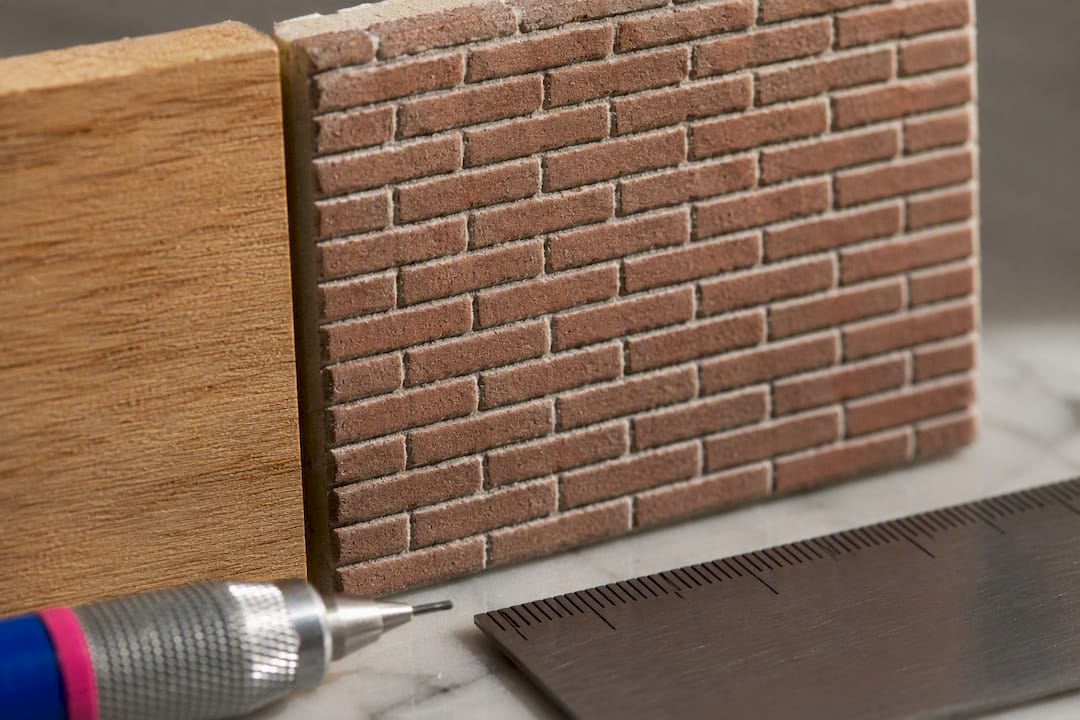
Molding profiles, baseboards, and window trim all need the same scrutiny. A crown molding that measures 6 inches deep in real life should measure 0.5 inches in 1:12, not the “close enough” quarter inch a lot of prebuilt kits ship with. That gap is subtle in isolation but adds up fast when several architectural elements in the same room are all slightly oversized.
The safest rule: when in doubt, measure a real-world reference (a brick, a floorboard, a doorframe) and run it through your scale factor before committing to a material or texture. Guessing by eye is how most “almost right” builds end up looking slightly off in ways that are hard to pinpoint later.
Photographing Miniatures So the Scale Actually Reads
A miniature photographed badly looks like a toy. A miniature photographed well looks like a real room, and the difference almost always comes down to depth of field and camera angle rather than the piece itself.
Shoot at eye level with your scene, roughly where a person’s eyes would sit relative to that room in real life. Shooting from above, the way you’d naturally look down at a dollhouse on a table, instantly signals “toy” to the viewer’s brain because it’s a perspective humans never actually experience indoors.
Aperture matters more in miniature photography than almost any other genre. A wide open aperture creates a shallow depth of field that mimics macro photography, which paradoxically makes a scene look smaller and more toylike. Stopping down to a narrower aperture keeps more of the scene in focus at once, which is closer to how the human eye perceives a full-sized room.
Lighting should avoid harsh direct flash, which flattens texture and exaggerates the plastic look of many miniature materials. Soft, angled light brings out the texture work you scaled so carefully in the first place, whether that’s brick grain or fabric weave.
Background matters too. A busy real-world background behind your dollhouse instantly breaks the illusion, so a plain backdrop or slightly blurred out-of-scale background helps keep the eye anchored inside the scene you built.
The Part of This Guide Most Collectors Skip
Most scale guides treat measurement as a formality, something to confirm what you already suspected. That’s backwards. The single biggest source of buyer’s remorse in this hobby isn’t picking the “wrong” scale. It’s skipping the measurement step entirely and trusting a product photo instead.
Conventional advice tends to push new hobbyists toward 1:12 by default, and for good reason: it has the deepest catalog and the most forgiving margin for error. But that advice undersells how much space 1:12 actually demands once you’re a few rooms into a build. Anyone working with limited display space should seriously weigh 1:24 before committing, not after discovering their 1:12 house has taken over a room.
If there’s one habit worth adopting before any other, it’s this: measure first, buy second. Ceiling height, checked twice, beats trusting a listing photo every time. The formula and the chart in this guide only pay off if you actually use them before checkout instead of after a mismatched piece arrives.
— Thane Holland
Sources
- Determining Dollhouse Scale and Sizes of Miniatures — The Spruce Crafts
- Popular scales and conversion chart — The Create Miniatures Project (PDF)
- Dollhouse scale: what is it and why does it matter — Miniature Newbies
FAQ
How do I figure out what scale my dollhouse is?
Measure the first floor ceiling height, since it tends to stay more consistent across manufacturers than doors or windows. Divide that measurement against real-world equivalents (8 to 10 inches suggests 1:12, 4 to 5 inches suggests 1:24, and around 2 to 2.5 inches suggests 1:48).
Which is smaller, 1:12 or 1:24 scale?
1:24 is smaller. It’s exactly half the linear size of 1:12, so a piece that measures 2 inches in 1:12 measures 1 inch in 1:24.
Is Barbie a 1:12 or 1:6 scale doll?
Barbie and similar fashion dolls use playscale, which is 1:6, producing dolls roughly 11 to 12 inches tall. That’s much larger than 1:12 collector dolls, which typically stand 5.5 to 6 inches.
What are the different scales used for dollhouses?
The most common scales are 1:6 (playscale), 1:12 (the standard collector scale), 1:16, 1:18, 1:24 (half scale), 1:48 (quarter scale), and 1:144 (micro scale). Each serves a different balance of detail, space, and skill level.