

RC Car Scales Explained: Which Size Is Right for You?
RC car scales are the ratio between a model’s size and the real vehicle it represents. A 1/10 scale car is one-tenth the length of the full-size original. That single number determines how big your model is, how much it weighs, what terrain it handles, and how easy it is to find spare parts.
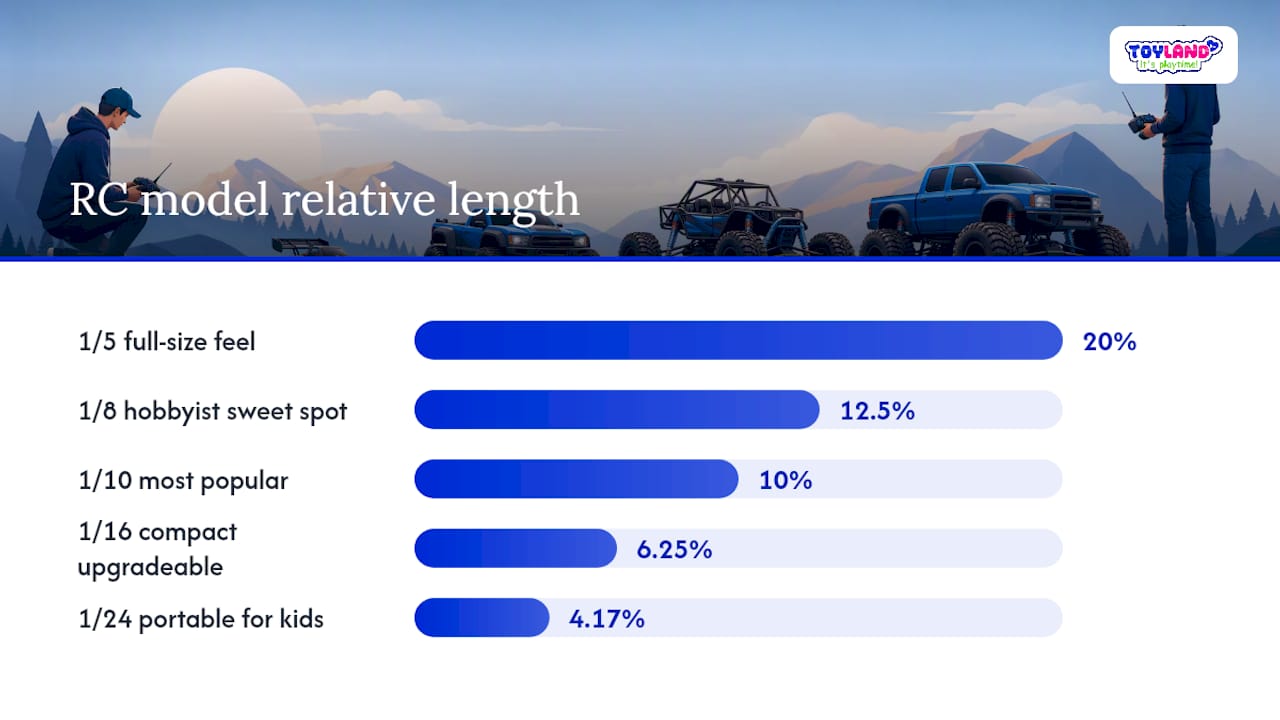
The most common hobby scales, from largest to smallest:
- 1/5 — full-size feel, gas or high-voltage electric, backyard and track use
- 1/8 — the serious hobbyist sweet spot, off-road and on-road racing
- 1/10 — the most popular scale overall, the best balance of size, parts, and price
- 1/16 — compact enough for smaller yards, still upgradeable
- 1/18 — entry-level and gift-friendly, limited upgrade path
- 1/24 — desk-to-driveway portable, great for kids and indoor drift
- 1/28 — ultra-compact, mostly indoor and micro-racing
- 1/64 — novelty and collector size, fits in a pocket
The 1/10 scale dominates hobby shops and online communities. It is the default recommendation for anyone starting out. The 1/8 scale is where competitive racing and serious off-road builds live.
Key Takeaways
The most practical RC car scale for most beginners is 1/10, because it balances size, parts availability, upgrade potential, and price better than any other scale in the hobby.
| Point | Details |
|---|---|
| Scale = size ratio | A 1/10 model is one-tenth the length of the real vehicle; smaller denominator means a bigger model. |
| 1/10 is the most popular | It offers the widest parts ecosystem, community support, and upgrade path for beginners and intermediates. |
| 1/24 for portability | At 4–8 inches long, 1/24 fits in a bag and works indoors, making it the top pick for kids and gift buyers. |
| Corner weight matters | Scale sets size; corner weight distribution determines handling and is tunable with a dedicated scale system. |
| Toylandeu™ catalog | Toylandeu™ carries RC models from 1/64 novelty cars to 1/16 off-road trucks with free worldwide shipping. |
Table of Contents
- How do RC car scale ratios actually work?
- RC car scale chart: typical sizes, weights, and best uses
- How to pick the right RC car scale for your space and goals
- Comparing the three most popular hobby scales: 1/10, 1/8, and 1/24
- Why scale alone doesn’t tell you how a car handles
- What Toylandeu™ customers tend to choose, and why
- Shop RC cars by scale at Toylandeu™
- Sources
- FAQ
How do RC car scale ratios actually work?
The fraction is straightforward: the top number is the model, the bottom number is the real car. A 1/10 scale means one-tenth the linear dimensions of the full-size vehicle. Smaller denominator, bigger model. A 1/5 is larger than a 1/10; a 1/24 is smaller.
Here is a quick example. A full-size sedan is roughly 180 inches long. Divide by 10 and you get an 18-inch model. Divide by 24 and you get a 7.5-inch model. That math works for any scale and any real vehicle.
The catch is that “real vehicle” part. A 1/10 monster truck and a 1/10 on-road sedan are both 1/10 scale, but they model different full-size vehicles with different wheelbases and body widths. That is why every scale has a length range rather than a single fixed number. Weight and electronics do not scale geometrically either. A battery pack, motor, and servo weigh what they weigh regardless of the chassis around them, so smaller-scale cars often feel heavier relative to their size than the ratio alone would suggest.
RC car scale chart: typical sizes, weights, and best uses
The table below draws on typical length and width ranges for common hobby scales and cross-references diecast size norms to show where RC and collecting scales overlap.
Why the ranges? Three factors drive the spread:
- Body style. A monster truck at 1/10 is wider and taller than a 1/10 touring car, even though both carry the same scale label.
- Wheelbase. Short-wheelbase buggies and long-wheelbase crawlers differ significantly even within the same scale.
- Chassis type. Truggy, buggy, crawler, and on-road platforms all have different proportions.
Pro Tip: Before buying a 1/8 or 1/5 model, measure your car trunk or storage shelf. A 1/8 buggy at 24 inches long needs real space. A 1/10 fits in most backpacks designed for laptops.
How to pick the right RC car scale for your space and goals
Start with the smallest scale that satisfies your goals. Bigger is not always better. A 1/5 in a small apartment is a problem; a 1/24 on a gravel trail is equally frustrating.
Work through these questions in order:
- How much driving space do you have? Indoor rooms and hallways suit 1/24 or 1/28. A backyard or park works well for 1/10 or 1/16. A dedicated track or large open field is where 1/8 and 1/5 shine.
- How will you transport it? If it needs to fit in a backpack or a carry-on bag, stay at 1/24 or smaller. For car-trunk transport, 1/10 and 1/16 are manageable. The 1/8 and 1/5 typically need a dedicated bag or box.
- What terrain are you targeting? Smooth floors and pavement favor on-road models at any scale. Grass, gravel, and dirt call for off-road tires and suspension travel, which are more capable at 1/10 and above.
- What is your budget, including upgrades? The 1/10 scale has the deepest aftermarket. Motors, ESCs, shocks, and bodies are widely available and competitively priced. Smaller scales have fewer upgrade options; larger scales cost more per part.
- What is your skill level? Larger, faster models are harder to control at speed. A 1/24 or 1/16 is forgiving for new drivers. A 1/8 brushless setup at 50+ mph is not.
- How important is the parts and community ecosystem? The 1/10 community is the largest. Forums, YouTube tutorials, and local club support are easiest to find for that scale.
Quick rule-of-thumb picks:
- Indoor or desktop fun → 1/24 drift car or 1/28
- Mixed outdoor use with room to upgrade → 1/10
- Compact off-road for kids or smaller spaces → 1/16 off-road monster truck
- Serious racing or bashing → 1/8
- Gift for a young child → 1/18 or 1/24
Comparing the three most popular hobby scales: 1/10, 1/8, and 1/24
These three cover most buyers. Here is how they stack up across the dimensions that actually matter for a purchase decision.
| Category | 1/10 | 1/8 | 1/24 |
|---|---|---|---|
| Best for | Beginners and all-around hobbyists | Competitive racing and serious bashing | Indoor use, kids, portability |
| Typical length | a range typical of 1/10 scale cars | 19–24 in | 4–8 in |
| Portability | Fits most backpacks and car trunks | Needs a dedicated bag or box | Pocket or small bag |
| Relative cost | Mid-range entry; affordable upgrades | Higher entry cost; premium parts | Low entry cost; limited upgrades |
| Parts availability | Widest selection, largest community | Strong, especially for racing | Limited; fewer aftermarket options |
| Skill level | Beginner to intermediate | Intermediate to advanced | Beginner |
The 1/10 wins on versatility. It is the scale where a beginner can buy a ready-to-run model and still have a clear upgrade path two years later. The 1/8 is where the hobby gets serious: faster, heavier, more expensive to crash. The 1/24 is the scale you grab when you want something fun that fits in a jacket pocket and runs on a kitchen floor.
Why scale alone doesn’t tell you how a car handles
Scale sets the size. It does not set the handling. That is where corner weight comes in.
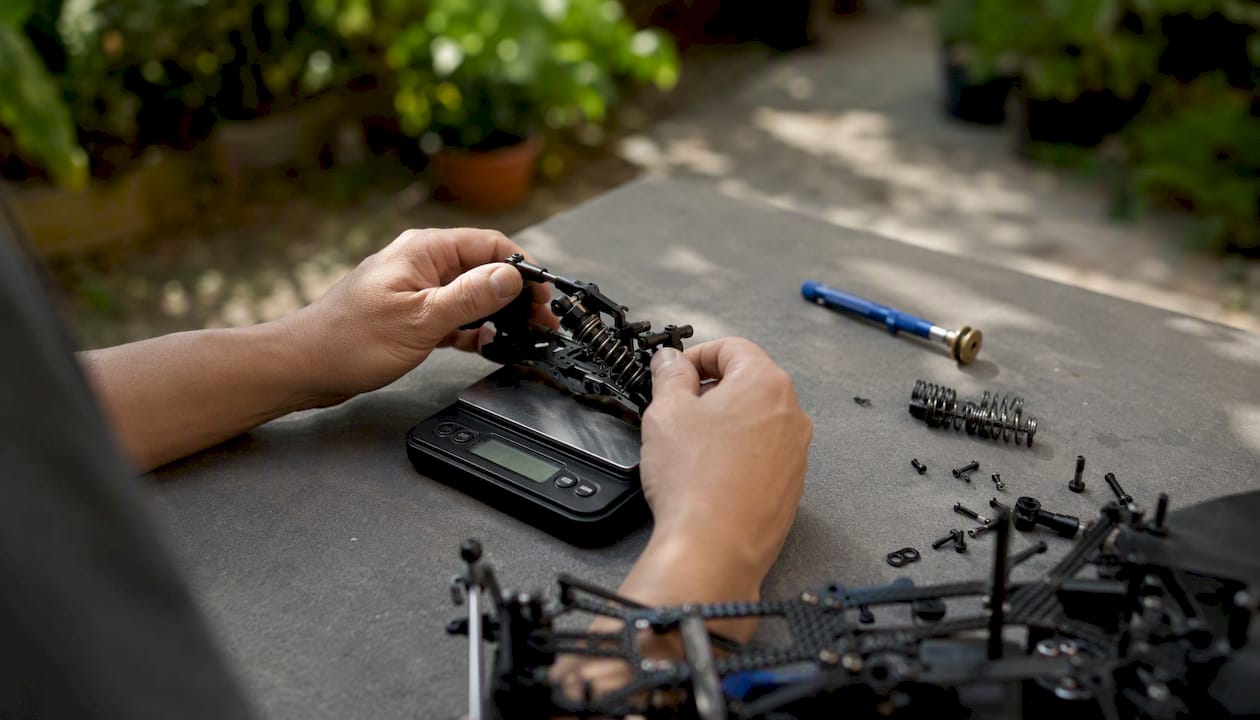
Corner weight is the load carried by each individual wheel. Overall weight tells you how heavy the car is; corner weight tells you how that weight is distributed across all four contact points. A car with 60% of its weight on the front axle will push wide in corners. A car with unequal diagonal weights will feel loose on one side and tight on the other.
Competitive hobbyists and racers use dedicated corner-weight scales to measure and balance their setups. SkyRC’s Corner Weight System measures each corner to roughly high-precision resolution found in dedicated RC car corner weight scales resolution and feeds front/rear and diagonal distribution data to a companion app. LABA7’s wireless racing scales use multi-pad load sensing with Bluetooth app integration for the same kind of detailed axle-weight analysis used in full-size motorsport.
Here is the basic tuning process:
- Place the car on a flat surface with all four pads under the wheels and record each corner’s weight.
- Compare front-to-rear balance and left-to-right diagonal pairs.
- Adjust ride height on the heavy corners (raising a corner shifts weight away from it) or move battery position to shift the front/rear split.
- Reweigh and repeat until the diagonals are within your target tolerance.
Pro Tip: A portable corner-weight scale is worth the investment once you start racing or chasing consistent lap times. Eyeballing ride height gets you close; measuring it gets you on the podium.
What Toylandeu™ customers tend to choose, and why
The pattern at Toylandeu™ is consistent: 1/10 models go to hobbyists who want a platform they can grow with, and 1/24 models go to parents buying gifts or to adults who want something fun and compact. Both make sense given what each scale actually delivers.
The 1/10 ready-to-run category is where most first-time buyers land. The scale is large enough to feel substantial, slow enough at stock settings to learn on, and supported by a parts ecosystem that means a broken shock or stripped gear is a $5 fix, not a reason to shelve the car. The 1/24 and 1/16 categories attract buyers with limited space or younger kids. A 1/16 drift racer or a compact off-road SUV fits on a shelf, travels easily, and still delivers real driving fun.
Toylandeu™ carries RC models across scales from 1/64 novelty cars up through 1/16 off-road trucks, alongside the RC buying guide that explains RTR, ARR, and other terms new buyers encounter. The catalog breadth means you can compare scales side by side rather than guessing from a spec sheet.
Shop RC cars by scale at Toylandeu™
Toylandeu™ stocks RC models across the most practical hobby scales, with free worldwide shipping and a catalog built for both first-time buyers and returning hobbyists.
For indoor and gift buyers, the mini off-road SUV is a compact, durable pick that handles grass and pavement without needing a dedicated storage case. Want something with a novelty twist? The gesture-controlled stunt car is a crowd-pleaser for kids and adults alike. For 1/24 fans, the 1/24 excavator and bulldozer set adds a construction-themed angle that works well as an educational gift.
Browse the full RC range at Toylandeu™ and filter by scale to find the model that fits your space, budget, and skill level.
Sources
- RC Car Sizes Explained: The Ultimate Guide to RC Scale Sizes (1/8, 1/10, 1/16, 1/18, 1/24) - Riverhobby Tech (Shenzhen) Co., Ltd.
- Corner Weight System - SkyRC
- Racing Scales: Corner Weight Scales - LABA7
- Diecast Model Car Scale Size Chart: 1:18 vs 1:24 vs 1:43 vs 1:64
FAQ
What scale is best for RC cars?
The 1/10 scale is the best all-around choice for most hobbyists. It balances size, parts availability, and upgrade potential better than any other scale, making it the default recommendation for beginners and intermediates.
What is the most popular RC car scale?
The 1/10 scale is the most popular hobby scale. Multiple hobby retailers and guides confirm it dominates the market because it works equally well for indoor/outdoor use, racing, and casual bashing.
Which is bigger, a 1/10 or a 1/16 scale RC car?
A 1/10 is bigger. A smaller denominator means a larger model: a 1/10 car typically runs 17–22 inches long, while a 1/16 runs 9–13 inches. The same rule applies across all RC car scales.
What order do RC car scales run in, from largest to smallest?
From largest to smallest: 1/5, 1/8, 1/10, 1/16, 1/18, 1/24, 1/28, 1/64. The larger the denominator, the smaller the model.
Is a 1/18 or 1/24 scale RC car better for a child?
Both work well for children, but the 1/24 is the more portable and forgiving option for young kids. The 1/18 is slightly larger and more stable on uneven surfaces, making it a better pick for outdoor play on grass or gravel.
Recommended
- RC 1:64 Scale Remote Control Car with Trailer - High-Speed Fun Await! ToylandEU
- RC 2025 High-Speed 1:16 Scale 4WD Off-Road Remote Control Monster Truck ToylandEU
- RC Ultimate 1:24 Scale Drift RC Car with Custom Tires & Mini-Cones Fun ToylandEU
- RC High-Speed 1:28 Mini 4WD RC Off-Road Car - Ultimate Drift Experience ToylandEU