

DDP Shipping Meaning: What Sellers and Buyers Need to Know
Delivered Duty Paid, or DDP, means the seller pays every cost and handles every customs step to get goods to the buyer’s door, duties and taxes included. The buyer’s job under this Incoterm is simple: unlock the door and unload.
Three things to know right away:
- Who pays: the seller covers freight, insurance, export clearance, import clearance, duties, and taxes.
- When risk transfers: at the named place of destination, once the goods are ready for unloading, not before.
- Where it shows up most: cross-border ecommerce, where a buyer in one country orders a product shipped from a warehouse in another.
The International Chamber of Commerce defines DDP as part of its Incoterms® rules, and carrier glossaries from UPS and DHL echo the same framework. Retailers use “landed cost,” the total price of a product once shipping, duties, and taxes are baked in, to figure out what to charge before the sale even happens.
Key Takeaways
DDP shifts nearly all shipping cost, customs work, and risk onto the seller, making it the most buyer-friendly and seller-demanding Incoterm in international trade.
| Point | Details |
|---|---|
| Seller pays everything | Freight, duties, taxes, and customs fees all fall on the seller under DDP. |
| Risk transfers at delivery | Goods pass to the buyer’s risk only once ready for unloading at the named place. |
| DDP vs. DAP | DAP leaves import clearance and duties to the buyer; DDP does not. |
| Costs can escalate fast | Duty reclassification, storage, and demurrage can quietly inflate landed cost. |
| Landed-cost tools matter | Calculating duties and taxes before checkout prevents underpricing and margin loss. |
Table of Contents
- What Is DDP Shipping, Exactly?
- Who Does What: Seller vs. Buyer Responsibilities
- How Does DDP Compare to DAP and EXW?
- What Does the DDP Timeline Actually Look Like?
- When Does DDP Actually Make Sense?
- What Fees Can Quietly Inflate a DDP Shipment?
- Offering DDP: A Practical Checklist for Sellers
- Why DDP Gets Misunderstood More Than Any Other Incoterm
- Sources
- FAQ
- Recommended Reads
What Is DDP Shipping, Exactly?
Under the Incoterms® rules published by the ICC, DDP sits at the far end of the responsibility spectrum. The seller assumes the maximum level of responsibility of any Incoterm, handling both export and import customs clearance and paying whatever duties and taxes the destination country charges.
DDP works across every mode of transport: ocean freight, air cargo, trucking, or a mix of all three. That flexibility is part of why it shows up so often in global retail rather than just bulk shipping.
A few quick facts:
- DDP is one of 11 Incoterms® rules, and it’s the only one where the seller pays import duties.
- UPS’s glossary and FedEx’s definition both describe DDP the same way: seller-managed door-to-door delivery, duties included.
- DHL frames DDP as the option where buyers pay nothing extra at delivery, no courier knocking with a customs bill in hand.
Who Does What: Seller vs. Buyer Responsibilities
DDP flips the usual script. In most international sales, the buyer handles import clearance and pays whatever the customs office demands. DDP moves nearly all of that onto the seller.
Seller responsibilities:
- Export clearance and documentation in the origin country
- International freight booking and payment
- Import clearance in the destination country
- Duties, taxes, and customs fees
- Customs brokerage arrangement
- Delivery to the named place, ready for unloading
Buyer responsibilities:
- Unloading the goods at the named place
- Providing accurate delivery details and access
Sellers shipping into a country with strict import rules sometimes need a local importer of record or a registered local entity to clear goods legally. That’s a common trigger for hiring a customs broker rather than handling it in-house, a point UPS’s own supply chain guidance raises directly.
Pro Tip: Spell out the named place in writing, down to the specific address or terminal, not just the city. Vague delivery points are the single biggest source of DDP disputes over where risk actually transferred.
How Does DDP Compare to DAP and EXW?
Picking the right Incoterm often comes down to one question: who’s better positioned to deal with customs, the seller or the buyer?
- DDP: Seller pays freight, duties, taxes, and handles both export and import clearance. Risk transfers at the named place, ready for unloading.
- DAP (Delivered at Place): Seller pays freight and delivers to the named place, but the buyer handles import clearance and duties.
- DDU (Delivered Duty Unpaid, an older, informal term now generally covered by DAP): Same idea as DAP, seller delivers, buyer pays duties and clears customs.
- EXW (Ex Works): Seller does the bare minimum, just makes goods available at their own facility. Buyer arranges everything else, including pickup.
If your buyers are consumers who don’t want to deal with a customs office, DDP is the better fit. If you’re shipping into a market with genuinely complicated import rules and no local presence, Maersk’s guidance suggests DAP may be the smarter move, letting the buyer’s local knowledge handle the friction.
What Does the DDP Timeline Actually Look Like?
- Checkout and landed-cost calculation. The seller estimates duties, taxes, and fees upfront so pricing reflects the true delivered cost, not just the product price.
- Export clearance and booking. The seller files export paperwork and books space with a carrier or freight forwarder.
- International transit. Goods move by air, ocean, or ground, sometimes multimodal, depending on distance and urgency.
- Import clearance and duty payment. The seller (through a broker) clears customs in the destination country and pays whatever duties or taxes apply.
- Final delivery. Goods arrive at the named place, and risk transfers to the buyer once they’re ready for unloading.
DHL recommends running a duty and tax calculator at step one. Skip that step, and you’re pricing blind.
When Does DDP Actually Make Sense?
DDP earns its keep in specific situations, and it becomes a liability in others.
Good for buyers: no surprise customs bill at the door, no chasing down a broker, no guessing what a package will actually cost until it’s too late.
Good for sellers: full control over the delivery experience and a predictable service standard for customers, which matters a lot in ecommerce where a surprise duty bill kills repeat purchases.

Where it gets risky for sellers: higher upfront costs, a heavier compliance load, and sometimes the need for legal representation in the destination country. If margins are thin or the destination market has unpredictable customs enforcement, DAP or EXW may protect the seller better.
Ecommerce sellers shipping direct to consumers, as ToylandEU’s own approach to cross-border retail shows, tend to lean DDP because customers expect the price they see at checkout to be the price they pay.
What Fees Can Quietly Inflate a DDP Shipment?
DDP costs are rarely just “duties plus freight.” A handful of line items tend to sneak up on sellers:
- Import duties and VAT/GST, which vary by product category and destination
- Customs broker fees, charged per shipment or per entry
- Storage and demurrage charges when goods sit at a port during a customs hold
- Inspection fees, especially for regulated or flagged categories
- Carrier fuel and remote-area surcharges
- Currency and FX swings between quote and payment
Here’s how it compounds: a shipment gets reclassified under a different HTS code during customs review, the duty rate jumps, and the goods sit in a bonded warehouse for four extra days racking up storage charges. What looked like a straightforward delivery is suddenly a margin problem. Thomasnet’s breakdown of DDP risk points to exactly this kind of cascading delay.
Pro Tip: Some countries require sellers to hold local VAT registration or work through a registered importer of record before DDP shipments can even clear customs. Check this before you commit to DDP terms in your listings, not after a shipment is stuck at the border.
Offering DDP: A Practical Checklist for Sellers
Getting DDP right operationally takes more than good intentions. Here’s a working sequence:
- Set up landed-cost tooling. Use a duty and tax calculator to quote accurate delivered prices at checkout.
- Verify HTS/HS codes. Confirm the correct classification for every product category you ship, especially anything unusual like collectible dolls or specialty items that may draw extra scrutiny.
- Choose a customs broker. Decide whether a broker, a freight forwarder, or an in-house compliance hire fits your shipping volume.
- Confirm freight partner roles. Clarify who books space, who files export docs, and who manages the handoff at the border.
- Decide on insurance. Cargo insurance isn’t automatic under DDP, add it deliberately.
- Build documentation templates. Standardize your commercial invoice and packing list so nothing is missing at customs.
- Plan cashflow for duties paid upfront. DDP means you’re fronting duty payments before the customer’s payment fully clears, budget accordingly.
Guides on international dropshipping workflows, like EcomEye’s steps for international sellers, make a similar point: vendor roles need to be locked down before volume scales, not after.
Pro Tip: Test DDP with a handful of low-value shipments to a new country before committing your full catalog. It’s the cheapest way to find out if local import rules have a nasty surprise waiting.
Why DDP Gets Misunderstood More Than Any Other Incoterm
Most explainers treat DDP as a simple swap: seller pays instead of buyer. That framing undersells what’s actually happening. DDP isn’t just a cost transfer, it’s a compliance transfer. The seller now owns legal exposure in a country they may never have registered a business in.
The conventional advice, “just offer DDP for a better customer experience,” skips the part that actually matters: whether the seller can legally and reliably clear customs in every market they sell into. A toy retailer shipping into a country with strict safety certification requirements for children’s products faces a very different DDP calculation than one shipping into a market with light-touch enforcement.
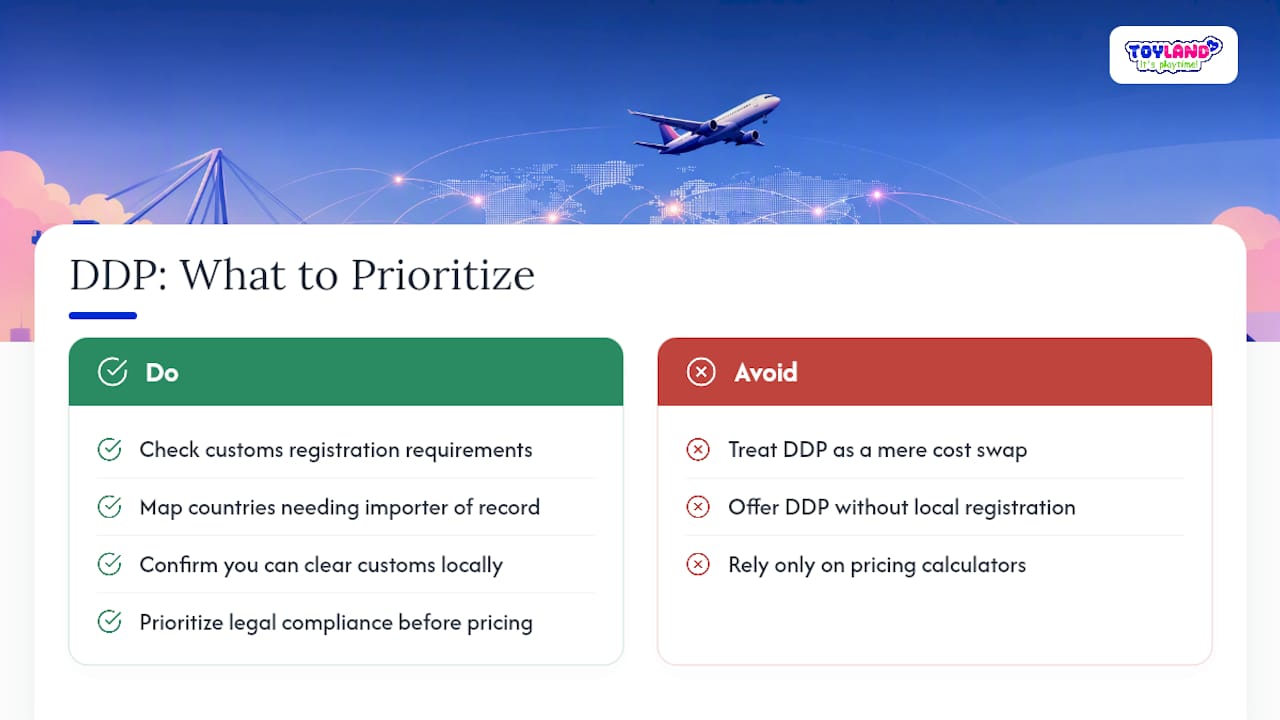
What should sellers prioritize first? Not the pricing model. The customs reality. Map out which destination countries actually require local registration or an importer of record before promising DDP terms on a listing. Everything else, the calculators, the broker relationships, the pricing buffers, is downstream of that one legal question.
Sources
- Trade
- Incoterms rules - ICC
- Delivered Duty Paid (DDP) - UPS Supply Chain Solutions
- DDP Shipping – How DHL helps
FAQ
Who Pays Shipping on DDP?
The seller pays all shipping costs under DDP, including freight, insurance, export and import clearance, and any duties or taxes owed at the border.
Is DDP Shipping Worth It?
It depends on the market and margin. DDP tends to be worth it for ecommerce sellers targeting consumer buyers who expect no surprise fees, but it can strain margins in markets with unpredictable customs costs.
Is DDP Free Shipping?
Not exactly. DDP means the seller absorbs shipping and duty costs rather than charging the buyer separately, but that cost typically gets built into the product price rather than eliminated.
Why Is DDP So Expensive?
DDP costs add up because the seller covers freight, duties, taxes, customs brokerage, and sometimes storage or demurrage fees, all in one bundled price instead of splitting them with the buyer.
Recommended Reads
- Toy Shopping in Europe 2025: Online vs. Offline Trends Explained
- Why International Toy Shopping Expands Play and Learning
Shopping for a gift that ships across borders? Toylandeu™ builds duty and shipping costs into pricing for products like the RC Revolutionary Gesture-Controlled Stunt Car, so what you see at checkout is what you pay, no customs surprises waiting at your door.