

Place Value That Sticks: Base Ten Blocks Playbook for Teachers
Base ten blocks are four proportional manipulatives: units, rods, flats, and cubes, built on a 10:1 relationship at every level, and they exist to make place value and regrouping something students can touch instead of memorize. Teachers, tutors, and parents use them to turn abstract digits into physical groups kids can see, stack, and trade. If a child struggles with carrying or borrowing, base ten blocks are usually the fastest fix available.
TL;DR:
- Base ten blocks help students understand place value through proportional, physically engaging pieces that scale in a 10:1 ratio, from units to large cubes.
- Effective teaching involves modeling exchanges, guided questioning, and using the blocks to connect physical trades with standard algorithms.
- Activities like trading up to 100, error detection with illegal numbers, and trade explanations reinforce regrouping and place value concepts.
- Virtual manipulatives complement physical models by visually demonstrating trades, especially helpful for decimals and dynamic exchanges.
- Proper organization and targeted grade-level sequences are crucial for maximizing the blocks’ educational value and avoiding misconceptions.
Table of Contents
- What Are Base Ten Blocks? Units, Rods, Flats, and Cubes
- Why Do Base Ten Blocks Work So Well for Teaching Math?
- How to Use Base Ten Blocks for Place Value, Regrouping, and Decimals
- Base Ten Blocks Activities and Games That Actually Teach
- Sample Lesson Sequences by Grade Band
- Worked Problems and Practice Prompts
- Keeping Base Ten Blocks Organized and Accessible
- A Practical Note on Teaching With Base Ten Blocks
- Toylandeu™ Manipulative Picks for Place Value Lessons
- Sources
- FAQ
- Recommended Reads
What Are Base Ten Blocks? Units, Rods, Flats, and Cubes
A base ten block set has four pieces, and each one is exactly ten times bigger than the one before it. The smallest piece is a unit cube, a 1-centimeter cube representing “1.” Ten of those units line up to form a rod, representing “10.” Ten rods laid side by side form a flat, a 10-by-10 square representing “100.” Ten flats stacked make a large cube, representing “1,000.”
The relationships never change:
- 10 units = 1 rod
- 10 rods = 1 flat
- 10 flats = 1 cube (the large one, not the unit)
You’ll also see these called Dienes blocks (after mathematician Zoltan Dienes, who developed the concept) or place-value blocks. Same tool, different name, and none of the naming variation matters for classroom use. What does matter is scale: because a flat is physically 100 times the size of a unit, children absorb magnitude just by holding the pieces side by side, something flat counters or tokens rarely accomplish.
Virtual manipulatives fill a real gap here too. Digital versions, like those on the National Library of Virtual Manipulatives, can animate a trade happening in real time. A physical flat just sits there when ten rods sit next to it. A screen can show the rods sliding together and morphing into the flat, which helps some students see the “why” behind the trade before they ever touch a block.
Why Do Base Ten Blocks Work So Well for Teaching Math?
The short answer is sequencing. Base ten blocks fit the Concrete-Representational-Abstract model, usually shortened to CRA, which moves students through three stages instead of dropping them straight into symbols. First they manipulate real objects. Then they draw or label pictures of those objects. Only after that do they work with numerals and standard algorithms. Skipping straight to the abstract stage, which is what a worksheet of two-digit addition problems does, is exactly where a lot of students lose the thread.
Manipulatives like base ten blocks help students move from concrete handling to pictorial representations and then to abstract algorithms, a progression that gives struggling learners a physical bridge into procedures that otherwise look like arbitrary rules.
That progression comes directly from the CEEDAR framework on math instruction, and it’s not just theory. Educational research on manipulatives generally finds that conceptual understanding improves most when the physical objects are paired with guided questioning, not handed over and left alone. A block by itself teaches nothing; a block plus “why did you trade there?” teaches place value.
Statistic to know: the core mechanic behind every base ten activity is the 10:1 exchange rate. Ten units always trade for one rod, ten rods always trade for one flat. Every regrouping error a student makes traces back to breaking that single rule, which is also why the blocks double as a built in error checker. If a student’s grouping doesn’t reduce to that ratio, something in the count is wrong, and the mismatch is visible before you even grade the paper.
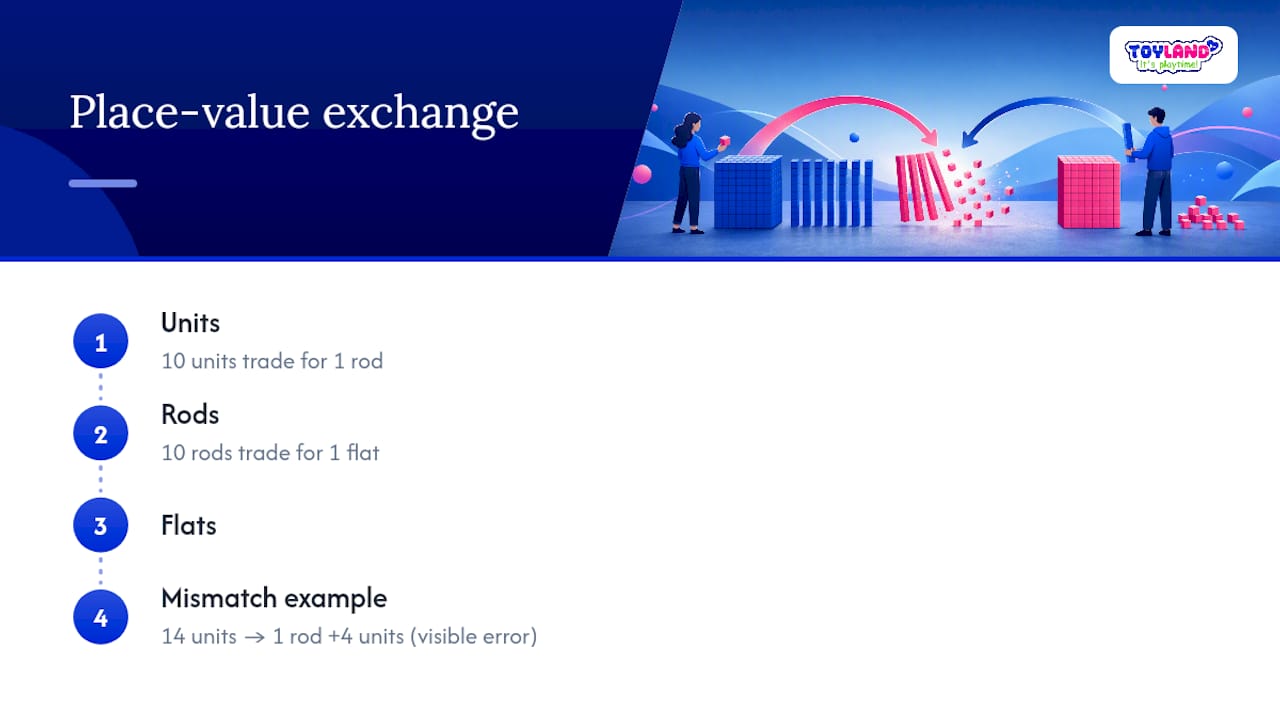
Teachers also lean on the size relationship for self-correction. A student who claims 14 units equals a rod and 4 units can literally see the extra pieces sitting there unmatched. That visual mismatch does more to correct the misconception than a red pen ever will.
How to Use Base Ten Blocks for Place Value, Regrouping, and Decimals
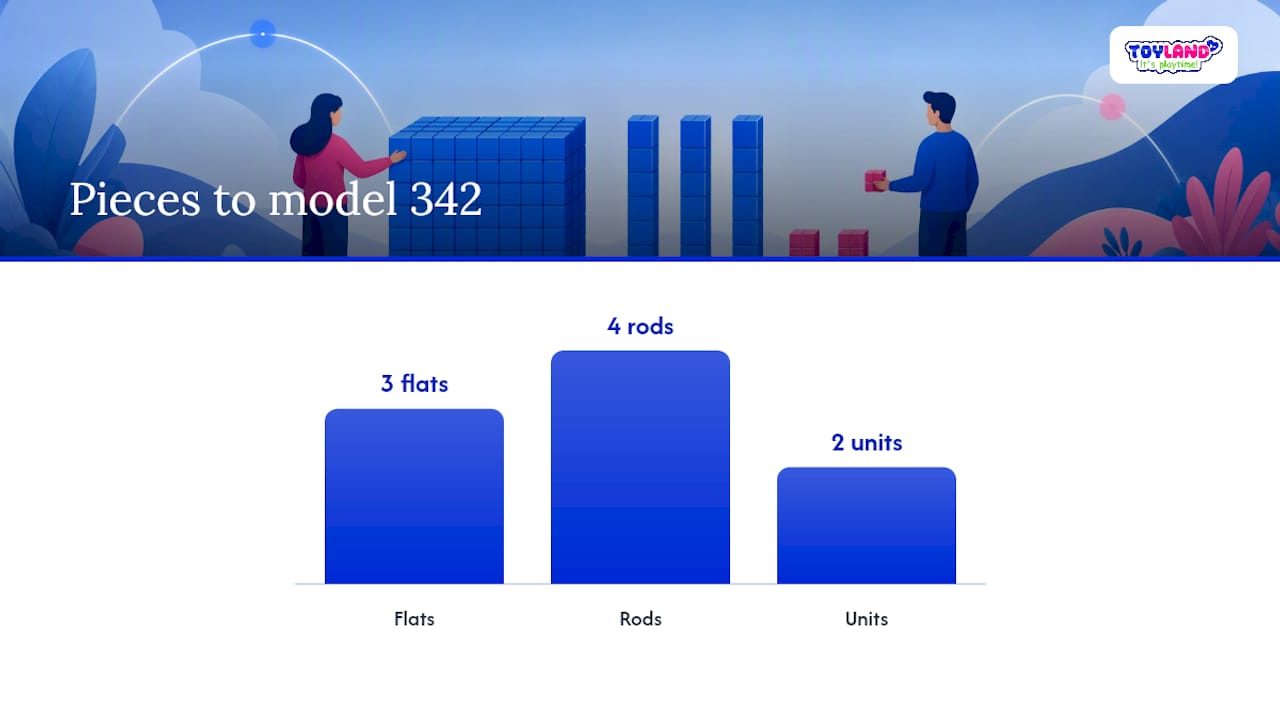
Modeling a number is the starting move. To show 342, lay out 3 flats, 4 rods, and 2 units. Say the expanded notation out loud as you build it: “300 plus 40 plus 2.” This single habit, building before writing, is the fastest way to stop students from writing “3042” when they mean 342.
Addition with regrouping, step by step:
- Model both addends separately with blocks (say, 47 and 28).
- Combine all units first: 7 units + 8 units = 15 units.
- Trade 10 of those units for 1 rod, leaving 5 units and a new rod on the table.
- Combine rods: the original 4 and 2, plus the new one, equals 7 rods.
- Read the result directly off the blocks: 7 rods, 5 units = 75.
Subtraction with regrouping runs in reverse. To solve 52 minus 27, you can’t take 7 units from only 2, so you break a rod back into 10 units first, leaving 4 rods and 12 units. Now you subtract cleanly: 12 minus 7 is 5 units, 4 minus 2 is 2 rods, giving you 25. Writing the trade notation alongside the blocks (crossing out a rod, adding “+10” to the units column) connects the physical move to the standard algorithm students will use later without blocks.
Multiplication uses an area model instead of repeated grouping. For 12 x 13, build a rectangle: one side made of 1 flat and 2 rods (representing 12), the other side made of 1 flat and 3 rods (representing 13). The rectangle’s interior fills with 1 large cube worth of area, plus partial flats and rods, and students add the regions to get 156. It’s the same logic they’ll later use for the standard algorithm’s partial products, just visible instead of abstract.
Division works as fair sharing. To solve 84 divided by 4, build 84 with flats, rods, and units, then physically deal the pieces into four equal groups, trading down flats into rods when a group can’t get a whole flat. Whatever ends up in one group is the quotient.
Decimals require one clever change: redefine the flat as your new “one.” That makes the rod worth 0.1 and the unit cube worth 0.01. Comparing 0.7 and 0.65 becomes concrete: 0.7 is 7 rods, 0.65 is 6 rods and 5 units, and laying them side by side shows immediately which pile is bigger, something that trips up plenty of students when the numbers are just written on a whiteboard.
Base Ten Blocks Activities and Games That Actually Teach
Worksheets drill; games diagnose. These three activities cover the range from kindergarten counting to fourth-grade regrouping fluency.
- Race to 100. Materials: one die, a pile of unit cubes, a supply of rods, and one flat per player. Roll the die, take that many units, and any time you have 10 or more units, trade them for a rod. The first player to trade up to one full flat wins. It’s the single cleanest way to make the 10:1 rule automatic, because the trading isn’t optional, it’s the whole game.
- The trading game. Give pairs of students a random pile of units and rods and ask them to trade up as far as possible, then explain their moves out loud. Ask, “How did you know you could trade there?” and “What would happen if you had one fewer unit?” Those two questions do more for transfer to written algorithms than another worksheet page would.
- Illegal numbers. Show a “number” built incorrectly, say, 14 units and 2 rods, and ask students to spot what’s wrong and fix it. This puzzle format is a low-effort, high-return way to sharpen error detection and flexible regrouping thinking, and kids tend to enjoy playing “teacher” and catching the mistake.
For small groups or one-on-one tutoring, slow the pace and narrate every trade aloud before the student repeats it back. English language learners benefit from pairing the physical trade with sentence frames (“I traded 10 units for 1 rod because…”). Students with fine-motor challenges do better with slightly oversized foam or magnetic block sets rather than the smallest plastic pieces.
Pro Tip: Run “illegal numbers” as a two-minute warm-up at the start of every regrouping unit. It takes almost no prep and resets the whole class’s attention on the 10:1 rule before the real lesson starts.
Sample Lesson Sequences by Grade Band
Pacing base ten instruction depends heavily on grade level, and jumping straight to multi-digit regrouping with kindergartners is the most common overreach teachers make.
Kindergarten and early first grade:
- Start with loose counting and grouping, not fixed blocks. Let children physically build groups of ten from smaller cubes before introducing a pre-made rod.
- Spend most sessions just naming quantities: “That’s a group of ten and 3 more.”
- Transition to formal rods and flats only once grouping-by-ten feels automatic, usually mid-first-grade.
Grades 1 to 2:
- Focus lessons squarely on trading: units to rods, rods back to units.
- Introduce two-digit addition and subtraction with regrouping once trading is fluent, typically over a 3 to 5 day sequence.
- Checkpoint with a quick exit ticket: “Model 47 with blocks, then add 6.”
Grades 3 to 5:
- Extend into multi-digit operations, the area model for multiplication, and decimal place value using the redefined flat.
- Budget one lesson per new concept (multiplication area model, decimal comparison, division sharing) and one review lesson pairing blocks with the written algorithm.
- Use a five-minute formative check at the end of each lesson: hand students a number and ask them to build it, then translate it to standard notation without blocks.
Worked Problems and Practice Prompts
Try these with students, then compare their block setup to the model answer.
- Build 256. Model: 2 flats, 5 rods, 6 units. Ask them to say the expanded form aloud.
- Add 38 + 47. Combine units (8+7=15), trade 10 for a rod, leaving 5 units. Combine rods (3+4+1 new = 8). Answer: 85.
- Subtract 63 − 28. Break a rod into 10 units (now 5 rods, 13 units), subtract cleanly: 5 units, 3 rods. Answer: 35.
- Model 0.4 and 0.38, then compare. Flat = 1, so 0.4 is 4 rods; 0.38 is 3 rods and 8 units. 0.4 is larger.
- Divide 96 ÷ 3. Build 96, deal into 3 equal groups, trading a flat down into rods as needed. Each group gets 32.
When students explain their reasoning, listen for whether they mention the trade explicitly (“I had to break a rod because I didn’t have enough units”). That phrase is the tell that they understand regrouping rather than just following steps. For partial credit, award marks for a correct block model even if the final written number is wrong. The error usually lives in translation, not understanding.
Keeping Base Ten Blocks Organized and Accessible
A disorganized bin of blocks kills more lesson time than any pedagogy problem. Label each storage bag by piece type and count, and recount sets at the end of each unit rather than the start of the next one, so missing pieces surface while you can still trace them.
- Keep a small “missing pieces” kit of loose unit cubes and extra rods on hand for sets that come up short mid-lesson.
- Reserve virtual manipulatives for showing a trade in motion, then hand out physical sets for the actual practice.
- Younger students who struggle with fixed-size pieces often do better starting with interlocking cubes they build into tens themselves before moving to base ten blocks.
- For students needing an alternative texture or grip, Unifix cubes cover similar ground on place value, even without the flat/cube proportional scale.
Pro Tip: Wipe down shared sets weekly, not just after visibly messy activities. Blocks that sit in bins for a full semester between full cleanings pick up more grime than teachers expect.
A Practical Note on Teaching With Base Ten Blocks
Most guides treat base ten blocks like a solved problem: hand them out, watch understanding appear. It doesn’t work that way. The blocks only do their job when a teacher or parent keeps asking “why did you trade there?” instead of just checking the final answer. There are building block sets and math manipulatives available that hold up to repeated, hands-on use in real classrooms, not just a demo shelf. If you’re assembling a kit for a group of students, look for classroom-sized sets built for regular handling.
— Thane Holland
Toylandeu™ Manipulative Picks for Place Value Lessons
Some toy and educational kit retailers offer worldwide shipping and a family-run approach that can help classroom or homeschool orders avoid delays from cross-border fees or slow logistics, which can be a pain point when restocking manipulatives mid-semester.
For place value lessons specifically, start with the Building Block Sets | Compatible Bricks & MOC Kits collection, which includes classroom-appropriate sets sized for small-group work. If you want a wooden alternative with a different tactile feel, the Red and Blue Bars Montessori Math Blocks offer another proportional model for kids ages 6 to 12. When choosing between options, match set size to your group (one kit per pair of students works best for trading games), check whether the material suits younger hands (wood resists cracking better than thin plastic under daily classroom use), and confirm the set includes enough flats for whole-hundred activities like Race to 100. Browse the current catalog and pick a set sized for your classroom or homeschool group today.
Sources
- Base Ten Blocks | Brainingcamp
- What Are Base Ten Blocks? Explained For Elementary Schools | Third Space Learning
- Race to 100 math game (activity PDF)
- CEEDAR handout on math instruction and manipulatives
FAQ
How Do You Write 100 With Base Ten Blocks?
You model 100 with a single flat, the 10-by-10 square piece, since 10 rods trade evenly for 1 flat. You could also show it as 10 individual rods lined up before trading, which is a useful step for demonstrating the regrouping rule itself.
Are Base Ten Blocks Effective for Teaching Math?
Yes. They follow the Concrete-Representational-Abstract sequence that education research supports for building place value understanding, and the proportional sizing makes magnitude and regrouping visible rather than abstract. They work best when paired with guided questioning, not handed to students without discussion.
What Age or Grade Are Base Ten Blocks For?
Base ten blocks suit kindergarten through about fifth grade, with the heaviest use in grades 1 through 4 for place value, regrouping, and multi-digit operations. Kindergartners typically start with looser grouping activities before moving to fixed-size blocks once counting by tens feels automatic.
Why Have Some Math Curriculums Moved Away From Base Ten Blocks?
Some programs shift toward other manipulatives or drawn models (like number lines or bar models) once students show fluency, since blocks can become a crutch if students never transition to abstract notation. The blocks themselves aren’t the issue. The fix is deliberately fading their use as part of the CRA progression, not abandoning them outright.
Can Toylandeu™ Help Me Get a Classroom Set of Manipulatives?
Toylandeu™ carries building block and manipulative options through its building block sets collection, with free worldwide shipping on orders. Current pricing and set sizes are listed directly on the site.
Recommended Reads
- Exploring Numicon Math Manipulatives Effectiveness
- Innovative Mathematics: The Power of the Concrete Pictorial Abstract Method
- Classroom Ready Multiplication Games for Kids
Recommended
- The Best Fraction Manipulatives for Every Grade and Home Lesson
- Red and Blue Bars Montessori Math Blocks for Kids 6 to 12 Wooden Busy Board Educational Toy
- Unlocking Math Magic: Creative Hands-On Activities for Kids
- Montessori Wooden Counting Peg Board For Kids Durable Wooden Math Learning Toy For Preschool