

The Best Fraction Manipulatives for Every Grade and Home Lesson
Fraction tiles, circles, and bars work best when a child is first meeting the concept of a part and a whole. Fraction strips and towers take over once students need to compare or find equivalence. Pattern blocks and LEGO bricks earn their place when the “whole” itself needs to change shape. Virtual apps step in for homework, remote practice, and any moment a teacher needs to save or share a student’s work instantly.
Start hands-on, move to virtual. That order isn’t a preference; it’s how kids actually learn. Concrete interaction with physical pieces builds the intuition that makes symbolic notation stick later, a point the National Library of Virtual Manipulatives and federal education researchers have both documented.
Here’s the quick-pick list:
- Fraction tiles, bars, and circles: best for introducing part-whole thinking, addition, and subtraction.
- Fraction strips and towers: best for comparing fractions and building equivalence.
- Pattern blocks and LEGO: best for flexible-whole reasoning and spatial thinking.
- Virtual fraction apps: best for practice, denominator scaling, and sharing student work digitally.
Key Takeaways
Hands-on fraction manipulatives should come before symbolic instruction, and virtual tools work best as a follow-up for practice and sharing, not a replacement for physical pieces.
| Point | Details |
|---|---|
| Start concrete | Introduce fractions with tiles, circles, or bars before moving to symbols or worksheets. |
| Use strips for comparison | Fraction strips and towers make equivalence and ordering visible without extra explanation. |
| Teach the flexible whole | Pattern blocks and LEGO show that a fraction depends on what counts as “one.” |
| Save virtual tools for practice | Apps like NLVM and the Math Learning Center’s Fractions app excel at scaling and sharing work. |
| Buy for durability and coverage | Toylandeu™'s Magnetic Montessori Math Kit covers fractions and percents in one classroom-ready set. |
Table of Contents
- What Are Fraction Manipulatives, and What Are the Main Types?
- Hands-On Fraction Manipulatives That Actually Get Used in Class
- Which Virtual Fraction Manipulatives Are Worth Using?
- Fraction Activities That Work in Class and at Home
- How to Choose Fraction Manipulatives for Your Classroom or Home
- Toylandeu™ Resources and What’s Verified So Far
- What Actually Moves the Needle With Fraction Manipulatives
- Where to Buy Classroom-Ready Fraction Manipulatives
- Useful Tools for Teaching Fractions Online
- Sources
- FAQ
What Are Fraction Manipulatives, and What Are the Main Types?
Fraction manipulatives are concrete tools, physical or digital, that let students touch, move, or drag pieces representing parts of a whole. They give kids something to reason with before they’re asked to reason in the abstract, using symbols like ¾ or 5/8.
Most classrooms and homes rely on a handful of core categories:
- Tiles and bars: rectangular pieces that stack to show equivalence and operations.
- Circles: pie-shaped wedges that model fractions the way kids already picture pizza or cake.
- Strips and towers: long pieces divided into equal parts, ideal for lining up comparisons.
- Number lines: show fractions as points and distances, useful for ordering and scaling.
- Pattern blocks: shapes that can represent different “wholes” depending on how you group them.
- Virtual apps: digital versions of all the above, with save and share features built in.
The real skill isn’t memorizing one tool. It’s learning that a “whole” can be a circle, a rectangle, or six triangles arranged into a hexagon, and that a fraction still means the same thing no matter which shape holds it. Rotating between two or three models is what turns a shaky concept into a durable one.
Hands-On Fraction Manipulatives That Actually Get Used in Class
Physical manipulatives remain the backbone of early fraction instruction, and for good reason: kids can stack them, flip them, and physically prove that two quarters equal one half.
Fraction tiles and bars work like building blocks. A student lines up two 1/4 tiles next to a 1/2 tile and sees the equivalence without being told it’s true. Teachers use the same tiles for addition and subtraction by asking students to combine or remove pieces and name the result. Magnetic versions, like the dual-sided magnetic fraction and percent board, let a class see a fraction, decimal, and percent on the same piece, which speeds up the jump to later math units.
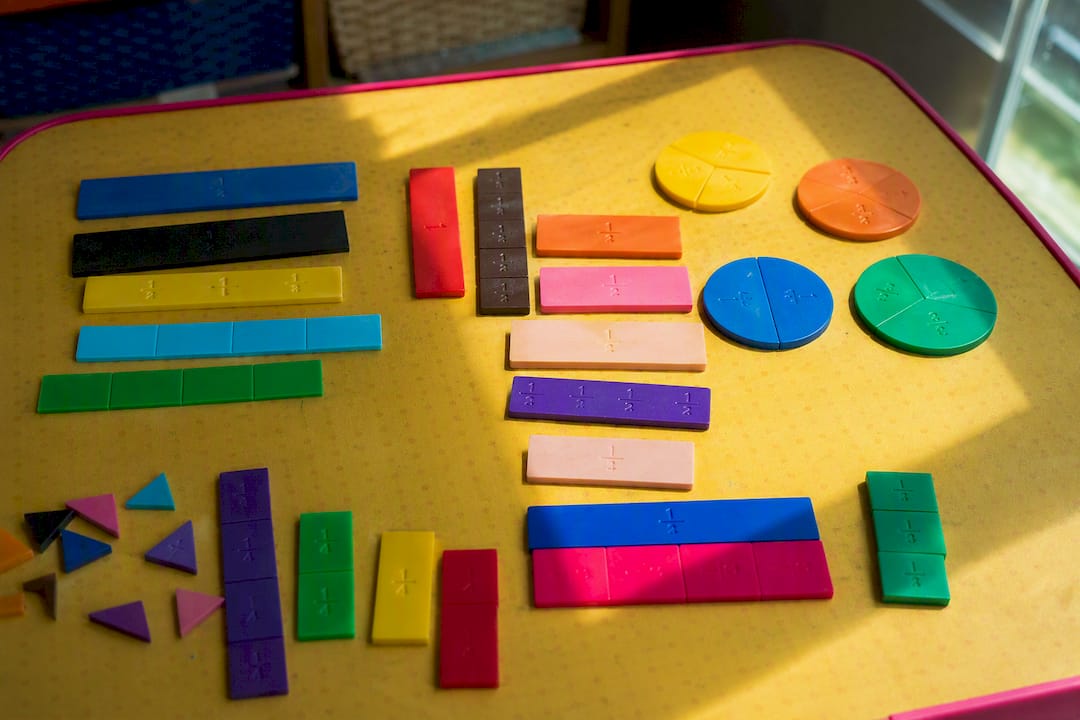
Fraction circles mimic something every kid already understands: sharing a pizza. Wedges snap together to rebuild a whole circle, which makes composing and decomposing fractions feel like a puzzle rather than an assignment.
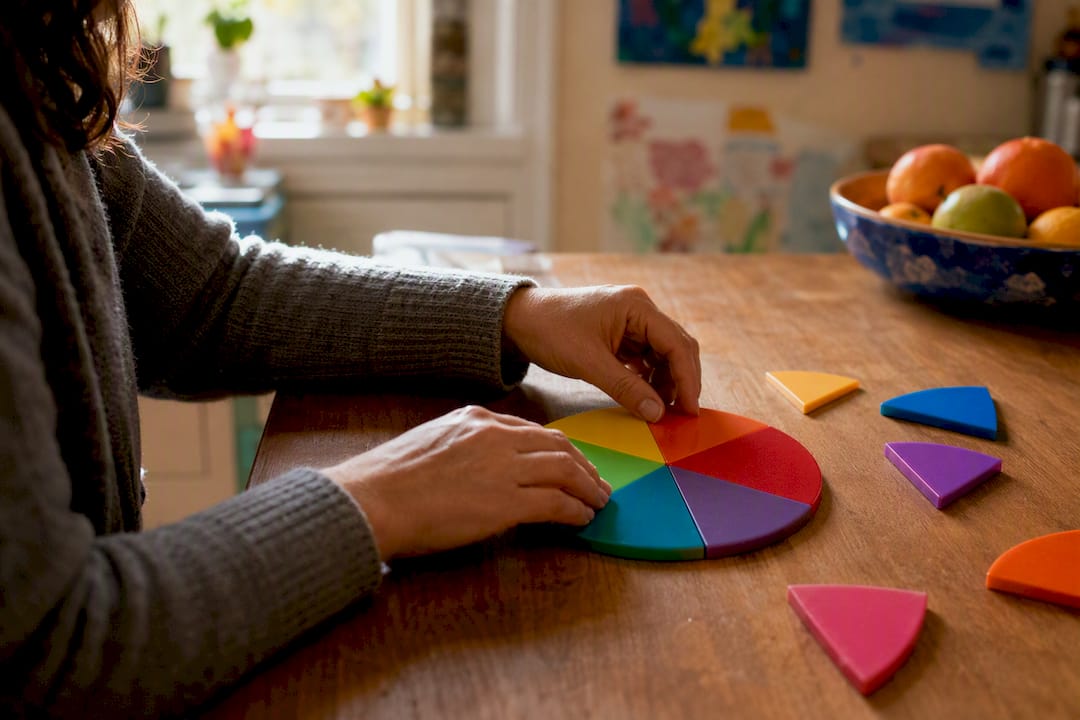
Fraction strips and towers add a comparison feature tiles alone don’t offer. Line up a strip of thirds next to a strip of sixths, and a student can see 2/6 sitting exactly on top of 1/3. Digital tools built around this idea, including the mathies Fraction Strips tool, extend the same logic into “trains” and equivalence bars for ordering tasks.
Pattern blocks, tangrams, and LEGO handle a trickier idea: the flexible whole. Group six triangles into a hexagon, and suddenly one triangle is a sixth. Rearrange the same triangles into a different shape, and the fraction value shifts with it. This is where kids start to understand that a fraction is relative to what you call “one,” not a fixed size.
- Grades K to 2: circles and simple tiles for unit fractions (halves, thirds, fourths).
- Grades 3 to 5: strips, bars, and tiles for equivalence, addition, and subtraction.
- Grades 6 and up: number lines, pattern blocks, and scaling tasks involving unlike denominators.
Pro Tip: Buy one extra full set beyond your headcount. Pieces go missing constantly, and a short set kills a lesson faster than a bad worksheet.
For classrooms watching budget, printable tile and strip templates cover the basics, while wooden or magnetic sets survive years of daily handling and are worth the extra cost for a permanent math center.
Which Virtual Fraction Manipulatives Are Worth Using?
Digital tools solve a problem physical pieces can’t: instant scaling and shareable proof of student thinking. A good virtual manipulative typically covers five interaction modes:
- Fraction wedges (circle mode): drag, rotate, and color pieces to build or compare fractions.
- Bars and strips: stack digital strips the same way physical ones work, just resizable.
- Fraction pieces: draggable shapes that snap together to model composition.
- Number line tools: plot fractions as points for ordering and estimation practice.
- Equivalence and ruler tools: overlay fractions to prove equal value visually.
Look for teacher-facing features too: adjustable denominators, the ability to save or export student work, annotation tools for feedback, and step replay so a teacher can see how a student arrived at an answer, not just the final image.
The NLVM fraction pieces tool supports denominators including 2, 3, 4, 5, 6, 8, 10, and 12, with wedges and trapezoids students can drag, rotate, and label. That range covers nearly every fraction a K to 6 curriculum will ask for. The Fractions app from The Math Learning Center is better suited to strip and train activities, with built-in save and share features that let a student email a screenshot straight to a parent or teacher.
A practical rotation looks like this: model a new concept on the whiteboard using the projected app, send students to individual devices for guided practice, then collect screenshots as an informal check before moving to independent work.
Fraction Activities That Work in Class and at Home
Manipulatives only pay off when they’re tied to a specific task. These activities scale from kindergarten through middle school.
- Unit-fraction discovery (K to 2): give students circles or pattern blocks and ask them to build halves, thirds, and fourths without instructions first, then discuss what they notice.
- Equivalent-fractions match (3 to 5): pair physical tiles with a digital equivalence bar and have students find every match they can in five minutes.
- Addition and subtraction centers (3 to 6): whiteboard cards paired with fraction tiles let small groups solve problems and show their work with the pieces still in place.
- Number-line ordering challenge (4 to 6): students plot a mixed set of fractions on a shared number line and defend their placement out loud.
- Recipe or sundae-shop scaling (home-friendly): double a recipe that uses fractional measurements, or build a “sundae shop” where toppings represent fractional portions of a bowl.
- Snapshot checks: ask a student to build a fraction with pieces, snap a photo, and explain it in one sentence. It’s a two-minute formative assessment that beats a worksheet for catching misconceptions early.
How to Choose Fraction Manipulatives for Your Classroom or Home
Picking the right set comes down to four questions: does it match your grade level, does it cover the denominators you’ll actually teach, is it labeled clearly, and will it survive daily use?
- Grade alignment: younger students need simple halves and fourths; older students need denominators up to twelfths and beyond.
- Denominator coverage: check that a set includes thirds, sixths, and eighths, not just the easy halves and fourths.
- Color-coding and labels: sets that mark fractions, decimals, and percent on the same piece save serious teaching time later.
- Set size: buy enough for small-group centers, plus spares for pieces that wander off.
- Budget tier: printable templates work for quick practice; magnetic or wooden kits hold up for a full school year of rotation.
Pro Tip: Store each fraction family (halves, thirds, quarters) in its own labeled bin. Mixed bins waste more class time than any other single classroom-management mistake.
Copy this line into your supply list: buy one durable core set for demonstration, one printable backup for centers, and one spare set for replacement pieces.
Toylandeu™ Resources and What’s Verified So Far
Toylandeu™ carries physical manipulatives built for classroom durability, including the Magnetic Montessori Math Kit for fractions and percents, alongside blog coverage of hands-on math tools like the Numicon manipulatives review.
What’s confirmed: product listings with specifications, and topical blog posts covering manipulative-based learning. What’s not yet available: independent classroom case studies or third-party testimonials specific to fraction kits.
- Product pages with sizing and material details are live now.
- Blog posts on hands-on math activities are published and linked throughout this guide.
- Teachers wanting proof before a bulk order can start with a single set, run a one-week pilot with one class, and request sample photos from the listing before scaling up.
What Actually Moves the Needle With Fraction Manipulatives
Most advice on this topic treats manipulatives as interchangeable, buy any set of tiles and you’re covered. That’s not quite right. The research consistently points to the flexible whole idea as the piece most classrooms skip, and it’s the one that separates kids who can name a fraction from kids who actually understand what it represents.
Circles and tiles are easy defaults because they’re familiar, but a set that always uses the same shape as “one whole” quietly teaches kids that fractions are fixed sizes rather than relationships. Pattern blocks and LEGO force a harder, more valuable question: what happens to the fraction when the whole itself changes? That’s the moment kids stop reciting rules and start reasoning.
The other overrated habit is treating virtual tools as a replacement for physical pieces rather than a second pass at the same idea. Screens are excellent for scaling denominators fast and for sending proof of work home, but they shouldn’t be the first stop for a five-year-old meeting fractions for the first time. Hands first, screens second, and don’t skip the flexible whole.
— Thane Holland
Where to Buy Classroom-Ready Fraction Manipulatives
Toylandeu™ stocks fraction kits built for repeated classroom handling, not one semester of use. The Magnetic Montessori Math Kit fraction and percent learning set pairs magnetic strips and bars so a teacher can demo on a whiteboard and hand matching pieces to small groups the same day.
If you’re setting up a math center, order one extra student set beyond your headcount and confirm the denominators match what you’re teaching this term, sixths and eighths matter as much as halves. Toylandeu™ ships internationally with a catalog that goes well beyond fractions, so the same order can cover a STEM kit or a building-brick set for a rainy-day activity table. Check the fraction and percent kit’s listing now and see if the piece count fits your class size before the next unit starts.
Useful Tools for Teaching Fractions Online
A short list of free digital tools covers most classroom and homework needs without a subscription.
- NLVM fraction pieces: deep manipulative library with teacher notes covering denominators from 2 through 12, plus suggested lesson sequences.
- Fractions app by The Math Learning Center: strips, trains, and save/share features that make it easy to collect student work as evidence of understanding.
- mathies Fraction Strips tool: strong teacher guidance and activity ideas built around trains, equivalence bars, and ruler-style comparisons.
Sources
- Fraction Pieces teacher documentation — NLVM
- Fractions by The Math Learning Center
- Fraction Strips Tool documentation — mathies
FAQ
What manipulatives can I use for fractions?
Fraction tiles, circles, strips, towers, number lines, and pattern blocks all work, along with virtual versions of each through tools like NLVM’s fraction pieces.
What are some good toys to teach fractions?
Magnetic fraction and percent kits, LEGO bricks used for flexible-whole activities, and fraction circle puzzles all double as toys and teaching tools; Toylandeu™'s Magnetic Montessori Math Kit is built specifically for this.
What are some practical activities for learning fractions?
Unit-fraction discovery with circles, equivalent-fraction matching with tiles, number-line ordering challenges, and recipe-scaling at home all build fraction sense through repetition and hands-on proof.
Recommended
- Magnetic Montessori Math Kit Fraction and Percent Learning Set With Strips and Bars for Ages 12 and Up ToylandEU™
- Exploring Numicon Math Manipulatives Effectiveness – ToylandEU
- Unlocking Math Magic: Creative Hands-On Activities for Kids – ToylandEU
- Master Math Playfully: The Best Montessori Math Toys Revealed – ToylandEU