

Buy Right for Every Age: STEM Toys from 0–18 Months to Teens
The right progression starts with sensory exploration for infants, moves into cause-and-effect and simple building for toddlers, then shifts toward mechanics, coding, and circuitry as kids move through elementary school and into their teens. The one rule that holds at every stage: match the toy to the child’s current skills, check the safety label for their age, and stay involved enough to help when the puzzle gets hard.
TL;DR:
- Sensory toys for infants should promote touch and sound exploration, avoiding small parts and encouraging verbal interaction to support neural development.
- Toddlers benefit most from cause-and-effect toys that reinforce feedback loops, with safety checks for small hazards due to their mouthing tendencies.
- Preschool STEM toys should focus on open-ended building and simple coding, with attention to expandability and ease of use for developing planning skills.
- Elementary-age children excel with kits that introduce real wiring, programming, and scientific experimentation, requiring adult supervision for advanced projects.
- Age labels serve as safety guidelines, not strict developmental markers; choose toys based on individual child’s skills and interest levels for maximum engagement.
Table of Contents
- Stem Toys by Age: A Quick Developmental Map
- Stem Toys for Infants (0 to 18 Months): Sensory Play First
- Stem Toys for Toddlers (1 to 3 Years): Cause and Effect Takes Over
- Stem Toys for Preschoolers (3 to 5 Years): Building and Early Design Thinking
- 5 Best Approaches to Stem Toys for Ages 5 to 7
- Stem Toys for Preteens (9 to 11 Years): Real Wiring and Independent Projects
- Stem Kits for Teens (12 to 16+): Advanced Electronics and Lab-Style Work
- How to Choose the Right Stem Toy at Any Age
- Why Trust This Stem Toy Guide
- Making Stem Toys Work for Kids With Different Needs
- Letting Stem Toys Coexist With Open-Ended Play
- The Overlooked Truth About Buying Stem Toys by Age
- Shop Stem Toys by Age at Toylandeu™
- Sources
- FAQ
Stem Toys by Age: A Quick Developmental Map
Before shopping, it helps to see where a specific age fits into the bigger picture. Zero to Three frames STEM learning as a continuum that starts with sensory exploration in infancy and gradually builds toward the kind of open-ended, logical problem-solving older kids and teens are capable of. That means the best STEM toys for toddlers look nothing like the best options for a 10-year-old, and neither should try to do the other’s job.
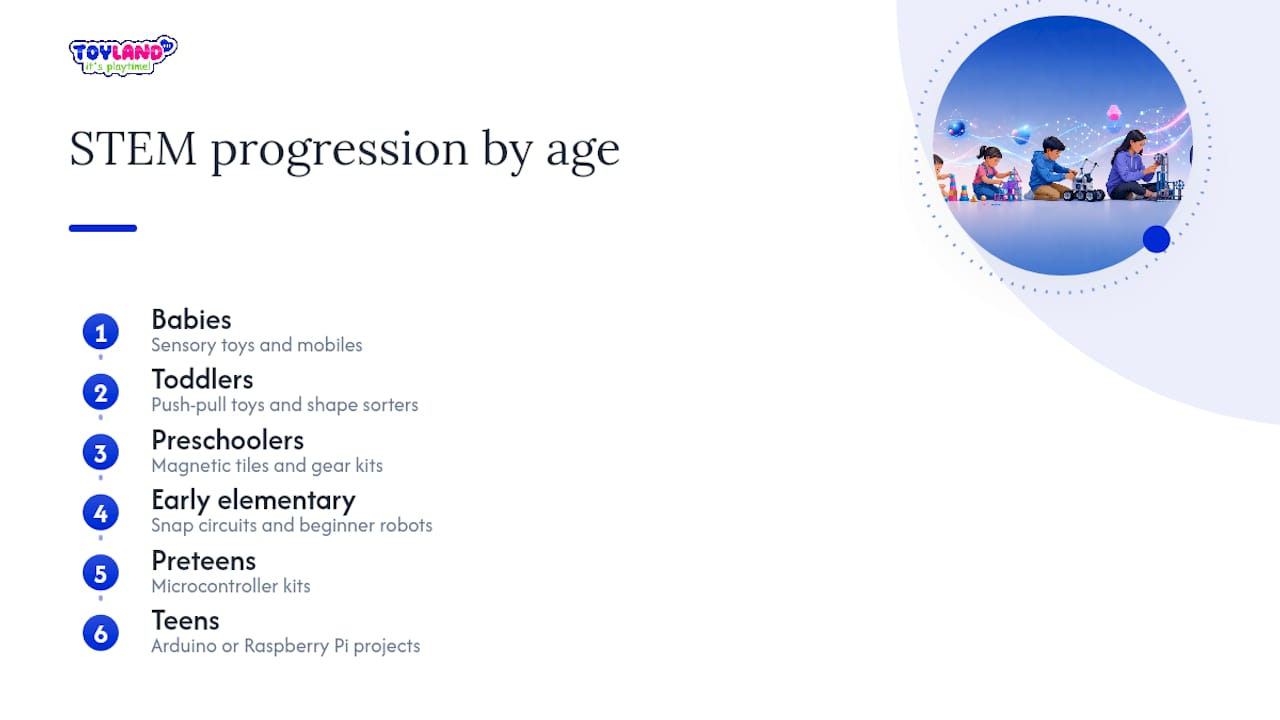
Here’s the rough arc: sensory toys and mobiles for babies, push-pull toys and shape sorters for toddlers, magnetic tiles and gear kits for preschoolers, snap circuits and beginner robots for early elementary kids, microcontroller kits for preteens, and Arduino or Raspberry Pi projects for teens. Every stage below breaks down what to actually put in the cart.
Stem Toys for Infants (0 to 18 Months): Sensory Play First
At this age, STEM learning is really just sensory learning. Babies build early motor skills and attention span through touch, sound, and repeated cause-and-effect moments, and CDC research on early brain development confirms that responsive, sensory-rich play during infancy directly supports neural growth.
Good options at this stage include:
- Textured sensory mats for tummy time
- Soft rattles that respond to grip and shake
- High-contrast mobiles for visual tracking
- Washable, chewable activity books with flaps or textures
Work these into routines you’re already doing, like tummy time or diaper changes, rather than treating play as a separate task. Stick to BPA-free materials, avoid anything with parts smaller than a golf ball, and wash soft toys weekly.
Pro Tip: Narrate what your baby is doing during sensory play (“you’re squeezing that rattle!”). That verbal interaction is part of what makes the play develop attention and language together.
Stem Toys for Toddlers (1 to 3 Years): Cause and Effect Takes Over
Toddlers are obsessed with consequences. Push a button, something happens. Stack a block too high, it falls. This is exactly the kind of feedback loop that builds early problem-solving, and it’s why the best STEM toys for toddlers lean heavily on physical cause-and-effect rather than screens or instructions.
Look for:
- Large, chunky blocks that stack and topple safely
- Push-pull toys with visible mechanisms (gears, wheels)
- Simple shape sorters and 4 to 6-piece puzzles
- Bath toys that pour, squirt, or float differently
Scaffold difficulty gradually. Once a toddler masters a 4-piece puzzle, move to 8 pieces rather than jumping straight to 20. Check for choking hazards constantly at this stage. Toddlers put everything in their mouths, and toys marketed for “3+” sometimes still ship with small magnets or batteries that need extra scrutiny before they land in a toy bin.
Stem Toys for Preschoolers (3 to 5 Years): Building and Early Design Thinking
Preschoolers start engaging in symbolic play and sequencing, which is a fancy way of saying they can now plan three or four steps ahead instead of reacting in the moment. This is prime time for open-ended building toys that reward that kind of thinking, and it lines up with what NAEYC’s guidance on early STEM learning recommends: play-based activities over anything resembling formal instruction.
Strong choices include:
- Magnetic tiles for 3D construction
- Simple gear and pulley kits
- Screen-free coding toys that use physical cards or buttons for sequencing
- Play-based science kits (color mixing, basic magnetism, simple sink-or-float tests)
Pro Tip: If a toy pairs with an app, preview the app yourself first. Some “educational” apps are mostly ads with a thin learning layer, and preschoolers can’t tell the difference.
Buy for expandability here. A magnetic tile set that grows with add-on packs outlasts a fixed 20-piece kit by years, not months.
5 Best Approaches to Stem Toys for Ages 5 to 7
Early elementary kids can hold multiple steps in their head, troubleshoot when something doesn’t work, and start recognizing patterns that look a lot like basic algorithms. This is where age-specific STEM games and kits start to resemble what most parents picture when they hear “STEM toy.”
- Marble runs with adjustable tracks. These teach sequencing and basic physics (gravity, momentum) through trial and error, with no instructions required.
- Snap circuit kits. Kids build real, working circuits with color-coded snap-together parts. Look for kits with a project booklet that scales from simple to complex.
- Beginner programmable robots. Toys that respond to button-sequence commands (not full coding) introduce the idea of giving a machine step-by-step instructions.
- Guided chemistry or physics kits. Kits with clear measurement steps build early scientific method habits, as long as an adult is nearby for setup.
- Design journals. Pair any kit with a notebook where kids sketch what they built and what they’d change. It costs nothing and builds documentation habits early.
Check that any kit has enough bonus projects or expansion packs to avoid a one-and-done shelf life.
Stem Toys for Preteens (9 to 11 Years): Real Wiring and Independent Projects
Preteens can handle abstraction: they understand that a line of code or a wiring diagram represents something that will actually happen. This is the age where toys stop simulating engineering and start being engineering, just at a beginner level.
Good picks include:
- Introductory microcontroller kits (block-based coding environments that control real hardware)
- Robotics kits with actual wiring and drag-and-drop programming
- Advanced construction sets with motorized or pneumatic components
- Small parts organizers, because these kits come with dozens of tiny components that are easy to lose
Keep an eye on part count and storage. A 200-piece robotics kit without a case turns into a frustrating floor hunt within a week. Point kids toward the maker communities and library STEM programs built around popular kits. Half the learning happens when a preteen searches for a fix to a problem the manual didn’t cover.
Stem Kits for Teens (12 to 16+): Advanced Electronics and Lab-Style Work
By the teen years, STEM play should look like sustained, multi-week projects rather than a single afternoon build. Kids at this stage are ready for real programming environments, actual soldering or breadboarding, and lab kits that require careful measurement and documentation. NSTA’s position on effective STEM education emphasizes exactly this kind of inquiry-based, student-driven approach over passive instruction.
Consider:
- Arduino or Raspberry Pi starter kits for programming and hardware projects
- Modular robotics platforms that support custom builds
- Advanced modular lab kits, such as the AlbiLAB scientific building system, which combines electronics, sensors, and 3D-printing support for ages 14 and up
- Circuit design kits with real soldering components (supervised)
Pro Tip: Before buying an advanced kit, check whether it has an active online forum or Discord. A dead support community means your teen is stuck googling error codes with no one to ask.
Any kit involving soldering, chemicals, or higher voltage needs adult supervision and a clear safety briefing before the first use, regardless of how “teen ready” the packaging claims to be.
How to Choose the Right Stem Toy at Any Age
Every good STEM toy purchase comes down to five questions, and running through them takes about thirty seconds once it’s a habit.
- Developmental fit: Does this match what the child can currently do, not what you hope they’ll grow into next year?
- Expandability: Can you buy add-on packs, or is this a closed, one-time experience?
- Safety: Does the age label match the actual part sizes and materials, not just the box art?
- Documentation: Does it include a real instruction booklet or project guide, or just a QR code to a thin web page?
- Cost versus value: Will this get played with for months, or once?
Wirecutter’s hands-on toy testing consistently finds that durability, easy setup, and replay value predict which toys actually get used long-term, and those three factors matter more than flashy marketing claims almost every time.
| Red flag | Why it matters |
|---|---|
| Hidden app subscription required to unlock features | Turns a one-time toy into a recurring cost |
| Small magnets or batteries on a toy labeled for under 3 | Age label doesn’t match actual choking risk |
| No printed instructions, only a link | Documentation often disappears when the link breaks |
| Single-use kit with no refill or expansion option | Short shelf life relative to price |
Before checkout, ask: what happens when my kid outgrows the beginner level in six months? If there’s no clear answer, look elsewhere. For a deeper breakdown by age, Toylandeu™'s STEM buying guide walks through specific product categories for kids from birth through age 12.
Why Trust This Stem Toy Guide
This guide was written by Thane Holland for an international toy retailer stocking a large catalog of STEM educational kits alongside robotics, building sets, and science kits for every age group. The age-band recommendations above draw on developmental guidance from organizations that actually study child development for a living, not marketing copy.
Sources shaping these recommendations include:
- Zero to Three on early sensory-based STEM foundations
- NAEYC on play-based learning for young children
- NSTA on inquiry-based STEM teaching practices
- Hands-on toy testing from outlets like Wirecutter
For product-specific questions, Toylandeu™'s STEM toy guidance for ages 3 to 12 covers how specific toy types map to school-age milestones.
Making Stem Toys Work for Kids With Different Needs
Age is only one variable. A STEM toy that’s developmentally perfect on paper can still be the wrong fit for a specific kid, and that’s worth planning for rather than discovering after the return window closes.
For kids with sensory processing differences, look for toys with adjustable stimulation levels; volume dials on electronic toys, textures that range from smooth to bumpy within the same set, and the option to play without lights or sound at all. A snap circuit kit that lets a child turn off the buzzer but keep the LED light is more usable than one that forces both.
Fine motor differences change which building toys make sense. Magnetic tiles and large-format blocks are generally more accessible than kits requiring precise pinching, like tiny gear assemblies, because they don’t demand the same dexterity to connect pieces successfully. Some robotics kits now ship with larger, easier-grip connector pieces specifically for this reason, so checking product photos for connector size before buying saves a lot of frustration.
For kids who process instructions differently, whether due to attention differences or language processing, kits with visual, icon-based instructions tend to work better than text-heavy manuals. Screen-free coding toys that use physical sequencing cards often bypass reading barriers entirely, which is part of why they show up so often in preschool and early elementary recommendations.
Budget is an accessibility issue too. A $15 sensory bin built from household materials, rice, water beads, and kitchen tools, can deliver the same tactile exploration goals as a $60 branded sensory kit. The developmental value comes from the interaction, not the price tag on the box.
Letting Stem Toys Coexist With Open-Ended Play
STEM toys work best as one part of a child’s play rotation, not the whole thing. A steady diet of instruction-driven kits, build this exact model, follow these exact code blocks, can quietly crowd out the unstructured play where kids actually practice original thinking.
For infants and toddlers, this balance is easy: almost all of their play is already open-ended by nature. The sensory mat doesn’t come with a “correct” way to explore it. As kids move into preschool and early elementary, though, the ratio starts to matter more. A magnetic tile set is technically open-ended (build anything) while a snap circuit kit with a project booklet is more directive (build this specific circuit). Both are valuable, and neither should dominate a child’s shelf entirely.
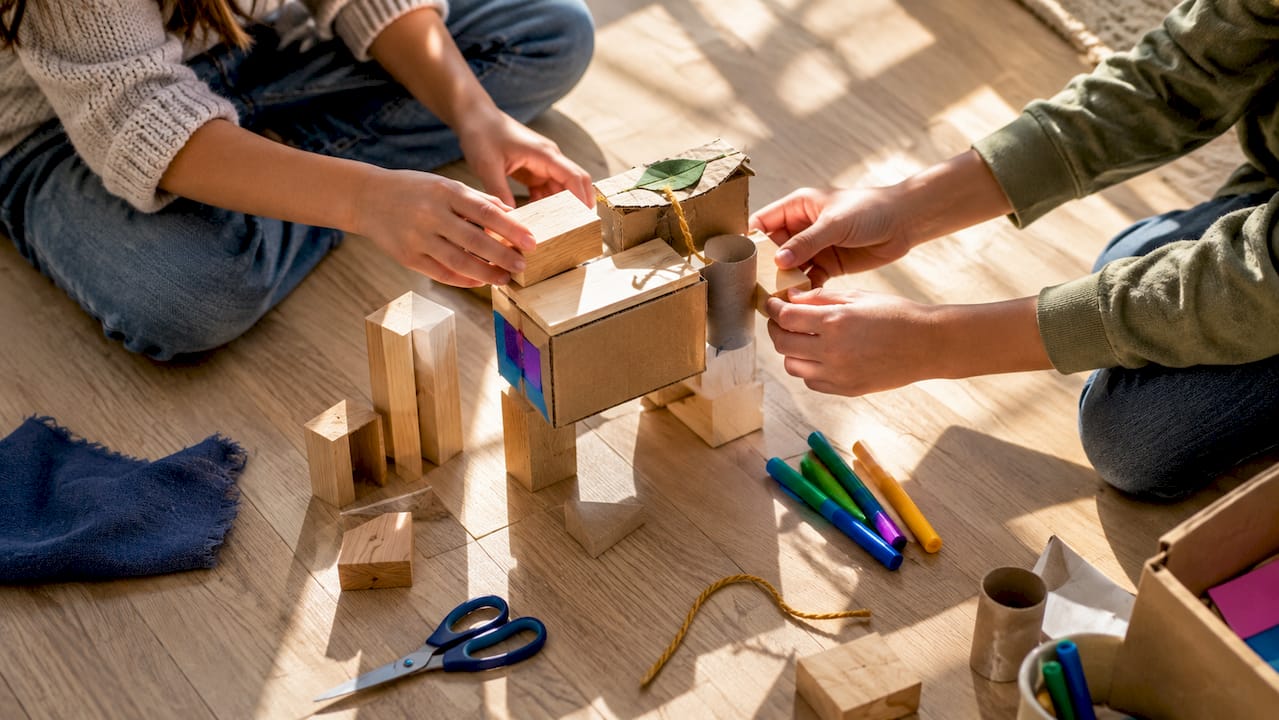
A useful habit: for every kit with a fixed set of instructions, keep at least one toy or material set with no instructions at all, loose parts, art supplies, plain blocks, a cardboard box. Kids who spend time in unstructured play tend to apply the mechanical thinking from their STEM toys more creatively when they’re free to invent their own rules.
By the teen years, this shifts again. Advanced kits like Arduino projects are inherently more open-ended than they look, since the “instructions” usually cover only the basic setup before the teen has to decide what to actually build. That’s arguably the healthiest version of STEM play: enough structure to get started, enough freedom to make it their own. The goal at every age isn’t to fill every shelf with STEM branding. It’s to make sure the analytical thinking those toys build has somewhere creative to go.
The Overlooked Truth About Buying Stem Toys by Age
Most advice on STEM toys treats age labels as gospel, and that’s the biggest mistake parents make. A box that says “8+” is a legal and safety guideline first, a developmental prediction second. Plenty of six-year-olds handle snap circuits fine with a little help, and plenty of nine-year-olds are still happiest with magnetic tiles. Buy for the kid in front of you, not the number on the box.
The conventional wisdom also overrates expensive, flashy kits and underrates boring durability. A $20 set of magnetic tiles that survives three years of daily building teaches more sustained engineering thinking than a $90 robot that breaks after a month of enthusiastic use. If you take one thing from the research behind this guide, take this: replay value beats feature count almost every time.
Where I’d push back hardest on standard advice is the pressure to start “coding” as early as possible. A three-year-old doesn’t need a coding toy. They need cause-and-effect toys that build the reasoning coding will eventually require. Skipping straight to screens and code blocks before a kid has mastered physical building is like handing someone a calculator before they understand what addition is. Sequence matters more than speed.
— Thane Holland
Shop Stem Toys by Age at Toylandeu™
Toylandeu™ stocks a wide STEM Toys collection spanning sensory kits for babies through advanced robotics and circuitry sets for teens, all searchable without wading through a catalog built for a different age group.
The collection filters by skill type and complexity, so a parent shopping for a five-year-old’s first snap circuit kit isn’t scrolling past teen-level Arduino boards to find it. Pair a STEM pick with something from the Building Block Sets and MOC Kits collection for open-ended building that balances out the more structured kits, or check the RC Toys lineup for preteens and teens who are ready to graduate into remote-controlled engineering builds. Browse the STEM collection now and filter by age to find the next toy that actually gets used past the first week.
Sources
- It’s never too early for STEM — Zero to Three
- Learning toys and STEM toys we love — Wirecutter
- STEM education teaching and learning — NSTA
FAQ
What age range are STEM toys suitable for?
STEM toys work for every age starting in infancy, with Zero to Three identifying sensory-based play from 0 to 18 months as the earliest form of STEM learning, scaling up through advanced robotics and lab kits for teens.
What is the best age to start STEM?
There’s no single starting age since sensory and cause-and-effect play in infancy already counts as early STEM learning; formal-feeling activities like coding and circuits typically fit best starting around ages 5 to 7.
What is the 20 toy rule for kids?
The 20 toy rule is a decluttering approach where parents limit a child’s accessible toys to around 20 items at a time, rotating others in and out to keep play engaging and reduce overwhelm, rather than a scientific standard tied to STEM development specifically.
What are some good STEM toys for a 7-year-old?
Strong options for a 7-year-old include snap circuit kits, adjustable marble runs, beginner programmable robots, and guided science kits, all of which build sequencing and troubleshooting skills appropriate for early elementary learners.
Are Montessori toys the same as STEM toys?
Not exactly. Montessori toys emphasize self-directed, open-ended exploration with natural materials, while STEM toys often include more structured mechanics, coding, or circuitry; many families use both, since Montessori-style open play pairs well with the more directive STEM kits covered above.