

The Best Math Toys for Preschoolers, Sorted by Skill and Age
Choose open-ended, hands-on manipulatives, think blocks, counters, sorting sets, and simple number games, to build preschool number sense and spatial reasoning. These toys outperform worksheets and drill apps because kids learn math by moving pieces with their hands, not by watching a screen or filling in a blank. Buy a mix that covers counting, patterns, and shapes, then match piece count to your child’s age. The specific picks and activities below tell you exactly where to start.
TL;DR:
- Toys that support counting, such as counting bears and dot-based card games, help children physically grasp number quantities through manipulation.
- Pattern development benefits from pattern blocks, bead strings, and sequencing cards, progressing from copying to creating original patterns.
- Spatial reasoning begins with wooden blocks, pegboards, and puzzles, encouraging mental rotation and shape-fit prediction, which are early geometric skills.
- Choosing toys suited to a child’s age, with adjustable difficulty and durability, promotes longer engagement and effective learning over time.
- Incorporating simple activities like outside counting walks and pattern hunts can extend the use of existing toys and reinforce math concepts.
Table of Contents
- Which Toys Teach Which Math Skill?
- Best Math Toys by Age, From Toddler to Kindergarten Prep
- How to Choose Math Toys That Actually Get Used
- Turn Any Toy Into a Math Lesson With These Activities
- What the Research Says About Play-Based Math Learning
- Why Open-Ended Toys Beat Worksheets for Preschool Math
- Build a Toylandeu™ Starter Kit for Preschool Math
- A Quick Note From the Author
- Sources
- FAQ
Which Toys Teach Which Math Skill?
Not every math toy teaches the same thing, and that’s the point. A toy that builds counting fluency won’t necessarily build spatial reasoning, so the smartest shopping strategy is to match the toy to the skill you want to grow.
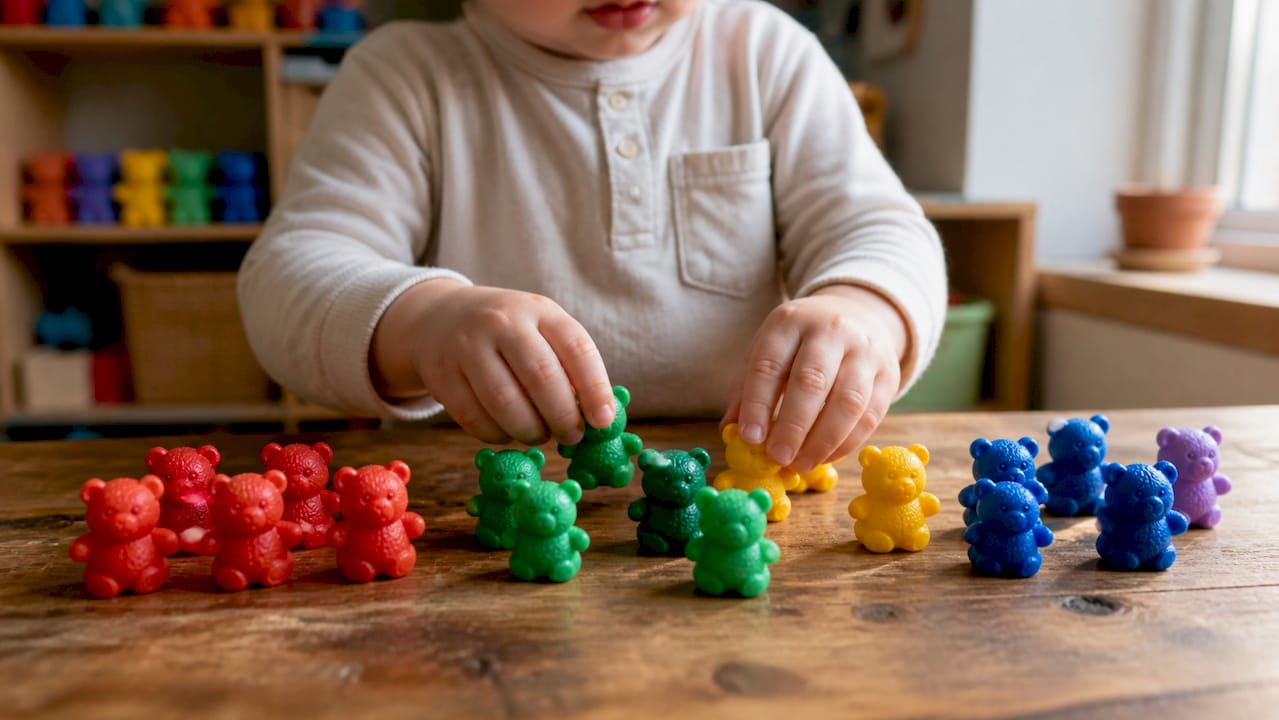
Number sense and counting come from toys kids can touch and move one at a time. Counting bears, linking cubes, and number trains let a child physically separate quantities. Card games that show visible dots or objects, like Tiny Polka Dot, reinforce the same idea by pairing a number with a countable image instead of an abstract numeral.
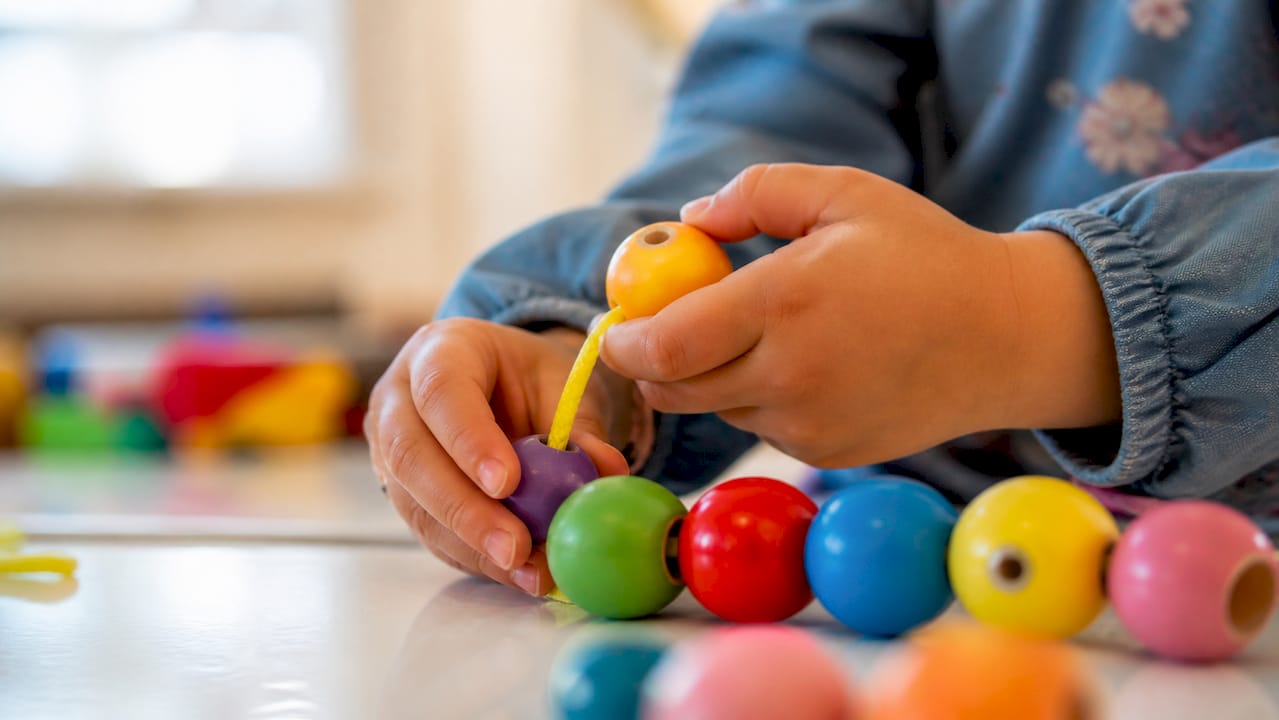
Patterns and sequencing develop through pattern blocks, bead strings, and sequencing cards. Start by asking your child to copy a pattern you’ve built, then step back and ask them to extend it, and eventually to invent their own. That progression, copy, extend, create, is how pattern recognition actually solidifies.
Spatial reasoning and geometry grow through wooden block play, pegboards, and simple jigsaw puzzles. These toys force a child to mentally rotate shapes and predict how pieces fit before they physically test the idea, which is early geometric thinking in action.
Measurement and comparison come from balance scales, measuring cups, and toys that sort by length or size. Ask “which one is heavier?” or “which cup holds more water?” and let your child test the guess.
- Number sense: counting bears, number trains, dot-based card games
- Patterns: pattern blocks, bead strings, sequencing cards
- Spatial reasoning: wooden blocks, pegboards, 4 to 12 piece puzzles
- Measurement: balance scales, measuring cups, length-sorting sets
Pro Tip: Watch for the learning signal, not just play itself. A child who starts saying “more” or “less” unprompted, or who can order objects 1 through 10 without help, is showing you the toy is working.
Best Math Toys by Age, From Toddler to Kindergarten Prep
Attention span and fine motor control change fast between ages 2 and 5, so a toy that’s perfect for a 4 year old can frustrate a 2 year old and bore a kindergartner. Buying by age first, then by skill, keeps play enjoyable instead of a battle.
- Ages 2 to 3: Stick to large manipulatives with just 4 to 8 pieces. Push-and-pull counting toys work well here because the focus isn’t math accuracy yet, it’s naming numbers and matching one object to one word. Chunky wooden shape sorters and oversized counting animals are ideal.
- Ages 3 to 4: Step up to 8 to 12 piece puzzles and simple matching or pattern games. This is also the age to introduce two-player counting games with basic turn-taking rules, since preschoolers are just starting to grasp fairness and sequence in play.
- Ages 4 to 5: Puzzles can jump to 12 to 20 or more pieces, and card or dice games can introduce simple addition and subtraction. A toy like My First Math Dice uses chunky dice and counter chips to bridge numeral recognition into basic addition without feeling like schoolwork.
Always check piece size against choking hazard guidelines for your child’s age, especially for toddlers who still mouth objects, and favor wooden or thick plastic pieces over anything with small magnets or button batteries. Durability matters here too. A toy that survives being dropped, chewed on, and stacked into a tower fifty times a day is worth more than one that looks nicer on a shelf.
How to Choose Math Toys That Actually Get Used
Most parents overbuy and underuse. A toy bin full of single-purpose gadgets gets ignored within a week, while one well-chosen manipulative set gets pulled out for years. Before you buy, run any toy through five questions.
- Does it support open-ended play? Can your child use it a dozen different ways, or does it only do one thing?
- Is it manipulable by hand? Sorting, stacking, and grouping with actual fingers is what builds the neural pathways used in later math.
- Does it offer multiple difficulty levels? A toy that grows with your child, like a puzzle set with swappable piece counts, avoids the “outgrown in a month” problem.
- Is it durable and made from safe material? Look for non-toxic finishes and solid construction over flimsy plastic.
- Does the price match the play value? A $15 set of counting bears used daily beats a $60 electronic toy used twice.
Toys with adjustable difficulty and steady durability hold their value over time, which means fewer repurchases as your child grows. When you’re reading a product page or asking a store associate, check the recommended age range, confirm the piece count, ask whether the set includes variations for older kids, and check whether replacement parts are sold separately.
Watch for red flags too. Single-use electronic toys that light up and make sounds but don’t invite manipulation rarely hold attention past the first week. Tiny loose pieces marketed for toddlers under 3 are a safety concern regardless of what the box claims. And any toy that offers no way to increase difficulty as your child improves will get outgrown fast.
Turn Any Toy Into a Math Lesson With These Activities
You don’t need a new toy for every skill. A handful of simple games layered on top of what you already own will stretch its use for months.
- Counting walk: Collect leaves, rocks, or acorns outside, then count and compare groups using “more” and “less.”
- Pattern hunt: Line up blocks or beads in a repeating pattern, then ask your child to “make the next one” in the sequence.
- Measurement race: Have your child estimate how many scoops fill a cup, then measure together and compare the guess to reality.
- Store game: Use counters as pretend currency, practicing one-to-one correspondence and simple addition as your child “buys” items.
For groups, turn these into rotating stations so each child gets hands-on time instead of watching one kid play. One-on-one, slow down and narrate what you’re doing out loud, since preschoolers absorb math vocabulary through hearing it modeled.
Pro Tip: If your child resists an activity, shrink it. Three rounds of a counting game beats a fifteen-minute session that ends in a meltdown.
What the Research Says About Play-Based Math Learning
Early-childhood researchers consistently point to the same conclusion: preschoolers learn math better through hands-on manipulation than through structured drills.
Hands-on experiences with sorting, stacking, and grouping objects build the neural pathways children later rely on for more complex mathematics, and open-ended toys like blocks and puzzles support number sense and spatial reasoning better than rigid worksheets.
Toylandeu™ covers this ground in more depth across a few resources worth a look if you want to go deeper. Our piece on Numicon-style math manipulatives breaks down why physical number representations stick better than flashcards, and our guide on sensory STEM toys covers how texture and movement reinforce early counting.
Takeaways to act on today:
- Prioritize toys your child can touch, move, and rearrange over anything screen-based.
- Match piece count to age, then increase it as skills grow.
- Rotate a small set of toys weekly instead of buying constantly.
Why Open-Ended Toys Beat Worksheets for Preschool Math
Worksheets ask a preschooler to sit still and produce a correct answer on the first try. Open-ended toys ask them to experiment, fail, adjust, and try again, which is a much closer match to how young children actually build understanding. A child stacking blocks into a tower that keeps falling is running dozens of micro-experiments in balance, height, and quantity, all without anyone grading the outcome.
Editorial reviewers echo this shift. Wirecutter’s roundup of learning toys specifically favors sets that encourage experimentation and problem-solving over toys built around a single correct answer, noting that this framing keeps kids engaged longer than drill-style tools. That distinction shows up in real behavior: a child handed a worksheet often stops the moment the page is “done,” while a child handed a set of blocks or counters keeps inventing new challenges on their own.
The mechanism behind this isn’t complicated. Worksheets test a skill after it’s learned. Manipulatives build the skill in the first place, letting a child physically model an abstract idea like “five” before they’re asked to write the numeral. Specialists who study early math development point out that building toys like magnets, gears, and blocks also support social interaction and creativity alongside number thinking, something a worksheet can’t touch. If you’re choosing between a workbook and a bin of counters for a 4 year old, the counters win on every measure that matters at this age.
Build a Toylandeu™ Starter Kit for Preschool Math
Skip the guesswork and build a starter kit that covers the three core skills in one purchase: a manipulative set for counting, a block set for spatial reasoning, and a simple game for patterns and turn-taking. That combination gives you daily flexibility without cluttering the toy shelf with single-purpose gadgets.
A solid starting point on Toylandeu™ is the Montessori wooden counting peg board, which handles the counting and one-to-one correspondence piece with sturdy, reusable wooden pegs instead of small parts that scatter and disappear. Pair it with a hands-on creative kit like the 24-color clay modeling set for shape and measurement exploration, since rolling, flattening, and comparing clay pieces teaches size and quantity in a way that feels like play rather than practice. Toylandeu™ ships this kind of manipulative-heavy catalog worldwide with free shipping, so you’re not stuck hunting three different stores for pieces that actually work together. Browse the full learning toy selection and put together a kit sized to your child’s current age and skills today.
A Quick Note From the Author
Give purposeful play ten to fifteen minutes daily, and within a week you’ll likely hear new counting or comparison words show up unprompted. Rotate one counting toy, one block set, and one pattern game weekly to keep it fresh.
— Thane Holland
Sources
- Math skills for preschoolers: How play-based learning shapes math education
- Important math concepts for preschoolers
- Toys and play resources — NAEYC
- Learning toys and STEM toys we love | Wirecutter
FAQ
What are some good math toys for preschoolers?
Counting bears, wooden blocks, pattern blocks, simple puzzles, and dot-based card games all build core preschool math skills through hands-on play rather than passive drills.
What is the best gift for a child who loves math?
A manipulative-based set that grows with skill level, like an expandable counting or building set, makes a better gift than a single-use electronic toy because it stays useful for years.
What should I teach a 4 year old in math?
Focus on counting to 20, recognizing numerals, comparing quantities with “more” and “less,” identifying basic shapes, and copying or extending simple patterns.
What are the best educational toys for a 4 year old?
Puzzles with 12 or more pieces, pattern and matching games, simple dice or card games, and building sets like blocks or pegboards all match a 4 year old’s growing attention span and fine motor skills.
Do open-ended toys really work better than learning apps or worksheets?
Yes. Play-based, manipulable toys build the physical and neural foundation for number sense and spatial reasoning that worksheets and drill apps tend to test rather than build.
Recommended
- Spark Curiosity with Math: Interactive Puzzles for Kids – ToylandEU
- Master Math Playfully: The Best Montessori Math Toys Revealed – ToylandEU
- Montessori Wooden Counting Peg Board For Kids Durable Wooden Math Learning Toy For Preschool ToylandEU™
- Best toys for group learning: a practical guide – ToylandEU